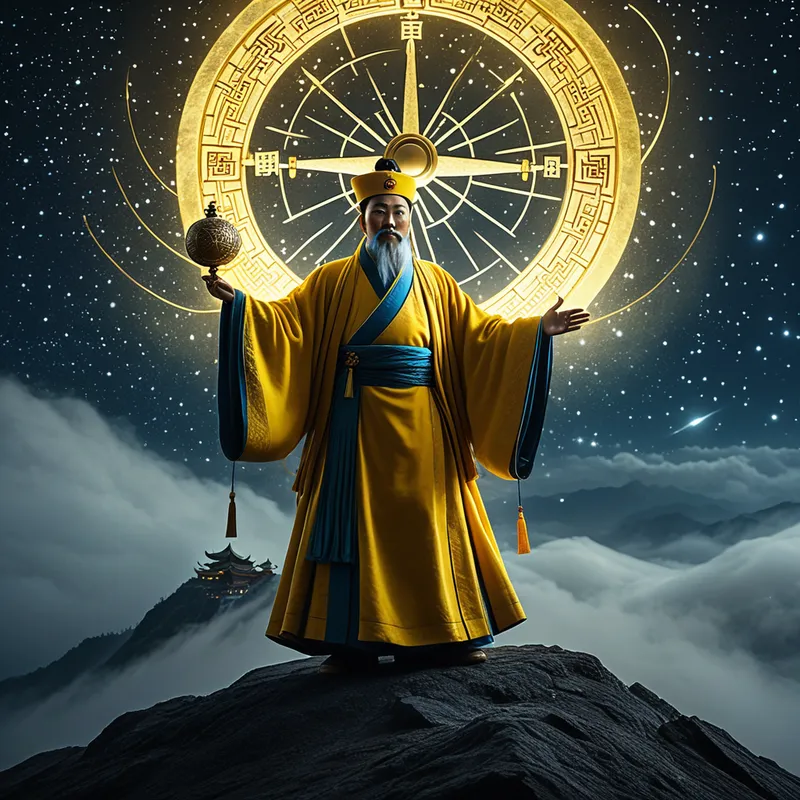
The Yellow Emperor's Compass Myth Meaning & Symbolism
A myth of the Yellow Emperor forging a cosmic compass to defeat chaos, symbolizing the human quest for inner order and psychological orientation.
The Tale of The Yellow Emperor’s Compass
In the dawn-time of the world, when the earth was still soft clay and the sky a thin, breathable membrane, chaos was not an abstract concept but a living, breathing fog. It was the age of Huangdi, the Yellow Emperor, whose rule was challenged not by armies, but by the very fabric of reality. The demon Chiyou and his monstrous kin had summoned a great miasma—a thick, impenetrable fog that swallowed mountains, silenced rivers, and turned the loyal sun into a pale, ghostly coin. In this blanket of grey, direction died. North, south, east, and west dissolved. Warriors stumbled in circles, farmers lost their fields, and the celestial order itself seemed to unravel.
Huangdi, his heart heavy with the disorientation of his people, climbed to the highest peak, where the stone was bare and the winds, though chaotic, still spoke. He looked not to the hidden sun, but to the deep patterns within. He remembered the constant, unwavering pole star, Beiji Xing, and the orderly procession of the constellations. The answer was not to fight the fog with sword or shout, but to remember. To make the hidden constant visible.
He summoned his most ingenious craftsman and sage. “We shall build a chariot,” Huangdi declared, his voice cutting through the muffled air. “But its wheels will not merely carry a man. They will carry a principle.” From the essence of the earth, they smelted bronze that held memory. They fashioned a figure of an immortal, its arm forever outstretched. And at its heart, they placed a marvel of gears and intention—a mechanism so subtle it felt the universe’s turn.
They called it the Zhinan Che. As the chariot moved, no matter how it twisted or turned through the blinding fog, the bronze figure on its top, through a labyrinth of differential gears, pointed unerringly to the south. It was a moving altar to orientation. When the day of the final battle came, Huangdi did not lead a charge. He led a procession of certainty. The chariot rolled ahead, its silent pointer a lance of knowledge against ignorance. The fog, deprived of its power to disorient, began to thin. Chiyou’s roars became confused, then desperate, as Huangdi’s forces, guided by this mechanical truth, advanced with impossible cohesion. The chaos was defeated not by violence, but by a restored sense of place. The compass had not cleared the fog; it had cleared the mind.
Cultural Origins & Context
The myth of the Yellow Emperor’s Compass, often intertwined with stories of the Zhinan Che, is a foundational narrative from the corpus of early Chinese legendary history. These tales are preserved in texts like the Shiji and later compilations such as the Lüshi Chunqiu. Huangdi is not merely a king but a culture hero, a pivotal figure credited with establishing the bedrock of Chinese civilization—medicine, silk, writing, and statecraft.
The compass myth served a profound societal function. In a culture deeply concerned with harmony between humanity (renjian) and the cosmos (tian), the story validated the imperial mandate and the scholar’s role. The Emperor, as the Son of Heaven, was the human locus of cosmic order. His ability to overcome chaos—represented by Chiyou’s fog—and restore directional clarity was a metaphor for good governance. The myth was told and retold not just as history, but as a political and philosophical ideal: true leadership is the ability to provide orientation when all seems lost, using wisdom (zhi) and artifice that aligns with natural law (Dao).
Symbolic Architecture
At its core, the myth is a drama of consciousness confronting the undifferentiated. The fog is the primal chaos, the massa confusa of the psyche—unprocessed emotion, trauma, or sheer existential confusion. The Yellow Emperor represents the organizing principle of the conscious mind, the ego that seeks to establish a functioning identity and world.
The compass is not a weapon, but a tool of remembrance. It does not create direction; it reveals the direction that already, eternally, is.
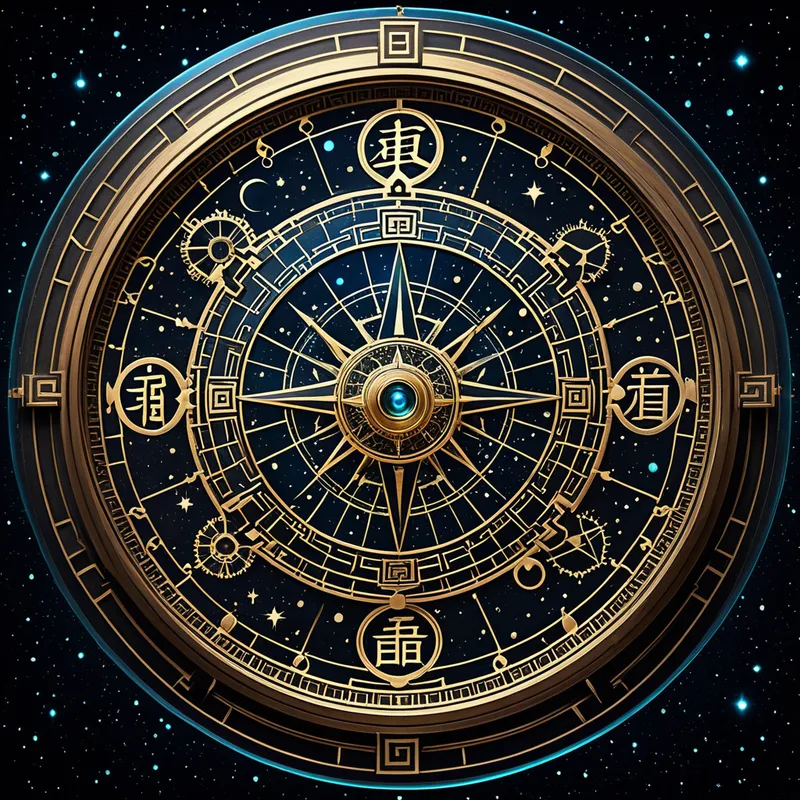
The genius of the symbol lies in its mechanism. The compass on the chariot does not magically repel fog; it maintains its orientation despite the fog. This is the key. Psychologically, it represents a transcendent function—a psychic structure (like a core value, a spiritual practice, or a piece of self-knowledge) that remains constant regardless of the emotional or circumstantial chaos swirling around the individual. The south-pointing figure is the symbolic Self, the central, enduring aspect of the personality that knows its true bearing even when the conscious ego is utterly lost.
Chiyou, then, is not pure evil, but the necessary shadow of chaos. He is the force that compels the development of consciousness. Without the fog, the compass need not be invented. The conflict is an alchemical nigredo, the necessary blackening that precedes clarification.
The Dreamer’s Resonance
When this myth stirs in the modern unconscious, it often manifests in dreams of profound disorientation. The dreamer may be in a familiar city made unfamiliar, a house with endlessly shifting rooms, or a featureless landscape under a uniform grey sky. The somatic feeling is one of vertigo, weightlessness, and deep anxiety—the gut-level sense that “I do not know which way to go.”
This is the psychological fog. It signals a state where old identities, goals, or moral frameworks have dissolved, but new ones have not yet coalesced. The dreamer is in a liminal space between psychic structures. The appearance of a compass, a map, a guiding star, or a figure pointing the way in such a dream is the nascent symbol of the transcendent function emerging. It is the psyche’s own attempt to build its Zhinan Che. The dream may not provide the answer, but it presents the tool for finding it. The emotional shift upon discovering this tool is not joy, but a profound, calming relief—the relief of potential orientation.

Alchemical Translation
The individuation journey modeled here is not one of heroic conquest, but of sagacious invention. The ego (the Yellow Emperor) does not slay the chaos (Chiyou) outright; that would be repression. Instead, it acknowledges the chaos, feels utterly lost within it, and is thereby forced to innovate at a deeper level of the psyche.
The first stage is the descent into the fog—the acceptance of a life crisis, depression, or confusion as meaningful, as the materia prima for transformation. The second is the retreat to the “mountain peak”—a turning inward, a consultation of internal constants (one’s deepest values, untouched core memories, or archetypal wisdom). The third is the “forging”: the conscious, often painstaking work of therapy, reflection, art, or ritual that builds a new psychic structure. This structure is the inner compass—a synthesized perspective that can hold contradiction and navigate uncertainty.
True north is not a place on a map, but a fidelity to the Self. The compass chariot translates cosmic constancy into terrestrial navigation, just as individuation translates archetypal wholeness into a lived, oriented life.
The final battle is the application of this new structure. As one begins to move through life guided by this hard-won inner orientation, the external chaos loses its power to paralyze. It may still exist, but it can no longer dictate one’s course. The triumph is the realization that the fog was never the true enemy; the enemy was the absence of a mechanism to see through it. In aligning with one’s inner Beiji Xing, one becomes, in a sense, both the Emperor and the compass, the ruler and the tool, forever engaged in the sacred act of finding the way.
Associated Symbols
Explore related symbols from the CaleaDream lexicon: