The Yawari Jaguar Ritual Myth Meaning & Symbolism
A myth where a hunter's ritualistic sacrifice to the Jaguar Spirit transforms his soul, forging a sacred bond between humanity and the untamed forest.
The Tale of The Yawari Jaguar Ritual
Listen. The forest is not silent. Beneath the green cathedral of ceiba and kapok, a pulse beats—the deep, resonant heartbeat of the world. In a time when the rivers were the veins of the earth and the stars were the eyes of the ancestors, there lived a hunter named Yawari. He was the best among his people, his arrows true, his steps silent as a falling leaf. Yet, for three cycles of the moon, his hunts returned empty. The tapir, the peccary, the birds—all had vanished, as if swallowed by the earth itself. His people grew thin, their children’s cries a sharp wind in the village clearing.
Desperation is a bitter root. Yawari knew the old stories whispered by the fire: when the world falls out of balance, one must speak to the Jaguar Spirit, the true lord of the green shadow. But to speak to it is not to use words. It is to offer a language older than speech.
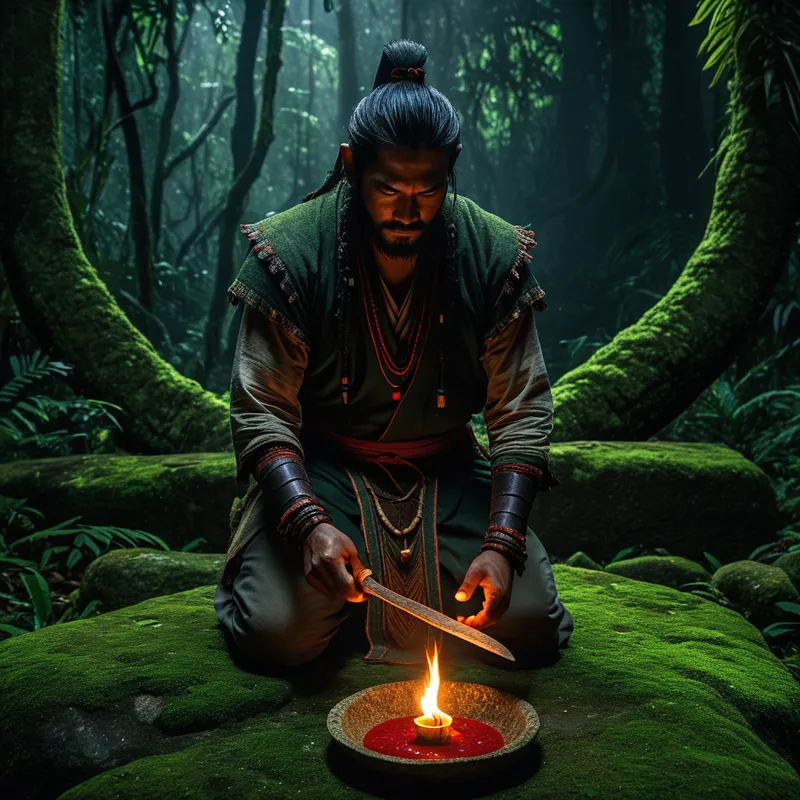
On a night when the moon was a sliver of bone, Yawari left the safety of the village. He journeyed deep into the Heart of the Forest, to a place where the air was thick with the scent of damp earth and orchids. There, he found a flat stone, an altar worn smooth by time and intention. With trembling hands, he built a small fire. He took the sharpest thorn from a chonta palm, and with a breath held not in fear, but in fierce offering, he drew it across his own palm. His blood, dark and vital, fell into a hollowed gourd bowl.
He called out, not with his voice, but with his entire being. “I have taken life to sustain life. Now I give my own life, so that life may continue. I stand before you not as a master, but as a petitioner. I offer my strength, my fear, my very blood.”
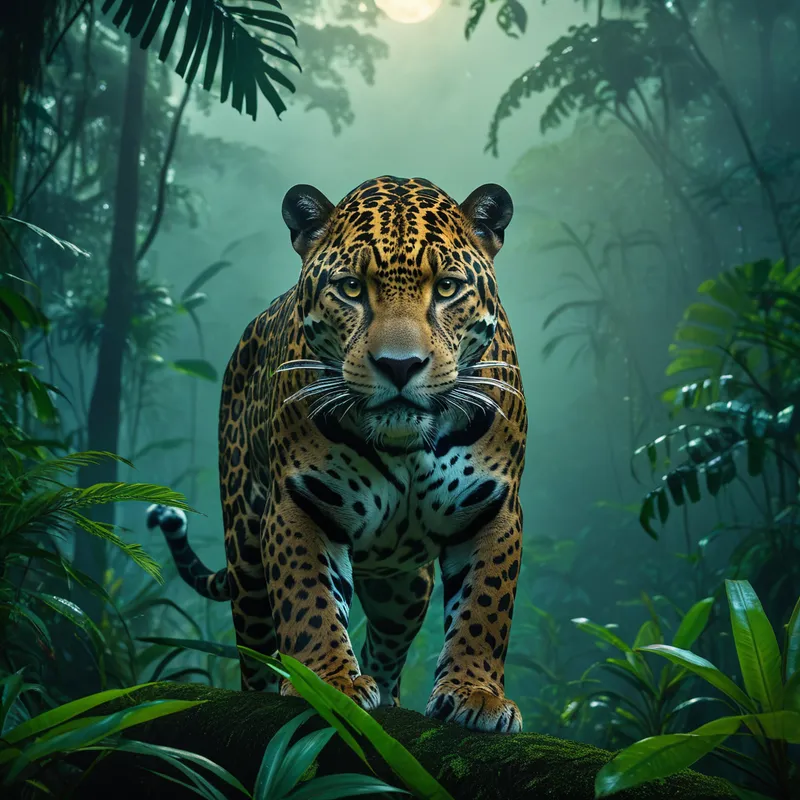
The fire sputtered. The jungle held its breath. Then, from the wall of impenetrable darkness, two emerald suns ignited. The Jaguar Spirit emerged—not merely a beast, but a cosmic force woven of night, muscle, and terrible grace. It approached the altar, its gaze pinning Yawari not in threat, but in profound assessment. It lowered its great head and drank from the bowl.
In that moment, a circuit was completed. A searing pain, then an ecstatic warmth, flooded Yawari’s veins. He did not see the world with his eyes anymore; he felt it. He felt the panic of the fleeing deer, the patient hunger of the waiting caiman, the slow, dreaming thoughts of the ancient trees. The boundary between hunter and hunted, between human and forest, dissolved. The Jaguar Spirit touched his forehead with a paw, and the knowledge of the balance flowed into him: to take only what is needed, to give thanks in the taking, to be both protector and partaker.
When Yawari returned at dawn, he was changed. His steps held the silence of the jaguar, and his eyes held the depth of the forest. He led the hunt, and the animals came, not as victims to a predator, but as participants in a sacred exchange. He had not conquered the Jaguar Spirit; he had forged a pact with it, becoming the living Bridge between his people and the wild soul of the world.
Cultural Origins & Context
This myth originates from various Indigenous Amazonian traditions, particularly among groups in the Upper Amazon basin for whom the jaguar (Panthera onca) is not merely an animal but a paramount spiritual entity. It is a shamanic narrative, typically recounted by elders or shamans (payés) during rites of passage, before major communal hunts, or in times of ecological crisis. Its function is profoundly pedagogical and cosmological.
It serves as an oral charter that encodes the ethics of living within an ecosystem. The story transmits the non-negotiable law of reciprocity: the forest gives sustenance, and humanity must offer something of equal value in return—respect, ritual, and a part of oneself. The Yawari Jaguar Ritual mythically establishes the protocols for this exchange, moving the relationship from one of potential exploitation to one of sacred partnership. It is a story that binds the community’s survival to a framework of reverence, ensuring that practical hunting knowledge is inseparable from spiritual responsibility.
Symbolic Architecture
At its core, the myth maps the terrifying and necessary [journey](/symbols/journey “Symbol: A journey in dreams typically signifies adventure, growth, or a significant life transition.”/) from a state of egoic [separation](/symbols/separation “Symbol: A spiritual or mythic division between realms, states of being, or consciousness, often marking a transition or loss of connection.”/) to one of participatory [consciousness](/symbols/consciousness “Symbol: Consciousness represents the state of awareness and perception, encompassing thoughts, feelings, and experiences.”/). Yawari begins as the skilled but isolated [Hero](/symbols/hero “Symbol: A hero embodies strength, courage, and the ability to overcome significant challenges.”/), whose mastery has failed because it was rooted in a one-sided dynamic of taking.
The ritual is the alchemical vessel where the raw material of the ego is dissolved so that a more conscious relationship with the Self can be forged.
The [Jaguar Spirit](/symbols/jaguar-spirit “Symbol: A powerful spiritual symbol representing primal power, stealth, and shamanic transformation, often seen as a guardian or guide between worlds.”/) represents the ultimate [Shadow](/symbols/shadow “Symbol: The ‘shadow’ embodies the unconscious, repressed aspects of the self and often represents fears or hidden emotions.”/)—not as evil, but as the immense, autonomous, and untamed power of [nature](/symbols/nature “Symbol: Nature symbolizes growth, connectivity, and the primal forces of existence.”/) and the unconscious psyche. It is the sovereign of all that is wild, unpredictable, and beyond [human](/symbols/human “Symbol: The symbol of a human represents individuality, complexity of emotions, and social relationships.”/) control. Yawari’s empty hunt signifies a psyche cut off from its instinctual foundations, starving in a self-made desert.
The Sacrifice of his [blood](/symbols/blood “Symbol: Blood often symbolizes life force, vitality, and deep emotional connections, but it can also evoke themes of sacrifice, trauma, and mortality.”/) is the pivotal [symbol](/symbols/symbol “Symbol: A symbol can represent an idea, concept, or belief, serving as a powerful tool for communication and understanding.”/). It is not a [payment](/symbols/payment “Symbol: Symbolizes exchange, obligation, and value. Represents what one gives to receive something in return, often tied to fairness, debt, or spiritual balance.”/), but a literal and psychic offering of his own [life](/symbols/life “Symbol: The symbol of ‘Life’ represents a journey of growth, interconnectedness, and existential meaning, encompassing both the joys and challenges that define human experience.”/)-force, his [vulnerability](/symbols/vulnerability “Symbol: A state of emotional or physical exposure, often involving risk of harm, that reveals authentic self beneath protective layers.”/), and his hubris. The [Ritual](/symbols/ritual “Symbol: Rituals signify structured, meaningful actions carried out regularly, reflecting cultural beliefs and emotional needs.”/) [Bowl](/symbols/bowl “Symbol: A bowl often represents receptivity, nourishment, and emotional security, symbolizing the dreamer’s needs and desires.”/) becomes the [Womb](/symbols/womb “Symbol: A symbol of origin, potential, and profound transformation, representing the beginning of life’s journey and the unconscious source of creation.”/) where two opposites—human culture and wild nature—mingle and are transmuted. By drinking the offering, the [Jaguar](/symbols/jaguar “Symbol: The jaguar symbolizes strength, power, and stealth, often associated with transformation and the spiritual journey.”/) [Spirit](/symbols/spirit “Symbol: Spirit symbolizes the essence of life, vitality, and the spiritual journey of the individual.”/) does not consume Yawari; it acknowledges and incorporates him. The resulting transformation grants Yawari the “[jaguar](/symbols/jaguar “Symbol: The jaguar symbolizes strength, power, and stealth, often associated with transformation and the spiritual journey.”/)’s [sight](/symbols/sight “Symbol: Sight symbolizes perception, awareness, and insight, representing both physical and inner vision.”/)”—the empathic, systemic [awareness](/symbols/awareness “Symbol: Conscious perception of self, surroundings, or internal states. Often signifies awakening, insight, or heightened sensitivity.”/) of being a thread within the web of [life](/symbols/life “Symbol: The symbol of ‘Life’ represents a journey of growth, interconnectedness, and existential meaning, encompassing both the joys and challenges that define human experience.”/), rather than a separate [actor](/symbols/actor “Symbol: An actor represents roles, transformation, and the performance of identity in dreams.”/) upon it.

The Dreamer’s Resonance
When this mythic pattern stirs in the modern Dream, it often manifests as dreams of being pursued by a large cat, of finding oneself in a dense, confusing jungle, or of participating in a strange, solemn ceremony. Somatically, one may awaken with a racing heart, a sense of awe, or a profound feeling of expansion.
Psychologically, this signals a critical encounter with the personal and collective Shadow. The dreamer is at their own “empty hunt”—a career, relationship, or creative endeavor that has suddenly become barren despite all applied skill. The psyche is demanding a ritual. It is calling for the dreamer to stop trying to control or conquer the problem (the Jaguar), and instead to consciously offer something of deep personal value—a cherished identity, a long-held grievance, a posture of pride—to the unknown. This is the process of making a sacred offering to one’s own depths. The terror and the ecstasy in the dream mark the dissolution of an old, outmoded way of being, preparing the ground for a new, more integrated consciousness to emerge.

Alchemical Translation
The Yawari Jaguar Ritual is a perfect map for the Jungian process of Individuation. It models the move from the persona of the competent provider to an engagement with the Self.
Individuation is not about becoming perfect, but about becoming whole; it requires the ritual sacrifice of who we think we are to who we truly are.
First, the Calling: The failure of the old mode (the barren hunt) is a grace, a brutal invitation from the Self to grow. Second, the Descent: Yawari enters the forest—the unconscious. He moves away from collective norms into a solitary, numinous space. Third, the Sacrificial Conjunction: At the Altar, he offers his blood (his vital energy, his egoic stance) to the Jaguar (the instinctual Self). This is the mysterium coniunctionis, the sacred marriage of conscious intention and unconscious power. Fourth, the Transmutation: He is not destroyed but rewired. He gains a participatory, empathetic consciousness. Finally, the Return: He brings this new awareness back to his community, not as a boast, but as a lived function. He becomes a mediator, embodying the healed relationship between the human and the more-than-human world.
For us, the ritual is internal. Our “jungle” is the unconscious. Our “jaguar” is the fierce, ignored, or feared aspect of our own nature—our rage, our creativity, our wild intuition. The ritual asks: What must I sincerely offer—what pride, what control, what old story—to this inner power to restore the flow of life? The pact forged is not with an external spirit, but with the sovereign totality of our own psyche. The bounty that returns is not merely external success, but the profound vitality of being in right relationship with all that we are.
Associated Symbols
Explore related symbols from the CaleaDream lexicon:
- Jaguar — The sovereign spirit of the rainforest, representing untamed instinct, power, and the transformative shadow that must be engaged, not conquered.
- Ritual — The structured, sacred act that creates a container for the dissolution of the old self and the conscious forging of a new pact with the depths.
- Sacrifice — The voluntary offering of something precious (ego, control, blood) not as loss, but as the essential currency for a transformative exchange with a greater power.
- Blood — The symbol of life-force, soul essence, and kinship; the most intimate offering that bridges the human and the divine, the conscious and the unconscious.
- Altar — The sacred, liminal space where the exchange occurs; it represents the focused center of the psyche where transformation is deliberately invoked.
- Forest — The dense, living totality of the unconscious, teeming with life, danger, and wisdom, into which one must journey to find the source of renewal.
- Bridge — The function Yawari embodies after his transformation; he becomes the living connection between the human community and the wild, instinctual world.
- Shadow — The Jaguar Spirit as the personification of the repressed, powerful, and autonomous aspects of the psyche that hold the key to wholeness.
- Hero — Yawari’s initial archetype, who must venture beyond the known village of the ego to confront a supreme challenge in service of his people.
- Dream — The myth itself operates as a collective dream, and its pattern replays in personal dreams as an encounter with one’s own primal, transformative powers.
- Heart — The courage required for the sacrifice and the empathic, feeling connection to all life that is the ultimate prize of the ritual transformation.
- Journey — The necessary movement from the known into the unknown, from a state of lack to a state of communion, which is the fundamental structure of the myth and the individuation process.