
The Yanomami Creation Myth Meaning & Symbolism
A myth of cosmic twins, one creator and one destroyer, whose eternal conflict births the world and defines the fragile order of human existence.
The Tale of The Yanomami Creation Myth
In the beginning, there was only the sky. A vast, empty dome of blue, arching over a great, primordial ocean. There was no land, no forest, no sun to cast a shadow. From this watery void, the first beings emerged: Omama and his brother, Yoasi. They were not born of a mother, but of the sky itself, twins yet opposites from the first breath.
Omama looked upon the endless water and saw a possibility for order. He dove deep, gathering the first mud from the ocean floor. With great effort, he piled it high, forming the first mountain, Hekura. From its peak, he began to shape the world. He blew upon the mud, and it hardened into earth. He traced his fingers through it, and the first rivers—the Orinoco, the Amazon—carved their paths, bleeding life into the barren ground. Where his sweat fell, the first seeds sprouted, unfurling into the immense, green cathedral of the rainforest. He fashioned the first people from the clay of the riverbank, breathing into them the spirit of community, teaching them the arts of the garden, the construction of the shabono, and the sacred rituals of life.
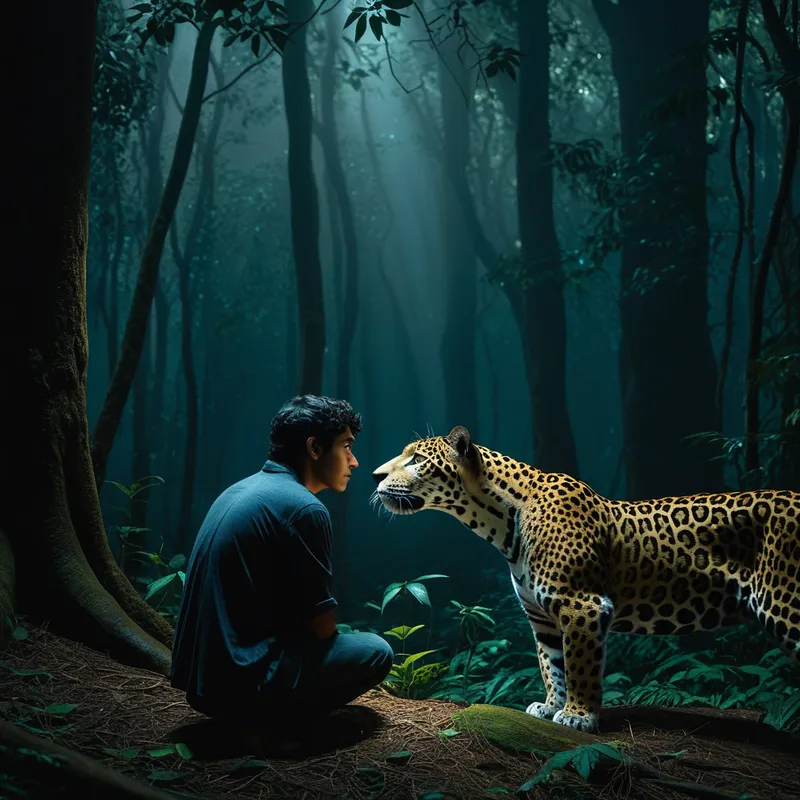
But Yoasi watched, and where Omama created, Yoasi twisted. He did not hate his brother’s work; he was its necessary shadow. When Omama made the gentle tapir, Yoasi sharpened its teeth and whispered to it of the hunt, birthing the jaguar. When Omama showed men how to cultivate manioc, Yoasi introduced the sting of venomous snakes and the decay that follows the harvest. He crept into the first shabono and sowed the seeds of argument, jealousy, and death. He did not create evil, but the wild, untamed counterpart to Omama’s order—the necessary chaos that makes life perilous and therefore sacred.
The conflict crescendoed. Yoasi, in a final act of defiance, sought to destroy the mountain Hekura itself, the pillar of his brother’s world. A great battle raged, not of weapons, but of primal forces—creation against dissolution, speech against silence, garden against forest. Omama, foreseeing that this struggle could unmake everything, made a fateful choice. He did not destroy Yoasi, for to do so would be to destroy a fundamental part of existence. Instead, he cast his brother out. He banished Yoasi to the depths of the forest, to the far skies, to the shadows at the edge of the firelight. Yoasi became the master of all that lies beyond the village clearing: the dangerous animals, the spirits of the dead, the unseen threats in the night.
With his opposite now set at a necessary distance, Omama completed his work. He placed the sun in the sky to mark the time of work and community, and the moon to govern the time of dreams and spirits. He then ascended, leaving humanity with his laws, his plants, and a world forever balanced on the knife-edge between his cultivated order and his brother’s wild, enduring presence.
Cultural Origins & Context
This myth is the bedrock of the Yanomami cosmological and social world. It is not a mere story but a living map of reality, passed down through generations by shamans (payés) and elders in the smoky, intimate space of the shabono. The telling is a ritual act, often tied to ceremonies, initiations, or times of crisis. Its function is profoundly pedagogical and stabilizing. It explains the origin of the environment they inhabit, justifies their social structures and horticultural lifestyle, and, most importantly, provides a framework for understanding the fundamental duality of existence. The myth legitimizes the shaman’s role as the mediator who can venture into Yoasi’s wild realms (through trance induced by the psychoactive yakoana) to wrestle with chaotic forces and bring back healing for the community. It is a charter for their way of life, defining the village (Omama’s domain) against the forest (Yoasi’s domain).
Symbolic Architecture
At its [heart](/symbols/heart “Symbol: The heart symbolizes love, emotion, and the core of one’s existence, representing deep connections with others and self.”/), this is a myth of irreducible duality. Omama and Yoasi are not good and evil in a simplistic sense; they are complementary cosmological principles. Omama represents culture, order, [fertility](/symbols/fertility “Symbol: Symbolizes creation, growth, and abundance, often representing new beginnings, potential, and life force.”/), and the conscious mind—the [impulse](/symbols/impulse “Symbol: A sudden, powerful urge or drive that arises without conscious deliberation, often linked to primal instincts or emotional surges.”/) to [structure](/symbols/structure “Symbol: Structure in dreams often symbolizes stability, organization, and the framework of one’s life, reflecting how one perceives their environment and personal life.”/), name, and cultivate. Yoasi embodies [nature](/symbols/nature “Symbol: Nature symbolizes growth, connectivity, and the primal forces of existence.”/) in its raw, untamed, and amoral state—the unconscious, the instinctual, the chaotic and creative-destructive forces that exist before and beyond [human](/symbols/human “Symbol: The symbol of a human represents individuality, complexity of emotions, and social relationships.”/) control.
The world is not built by a single hand, but in the tension between two. Creation is the child of order wrestling with chaos, and meaning is born from the space between them.
The central [symbol](/symbols/symbol “Symbol: A symbol can represent an idea, concept, or belief, serving as a powerful tool for communication and understanding.”/) of the [mountain](/symbols/mountain “Symbol: Mountains often symbolize challenges, aspirations, and the journey toward self-discovery and enlightenment.”/) Hekura is the [axis](/symbols/axis “Symbol: A central line or principle around which things revolve, representing stability, orientation, and the fundamental structure of reality or consciousness.”/) mundi, the point where the divine act of creation pierced the formless void. It is the first solid ground, the [source](/symbols/source “Symbol: The origin point of something, often representing beginnings, nourishment, or the fundamental cause behind phenomena.”/) of [life](/symbols/life “Symbol: The symbol of ‘Life’ represents a journey of growth, interconnectedness, and existential meaning, encompassing both the joys and challenges that define human experience.”/)-giving rivers, and the [conduit](/symbols/conduit “Symbol: A passage or channel that transfers energy, information, or substance from one place to another, often hidden or structural.”/) between the earthly and spiritual realms. The act of banishment, rather than destruction, is the myth’s most profound psychological [insight](/symbols/insight “Symbol: A sudden, deep understanding of a complex situation or truth, often arriving unexpectedly and illuminating hidden connections.”/). It acknowledges that the [shadow](/symbols/shadow “Symbol: The ‘shadow’ embodies the unconscious, repressed aspects of the self and often represents fears or hidden emotions.”/) (Yoasi) cannot be eradicated without destroying the self. It must be recognized, contained, and related to from a position of [strength](/symbols/strength “Symbol: ‘Strength’ symbolizes resilience, courage, and the ability to overcome challenges.”/) (Omama’s established order). The healthy psyche, like the Yanomami world, requires a cleared [space](/symbols/space “Symbol: Dreaming of ‘Space’ often symbolizes the vastness of potential, personal freedom, or feelings of isolation and exploration in one’s life.”/) for the ego (the [village](/symbols/village “Symbol: Symbolizes community, connection, and a reflection of one’s roots or origins.”/)) and a respectful, ritualized [relationship](/symbols/relationship “Symbol: A representation of connections we have with others in our lives, often reflecting our emotional state.”/) with the wild, unconscious [forest](/symbols/forest “Symbol: The forest symbolizes a complex domain of the unconscious mind, representing both mystery and potential for personal growth.”/) at its borders.
The Dreamer’s Resonance
When this mythic pattern stirs in the modern dreamer, it often manifests as dreams of conflict with a sibling, a double, or a shadowy figure who seems to undo one’s efforts. It may appear as a dream of building a house while a force (storms, wild animals, an unseen vandal) attempts to damage it. The somatic experience can be one of frustration, profound fatigue from a seemingly endless struggle, or the chilling awareness of a pervasive, opposing presence in one’s life.
Psychologically, this signals a critical stage in engaging with one’s own Shadow. The dreamer is in the role of Omama, attempting to construct a conscious identity, a career, a relationship—a “village” of order. Yoasi represents all the repressed, wild, “uncultivated” aspects: sudden rages, forbidden desires, creative blocks, or self-sabotaging tendencies that seem to arise from nowhere to undermine one’s plans. The dream is highlighting that a purely “Omama” approach—trying to build higher walls to keep the chaos out—is failing. The psyche is demanding a more sophisticated relationship with its own inherent duality.

Alchemical Translation
The individuation process modeled here is not about the hero slaying the dragon, but about the creator learning to dialogue with the destroyer. The first alchemical stage is separation: recognizing the Omama and Yoasi within. One must consciously build one’s mountain (Hekura)—establish values, discipline, a coherent sense of self. The subsequent, crucial stage is conjunction, not through fusion, but through conscious differentiation and relation.
The goal is not to become one with the shadow, but to hear its voice from across the river you have wisely carved between you.
Omama’s act of banishment is not repression; it is the creation of a boundary that allows for recognition. The modern individual must perform this same act: to consciously “banish” automatic, destructive impulses from the driver’s seat of consciousness, not to deny them. This creates the internal space—the river, the borderland—where one can then, like a shaman, voluntarily cross over (through introspection, active imagination, or engaging with art and dreams) to confront and negotiate with these inner Yoasi-forces. The transmutation occurs when we stop seeing our chaos as a mere enemy to be defeated and begin to understand it as the source of our raw vitality, our untamed creativity, and the very energy that, when properly channeled, fertilizes Omama’s garden. The completed Self is not a perfect, conflict-free unity, but a dynamic ecosystem where order and wildness maintain a sacred, tense, and fruitful equilibrium.
Associated Symbols
Explore related symbols from the CaleaDream lexicon:
- Forest — The domain of Yoasi, representing the untamed unconscious, the wild unknown, and the source of both danger and vital, primal energy.
- Mountain — The primordial Hekura, symbolizing the axis mundi, the first solid ground of consciousness, and the enduring structure of the ego and cultural order.
- River — The lifeblood carved by Omama, representing the flow of life, the boundaries between domains (order/wild), and the connective pathways of the psyche.
- Blood — The vital essence and the principle of life itself, often linked to the spiritual potency accessed by shamans and the deep, shared kinship of all living things.
- Shadow — The direct embodiment of Yoasi, representing the disowned, instinctual, and chaotic aspects of the self that must be acknowledged and related to.
- Spirit — The animating force of all things, from Omama’s creative breath to the hekura spirits shamans commune with, dwelling in the liminal space between worlds.
- Journey — The shaman’s voyage into the spirit forest, mirroring the individual’s inward journey to confront and integrate the shadow aspects of the psyche.
- Duality — The core structural principle of the myth, the eternal and necessary tension between opposing cosmic forces that generates all of manifest reality.
- Order — The domain and gift of Omama, representing culture, law, structure, and the conscious mind’s effort to create meaning from chaos.
- Chaos — The domain and essence of Yoasi, representing the primordial, creative-destructive potential that precedes and surrounds all human order.
- Sacrifice — Omama’s sacrifice of a total victory, accepting eternal tension to preserve the whole; the necessary giving up of purity for the sake of a complete, living world.
- Rebirth — The continual process represented by the garden and the forest, where death and decay (Yoasi’s work) feed new growth (Omama’s work) in an endless cycle.