
The Wounded Fisher King Myth Meaning & Symbolism
A king, wounded in the groin, presides over a barren land. Only the Grail Knight's compassionate question can heal him and restore the wasteland.
The Tale of The Wounded Fisher King
Listen, and hear the tale of the king who could not die and the land that could not live.
In the heart of the realm of Logres, there lies a hidden castle, Corbenic. Its lord is a man of great lineage, the [Fisher King](/myths/fisher-king “Myth from Arthurian culture.”/). Once, he was a mighty knight, a guardian of the deepest mysteries. But now, he is a man halved. A wound, dealt by a poisoned lance in a forgotten battle, burns in his thigh—or some say, his groin. It is a wound that will not close, that bleeds without ceasing, that offers no release in death, only the endless sigh of perpetual suffering.
His kingdom mirrors his flesh. Beyond the castle walls, the land is a Waste Land. Rivers run sluggish and thin. Trees bear no fruit. The fields yield only thistle and stone. The people move as ghosts, their voices hushed, their hope a dried-up well. The only solace for the king is the gentle motion of [water](/myths/water “Myth from Chinese culture.”/). He is taken daily to a boat on [the river](/myths/the-river “Myth from Buddhist culture.”/) that still flows near his castle, and there he fishes—not for sustenance, for there are few fish, but for the fragile peace the river’s rhythm brings. Hence, he is called [the Fisher King](/myths/the-fisher-king “Myth from Arthurian culture.”/).
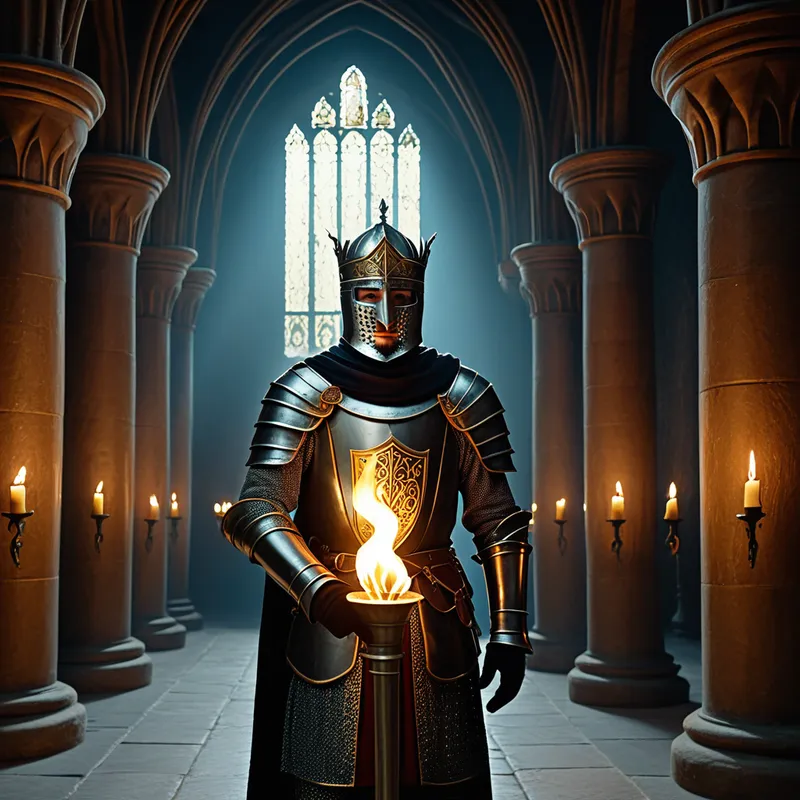
Into this twilight realm comes a questing knight, often the pure fool Sir [Perceval](/myths/perceval “Myth from Arthurian culture.”/). Lost and weary, he is guided by a mysterious fisher (the king himself) to a great castle. Within, he is greeted with solemn honor. He is led to a great hall where the wounded king lies upon a litter, his face pale but noble. A feast is laid, but it is a feast of silence.
Then, a awe-inspiring procession begins. A squire enters bearing a lance that bleeds a single, endless drop of blood into a silver cup. Then come maidens with candelabras. Another carries a tailloir of silver. And finally, a radiant maiden enters, holding aloft the [Grail](/myths/grail “Myth from Christian culture.”/) itself, shining with a light that is both celestial and deeply comforting. It passes through the hall, and from it, each person receives the food and drink they most desire. Yet, a profound etiquette of silence hangs over all.
Perceval is burning with questions: Whom does [the Grail](/myths/the-grail “Myth from Arthurian culture.”/) serve? Why does the lance bleed? What ails the king? But he has been schooled in the worldly chivalry of silence, of not prying into the affairs of his host. Fearing to be thought rude, he swallows his compassion and his curiosity. He says nothing.
The next morning, he wakes to an empty castle. The halls are deserted, the gates stand open. As he rides out, the very land seems to weep. Only later does a crone or a holy hermit reveal the terrible cost of his silence. Had he asked the healing question—“What ails you?” or “Whom does the Grail serve?”—the king would have been healed. His wound would have closed, the land would have burst forth in blossom and fruit, and the spiritual drought would have ended. But the moment passed. The knight failed, and the Waste Land remains.
Cultural Origins & Context
The myth of the Wounded Fisher King is the aching heart of the larger Arthurian cycle. Its most famous versions are found in the 12th and 13th-century French romances, primarily Chrétien de Troyes’ unfinished Perceval, or the Story of the Grail and later in the more explicitly spiritual Queste del Saint Graal. It is a myth that evolved in the hands of court poets, blending Celtic [otherworld](/myths/otherworld “Myth from Celtic culture.”/) motifs (like [the Cauldron of Plenty](/myths/the-cauldron-of-plenty “Myth from Celtic culture.”/)) with the burgeoning Christian mysticism of the Crusades era.
The story was not for the masses but for the knightly class and the court. It functioned as a profound mirror. In an age where chivalry was codifying into a system of external honor, [the Grail quest](/myths/the-grail-quest “Myth from Arthurian culture.”/)—and the failure at its center—posed an internal, spiritual challenge. It asked: What is true courage? Is it the strength to swing a sword, or the vulnerability to ask a compassionate question? The myth served as a corrective, suggesting that the ultimate quest was not for territory or glory, but for the healing of the soul and, by extension, the community. The king’s wound and the barren land became a powerful metaphor for a society feeling its own spiritual and moral decay.
Symbolic Architecture
The myth is a perfect symbolic ecosystem, where every element reflects a state of [consciousness](/symbols/consciousness “Symbol: Consciousness represents the state of awareness and perception, encompassing thoughts, feelings, and experiences.”/).
The Wound is not merely physical. Located in the generative loins, it symbolizes a [paralysis](/symbols/paralysis “Symbol: A state of being unable to move or act, often representing feelings of powerlessness, fear, or being trapped in waking life.”/) of [life](/symbols/life “Symbol: The symbol of ‘Life’ represents a journey of growth, interconnectedness, and existential meaning, encompassing both the joys and challenges that define human experience.”/) force, creativity, and sovereignty. The [king](/symbols/king “Symbol: A symbol of ultimate authority, leadership, and societal order, often representing the dreamer’s inner power or external control figures.”/) is stuck between life and [death](/symbols/death “Symbol: Symbolizes transformation, endings, and new beginnings; often associated with fear of the unknown.”/), unable to rule effectively or to let go. He represents a ruling principle—be it [the ego](/myths/the-ego “Myth from Jungian culture.”/), tradition, or the [animus](/symbols/animus “Symbol: In Jungian psychology, the masculine inner personality in a woman’s unconscious, representing logic, action, and spiritual guidance.”/)—that has been vitally injured and can only maintain a diminished, [twilight](/symbols/twilight “Symbol: A liminal period between day and night symbolizing transition, ambiguity, and the blending of opposites.”/) existence.
The Waste Land is the external [reality](/symbols/reality “Symbol: Reality signifies the state of existence and perception, often reflecting one’s understanding of truth and life experiences.”/) of that internal state.
The landscape of the soul always mirrors the condition of its ruler.
The Grail is the [symbol](/symbols/symbol “Symbol: A symbol can represent an idea, concept, or belief, serving as a powerful tool for communication and understanding.”/) of ultimate wholeness, the Self in its nourishing, transformative [aspect](/symbols/aspect “Symbol: A distinct feature, quality, or perspective of something, often representing a partial view of a larger whole.”/). It provides what is most needed, but it cannot be taken by force; it must be approached through the correct consciousness.
The pivotal [moment](/symbols/moment “Symbol: The symbol of a ‘moment’ embodies the significance of transient experiences that encapsulate emotional depth or pivotal transformations in life.”/) rests on the Question. This is the myth’s genius. Healing does not come from a magical potion, a battle, or a theft. It comes from an act of empathetic inquiry. The question represents the turning of [attention](/symbols/attention “Symbol: Attention in dreams signifies focus, awareness, and the priorities in one’s life, often indicating where the dreamer’s energy is invested.”/) from the outer spectacle to the inner [condition](/symbols/condition “Symbol: Condition reflects the state of being, often focusing on physical, emotional, or situational aspects of life.”/) of the other. It is the [birth](/symbols/birth “Symbol: Birth symbolizes new beginnings, transformation, and the potential for growth and development.”/) of psychological mindedness—the willingness to see and address the root of suffering.

The Dreamer’s Resonance
When this myth stirs in the modern [psyche](/myths/psyche “Myth from Greek culture.”/), it often manifests in dreams of profound stagnation and missed connection. You may dream of a loved one or a authority figure who is ill or injured, and you are present but unable to speak or help. You may wander through a familiar place—your childhood home, your workplace—that has become eerily empty, decaying, or frozen in time. There is a pervasive feeling of “if only I had said or done something.”
Somatically, this can correlate with feelings of heaviness, low energy, or creative block. Psychologically, it signals a critical juncture in what Jung called the individuation process. The dream-ego (Perceval) is being confronted with the suffering of a deeper, archetypal structure (the King). The failure to ask the question reflects a lingering identification with a [persona](/myths/persona “Myth from Greek culture.”/) of politeness, self-reliance, or intellectual detachment that prevents genuine engagement with the wounded, unconscious parts of [the self](/myths/the-self “Myth from Jungian culture.”/). The dream is highlighting the cost of that avoidance: the perpetuation of an inner wasteland.

Alchemical Translation
The alchemical journey modeled here is the transformation of leaden silence into golden speech, of passive witnessing into active compassion. The process begins with the recognitio—the recognition of the wound and [the wasteland](/myths/the-wasteland “Myth from Arthurian culture.”/) within one’s own life. This is the depressing but necessary [nigredo](/myths/nigredo “Myth from Alchemical culture.”/) stage.
The knight’s journey to the castle is the conscious effort to turn inward, to approach the seat of the soul’s suffering. The glorious but silent Grail procession represents the numinous contents of the unconscious presenting themselves—intuitions, dreams, synchronicities, creative sparks. They are dazzling but incomprehensible if met with a passive, awestruck gaze.
The Grail serves only those who dare to ask it to serve another.
The alchemical fire is kindled by the question. “What ails you?” directed inward, is the beginning of shadow work. It is the ego humbly interrogating the pain of the deeper Self. This question breaks the neurotic self-absorption that often surrounds a wound and transforms it into an object of compassionate inquiry. It applies the [solutio](/myths/solutio “Myth from Alchemical culture.”/)—the dissolving waters of empathy—to the hardened, festering injury.
The healing of the King is the integration of the wounded archetype. The restored fertility of the land is the result: a life where energy flows, creativity is possible, and one’s “kingdom” (one’s sphere of influence and experience) becomes nourishing and vibrant. The myth teaches that our deepest healing, and our greatest service to [the world](/myths/the-world “Myth from Tarot culture.”/), begins not with an answer, but with a brave, simple, and profoundly caring question asked of the suffering that resides at the very center of our being.
Associated Symbols
Explore related symbols from the CaleaDream lexicon: