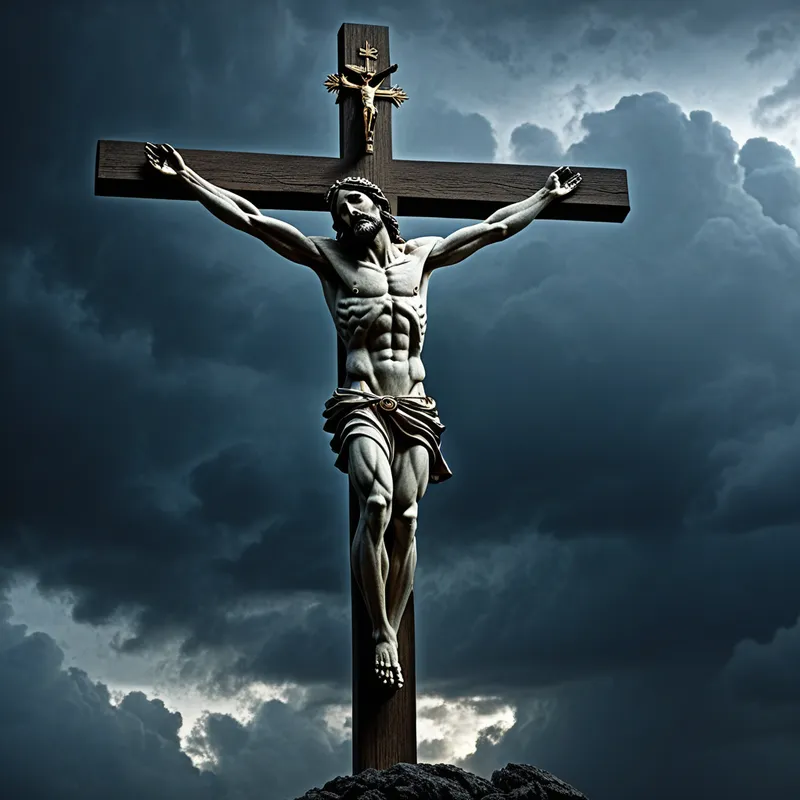
The Wounded Christ Myth Meaning & Symbolism
A myth of divine incarnation, betrayal, and execution, where the god's wounds become the source of healing and the portal to resurrection.
The Tale of The Wounded Christ
Listen. In the fullness of time, when the heavens bent low to touch the dust of earth, the Word became flesh and dwelt among us. He was called Yeshua, a carpenter’s son from the hill country of Galilee, yet his eyes held the depth of ancient seas and the fire of distant stars. He walked the sun-baked roads, his hands healing the sick, his voice calming storms, speaking of a kingdom not of territory, but of the heart—a kingdom where the last would be first, and the broken would be made whole.
But light casts long shadows. In the holy city, under the oppressive weight of empire and temple authority, his radical love became a threat. The powers that ruled through fear and purity could not abide a god who dined with outcasts and forgave sins with a touch. In a garden slick with night dew, he was betrayed by the kiss of a friend, his closest companions scattering like startled birds. He stood alone before cynical rulers, crowned not with gold, but with cruel thorns that bit into his brow.
They led him, stumbling under the weight of a rough-hewn crossbeam, to the Place of the Skull—Golgotha. The air was thick with the smell of dust, blood, and despair. There, they nailed his hands and feet to the timber and raised him between heaven and earth. For hours, he hung suspended, a bridge of suffering. The sun hid its face. He cried out with a voice that tore the veil of the world, “My God, my God, why have you forsaken me?” In that moment, the divine knew the utter desolation of the human soul.
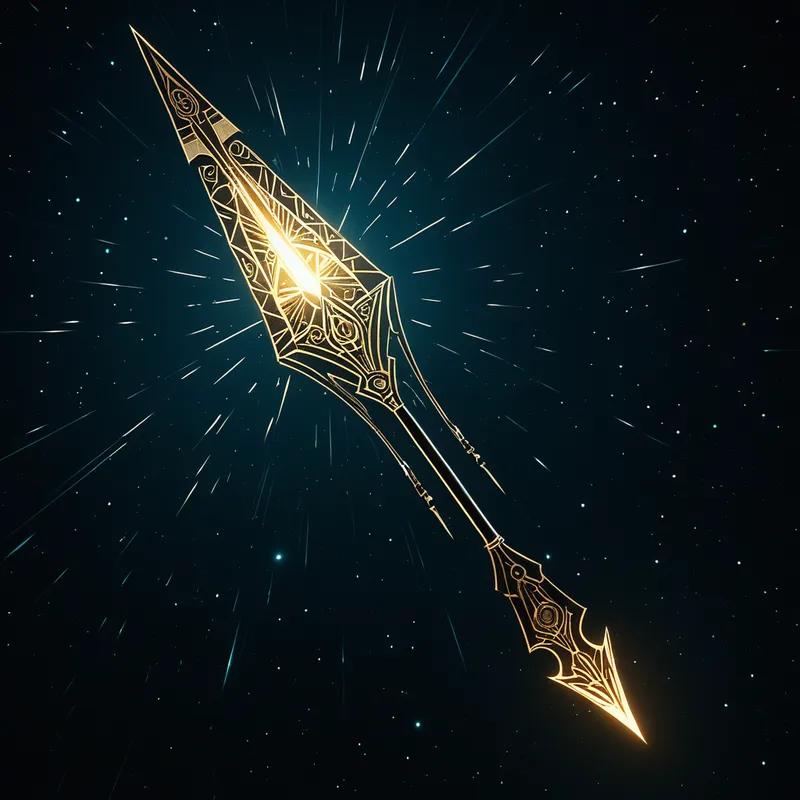
Then, a final act. A Roman soldier, ensuring death, thrust his spear into the god-man’s side. And from the wound flowed a sudden, startling cascade—blood and water, mingling on the dry, thirsty ground. With a last breath, he surrendered his spirit. The earth trembled. The sky wept. They took his body, wrapped it in linen with spices, and sealed it in a tomb hewn from rock, a dark cocoon of silence.
But the story does not end in the tomb. On the third day, at dawn, the stone was rolled away. The tomb was empty, save for the discarded burial cloths. He appeared, not as a ghost, but in a body both familiar and utterly transformed—a body that bore the wounds, now luminous and open, not as scars of defeat, but as seals of a love that had passed through the heart of death itself. He showed his wounded hands and side to his friends. The wound was not erased; it was transfigured. It had become the proof of identity and the source of peace. The one who was pierced had become the piercer of the ultimate veil.
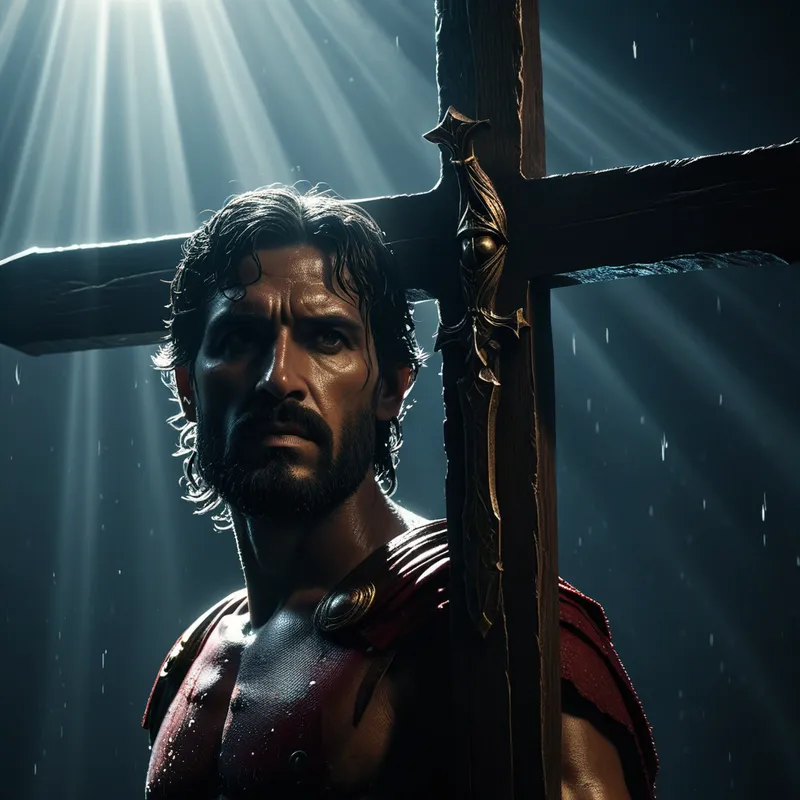
Cultural Origins & Context
This narrative is the foundational passion story of Christianity, crystallized in the four canonical Gospels written in the latter half of the first century CE. It emerged from a Second Temple Jewish milieu, grappling with Roman occupation and theological expectation. The story was not initially written but proclaimed orally—the “kerygma”—by apostles and evangelists in marketplaces and homes, functioning as both a testimony of faith and a subversive counter-narrative to Roman imperial power, which claimed salvation through Caesar.
The specific motif of the Sacred Wound in the side, detailed in the Gospel of John, became profoundly significant. In medieval piety, particularly through the visions of mystics like St. Gertrude and the devotion to the Sacred Heart, this wound was contemplated as the fountain of grace, the refuge for the soul, and the very portal to the divine. It served a societal function of modeling redemptive suffering, offering a framework through which believers could find meaning in their own afflictions by uniting them symbolically with the suffering of God.
Symbolic Architecture
Psychologically, the myth presents a staggering paradox: the point of greatest vulnerability becomes the source of ultimate strength and healing. The Incarnation itself symbolizes the descent of wholeness (the Self) into the fragmentation of conscious life. The wounds represent the inevitable, excruciating cost of that embodiment—the price of being fully real in a world of conflict, betrayal, and limitation.
The wound is not an accident on the path; it is the path. It is the narrow gate through which the divine enters the human, and the human touches the eternal.
The crucifixion is the ultimate confrontation with the shadow. Christ absorbs the projections of the world—its violence, its fear, its scapegoating rage—without returning them. He holds the tension of opposites: divine and human, love and betrayal, power and powerlessness. The flowing blood and water symbolize the release of this held tension, a dissolution that gives birth to a new substance—the aqua vitae of the spirit. The resurrection is not a reversal of the wounding but its integration; the wounded body is the resurrected body. The psyche’s wholeness, or individuation, is not a state of pristine perfection, but a state where our wounds are acknowledged, carried consciously, and recognized as integral to our unique identity and capacity for compassion.
The Dreamer’s Resonance
When this mythic pattern stirs in the modern dreamer, it often signals a profound initiation into a state of sacred wounding. One may dream of being pierced in the side, not with pain, but with a shocking, cathartic release. Or one may dream of tending to a wounded figure who, upon turning, bears one’s own face. The somatic experience can be one of pressure in the chest, a feeling of the heart “breaking open,” or a deep, melancholic ache that feels strangely necessary.
Psychologically, this is the process of the ego’s crucifixion—the dismantling of the persona and the conscious attitudes that have become too rigid or inflated. The dreamer is undergoing a necessary defeat, a betrayal by their own previously held certainties or ambitions. The dream-wound marks the point where the protective shell of the personality is punctured by a truth too powerful to ignore: perhaps a grief long buried, a love that demands vulnerability, or a calling that requires sacrifice. This is not pathology, but a sacred crisis, the psyche’s brutal, loving method of creating an opening for something larger to enter.
Alchemical Translation
The alchemical journey mirrored in this myth is the nigredo, the blackening, the descent into the prima materia of suffering and despair. The crucifixion is the mortificatio, the killing of the old king (the ego’s dominance). The spear thrust is the precise, surgical separatio, dividing the subtle (water, spirit) from the gross (blood, body), creating the opening for transformation.
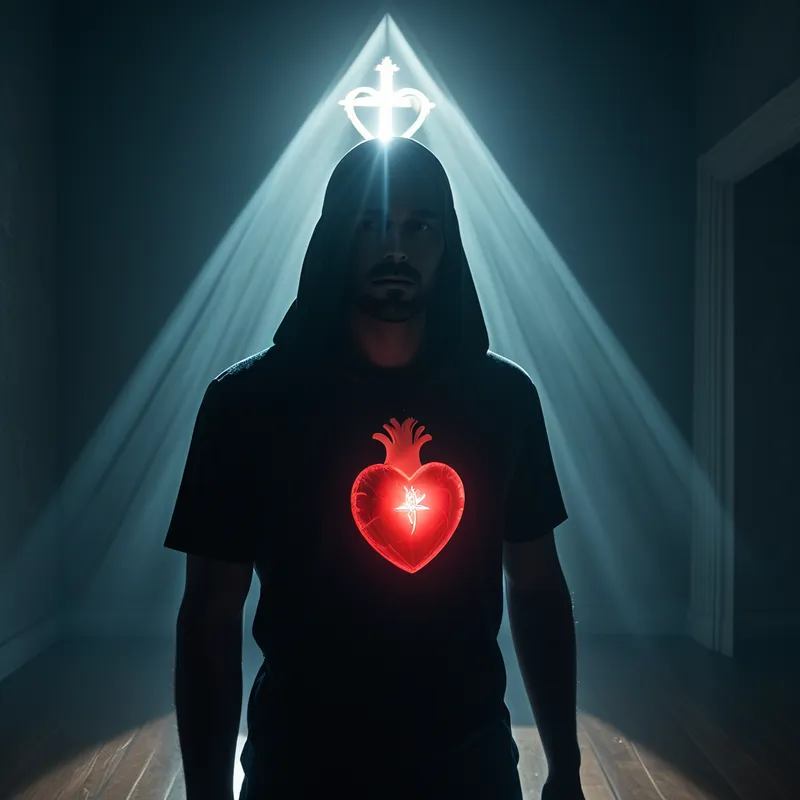
The alchemical vessel is the human heart, and the fire that transforms it is the unbearable tension of holding love in the presence of its betrayal.
The sealed tomb is the putrefactio and albedo, a necessary period of gestation in darkness. Here, in the solitude of depression or loss, the work of reconstitution happens unseen. The resurrection is the rubedo, the reddening—the emergence of the “glorified body” of the Self. For the modern individual, this translates to the process where a life crisis, a failure, or a deep hurt is not circumvented but fully endured. Through this conscious suffering, the base metal of the personality—our identifications, defenses, and pride—is broken down and, through the mysterious grace of the psyche, reconstituted into something more authentic and resilient. The wound, once a source of shame, becomes a wellspring of empathy, a touchstone of truth, and the very signature of one’s hard-won, individuated life. We do not transcend our wounds; we are transformed through them, and in their light, we recognize our shared, wounded, and healing humanity.
Associated Symbols
Explore related symbols from the CaleaDream lexicon: