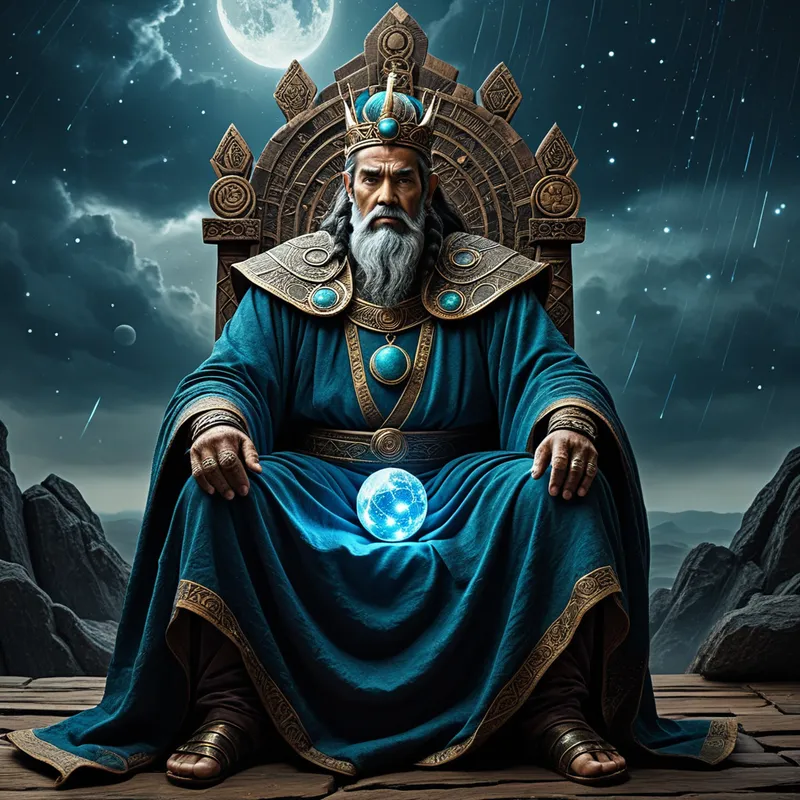
The Worried King Myth Meaning & Symbolism
A sovereign, paralyzed by visions of future ruin, learns that true power lies not in controlling fate, but in the courage of present-moment presence.
The Tale of The Worried King
Listen, and hear the tale that [the wind](/myths/the-wind “Myth from Various culture.”/) tells through the leaves of the oldest tree.
There was a king, and his realm was vast. His cities were marvels of polished stone, his granaries overflowed, and his people sang in the markets. He was a good king, by any measure—just in his judgments, fierce in his protections, and endlessly diligent. Yet, in the deepest chamber of his palace, a chamber where an ancient tree grew right through the marble floor and spread its branches to form the ceiling, the king was known by another name: The Worried One.
For this king possessed a sight—not of the present, but of the possible. When he looked at his thriving port, he did not see the bustling ships; he saw the hurricane that could one day shatter them. Gazing upon his laughing children, he saw the fevers that might steal their breath. In every ripe field, he perceived the locust swarm on a distant wind. His mind was a map of a thousand branching catastrophes, each path a potential future ruin. He slept little, pacing the chamber where the tree’s roots cradled [the earth](/myths/the-earth “Myth from Hindu culture.”/) and its leaves whispered secrets he was too frantic to hear.
His advisors grew weary. “The harvest is abundant, Majesty,” they would say. “The treaties hold.” But the king would shake his head, his eyes clouded with visions of drought and betrayal. He ordered higher walls, deeper storehouses, more intricate spy networks. The kingdom became a fortress of contingency plans, its people living in the long shadow of a disaster that never quite arrived. The joy seeped from the land, not from hardship, but from the constant, silent pressure of their sovereign’s unspoken fear.
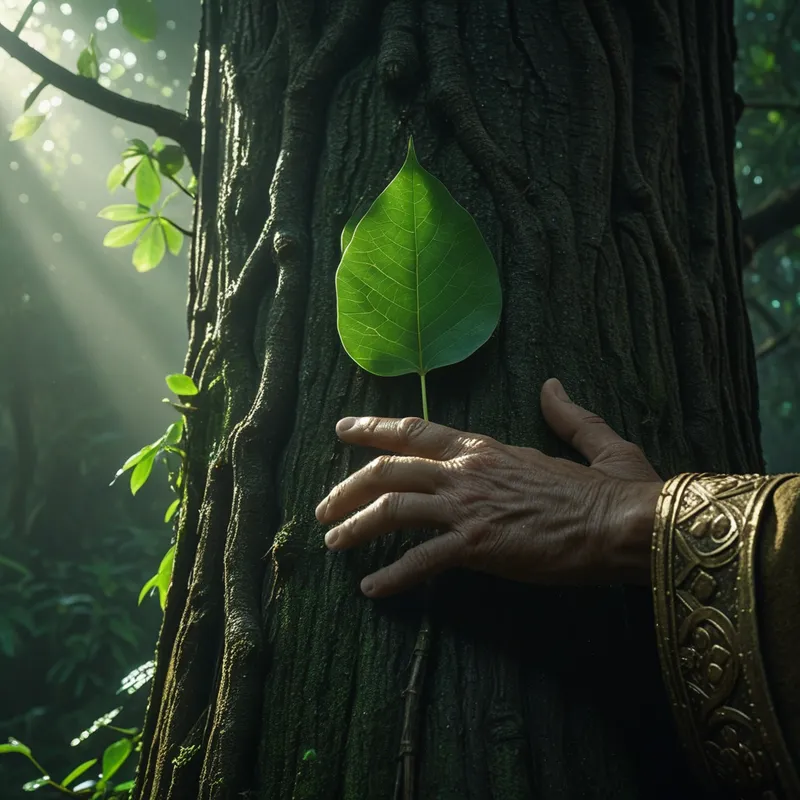
One evening, as a particularly vivid vision of a bridge collapsing during a festival seized him, the king collapsed against the great tree in his chamber. A single, withered leaf drifted down and landed in his open palm. In his exhaustion, a different kind of sight opened. He saw not the future, but the tree itself. He saw the patient, endless cycle of it: the root drinking deep in the silent dark, the sap rising unseen, the leaf unfurling to the sun, the leaf dying and falling to feed the root. It did not worry for the storm that might strip its branches. It simply was. It endured by being wholly present in each phase of its being.
A profound stillness settled upon the king, a stillness deeper than any fear. He did not move for a day and a night. When he finally rose, his face was changed. The deep furrow of worry remained, but it was now crossed by a new line of calm acceptance. He walked to his balcony and looked upon his kingdom, not as a map of perils, but as it was in that moment: the smell of evening bread, the sound of a lullaby from an open window, the feel of the cool stone beneath his hand.
He called for no new edicts. He dismantled no watchtowers. But he began to walk among his people again, not inspecting, but witnessing. He felt the solidity of the ground with each step. He listened to the complaints and joys without immediately crafting a solution for a hypothetical worse tomorrow. The kingdom did not magically become impervious to harm. A storm did later damage the port, and a child did fall ill. But the king met these events not as the terrifying confirmations of his prophecies, but as the present-moment reality they were. He led the repair of the ships and sat by the sickbed, his presence a steady anchor. The people, feeling his calm, found their own resilience. The kingdom remained, not as a perfect, defended artifact, but as a living, breathing entity, rooted in the now.
Cultural Origins & Context
The myth of The Worried King is a folktale variant found across numerous agricultural and early urban societies, from [the river](/myths/the-river “Myth from Buddhist culture.”/) valleys of Asia to the highlands of the Americas. It belongs not to a single canon, but to the oral tradition of “Various”—a catch-all for the shared human stories that bubble up independently wherever people gather under a leader and face an uncertain world. It was likely told by elders and storytellers at times of collective anxiety: on the eve of migration, before planting in a fickle climate, or during the reign of a particularly cautious or paranoid chieftain.
Its societal function was dual: it was a gentle critique of leadership paralyzed by abstraction, and a profound consolation for the common human experience of anxiety. For the ruler, it was a lesson in pragmatic presence over obsessive control. For the farmer fearing drought or the parent fearing illness, it was a narrative that dignified their worry while offering a mythic model for grounding. The story asserts that foresight has limits, and that true stewardship lies in engaged, compassionate response to the real, not the imagined.
Symbolic Architecture
The myth’s power lies in its elegant symbolic [opposition](/symbols/opposition “Symbol: A pattern of conflict, duality, or resistance, often representing internal or external struggles between opposing forces, ideas, or desires.”/). The Worried [King](/symbols/king “Symbol: A symbol of ultimate authority, leadership, and societal order, often representing the dreamer’s inner power or external control figures.”/) symbolizes the conscious ego tasked with the immense burden of control, [identity](/symbols/identity “Symbol: Identity represents the sense of self, encompassing personal beliefs, cultural background, and social roles.”/), and [responsibility](/symbols/responsibility “Symbol: Responsibility in dreams often signifies the weight of duties and the expectations placed upon the dreamer.”/). His [throne](/symbols/throne “Symbol: A seat of authority, power, and sovereignty, representing leadership, divine right, or social hierarchy.”/) [room](/symbols/room “Symbol: A room in a dream often symbolizes the self, representing personal space, mental state, or aspects of one’s identity.”/), especially the [chamber](/symbols/chamber “Symbol: A private, enclosed space representing the inner self, hidden aspects, or a specific stage in life’s journey.”/) with the [tree](/symbols/tree “Symbol: In dreams, the tree often symbolizes growth, stability, and the interconnectedness of life.”/), is the [psyche](/myths/psyche “Myth from Greek culture.”/) itself. The [king](/symbols/king “Symbol: A symbol of ultimate authority, leadership, and societal order, often representing the dreamer’s inner power or external control figures.”/)’s “[sight](/symbols/sight “Symbol: Sight symbolizes perception, awareness, and insight, representing both physical and inner vision.”/)” is not true [prophecy](/symbols/prophecy “Symbol: A foretelling of future events, often through divine or supernatural means, representing destiny, fate, and hidden knowledge.”/), but [the ego](/myths/the-ego “Myth from Jungian culture.”/)’s [capacity](/symbols/capacity “Symbol: A measure of one’s potential, limits, or ability to contain, process, or achieve something, often reflecting self-assessment or external demands.”/) for anxious [projection](/symbols/projection “Symbol: The unconscious act of attributing one’s own internal qualities, emotions, or shadow aspects onto external entities, people, or situations.”/), spinning endless “what-if” narratives in a futile attempt to secure the future and eliminate [vulnerability](/symbols/vulnerability “Symbol: A state of emotional or physical exposure, often involving risk of harm, that reveals authentic self beneath protective layers.”/).
The ego, in its role as ruler, often mistakes anxiety for diligence, and control for wisdom.
The Great Tree is the central, transformative [symbol](/symbols/symbol “Symbol: A symbol can represent an idea, concept, or belief, serving as a powerful tool for communication and understanding.”/). It represents [the Self](/myths/the-self “Myth from Jungian culture.”/)—the total, integrated psyche that includes both conscious and unconscious processes. It is the organic, autonomous [life](/symbols/life “Symbol: The symbol of ‘Life’ represents a journey of growth, interconnectedness, and existential meaning, encompassing both the joys and challenges that define human experience.”/) of the psyche that operates on a timescale and with a wisdom beyond the ego’s frantic calculations. Its cycle of root, sap, [leaf](/symbols/leaf “Symbol: A leaf symbolizes growth, renewal, and the cycles of life, reflecting both the natural world and personal transformations.”/), and decay is the process of psychic [metabolism](/symbols/metabolism “Symbol: Represents the body’s energy processing, transformation, and life-sustaining functions. Often symbolizes personal change, adaptation, and internal rhythms.”/), where experiences (even painful ones) are digested and transformed into growth. The king’s [moment](/symbols/moment “Symbol: The symbol of a ‘moment’ embodies the significance of transient experiences that encapsulate emotional depth or pivotal transformations in life.”/) of realization is not an act of thinking, but of merging—exhausting his ego’s project and, in that surrender, perceiving the deeper, rhythmic [pattern](/symbols/pattern “Symbol: A ‘Pattern’ in dreams often signifies the underlying structure of experiences and thoughts, representing both order and the repetitiveness of life’s situations.”/) of [the Self](/myths/the-self “Myth from Jungian culture.”/).
The shift from “[vision](/symbols/vision “Symbol: Vision reflects perception, insight, and clarity — often signifying the ability to foresee or understand deeper truths.”/) of [futures](/symbols/futures “Symbol: Dreams of futures represent potential paths, unknown outcomes, and the psychological tension between destiny and free will.”/)” to “[presence](/symbols/presence “Symbol: Presence in dreams often signifies awareness or acknowledgment of something significant in one’s life.”/) in the now” marks the transition from ego-rule to Self-rule. Sovereignty is redefined. It is no longer about preventing the storm, but about possessing the rootedness to withstand it and the [compassion](/symbols/compassion “Symbol: A deep feeling of empathy and concern for others’ suffering, often involving a desire to help or alleviate their pain.”/) to tend to the damage.
The Dreamer’s Resonance
When this myth activates in the modern dreamscape, it often manifests not as a literal king, but as a dreamer feeling overwhelming responsibility in a crumbling or labyrinthine space—a leaking house they must fix, a complex machine they must operate, or a group of people they are failing to lead to safety. The somatic feeling is one of tightness in the chest, shallow breath, and a racing mind within the dream.
This is the psyche staging the “Worried King” complex in real-time. The dreamer is undergoing a process of somatic confrontation with their own inner ruler who is over-identified with control. The crumbling environment reflects the ego’s perception that everything depends on its constant vigilance. The dream is not forecasting actual ruin; it is making visible the exhausting and impossible burden the dreamer’s conscious attitude is carrying.
The healing moment in such dreams comes as a sudden, irrational element of profound stillness: a patch of sunlight that feels eternally calm, a simple, perfectly intact object in the chaos, or the dreamer suddenly stopping to observe a small, natural detail like a spiderweb or a flowing stream. This is the “Great Tree” breaking through—the Self introducing the corrective of presence. The dreamwork is to identify and honor that still point upon waking, to recognize where in one’s life the worried ruler needs to step back and listen to the older, slower wisdom of the embodied psyche.
Alchemical Translation
The alchemical process modeled here is the transmutation of anxiety into grounded presence, or in Jungian terms, the integration of the ruling archetype with the Self. The [prima materia](/myths/prima-materia “Myth from Alchemical culture.”/) (base material) is the king’s corrosive, future-oriented worry—the [nigredo](/myths/nigredo “Myth from Alchemical culture.”/) state of blackening, where the spirit is consumed by its own shadowy projections.
The alchemical vessel is the king’s own body and mind, brought to the point of breakdown against the tree of the Self.
The king’s exhaustion and the falling leaf represent the necessary mortificatio—a symbolic death of the old, rigid ego attitude. This is not the death of responsibility, but the death of the illusion that perfect control is possible. In that stillness, the albedo (whitening) occurs: a clarifying insight, a moon-cool realization of a deeper pattern. He sees the tree’s cycle, the eternal present of nature’s law.
The final stage, the [rubedo](/myths/rubedo “Myth from Alchemical culture.”/) (reddening), is the king’s return to his people with a new quality of sovereignty. His concern has not vanished, but it has been cooked, transformed. It is now warmed by compassion and grounded in sensory reality. He has integrated the lesson of the tree: that life is a process of weathering and growth, not a fortress to be maintained. The “philosopher’s stone” produced is not invulnerability, but resilient presence—the ability to hold the throne of consciousness firmly, yet lightly, rooted in the dark earth of the unconscious and open to the changing sky of experience. The individual learns to rule their inner kingdom not as a paranoid dictator, but as a wise steward in service to the greater, living Self.
Associated Symbols
Explore related symbols from the CaleaDream lexicon: