The Worm Ouroboros Myth Meaning & Symbolism
The serpent that devours its own tail, symbolizing the eternal cycle of destruction and creation, and the alchemist's quest for the Philosopher's Stone.
The Tale of The Worm Ouroboros
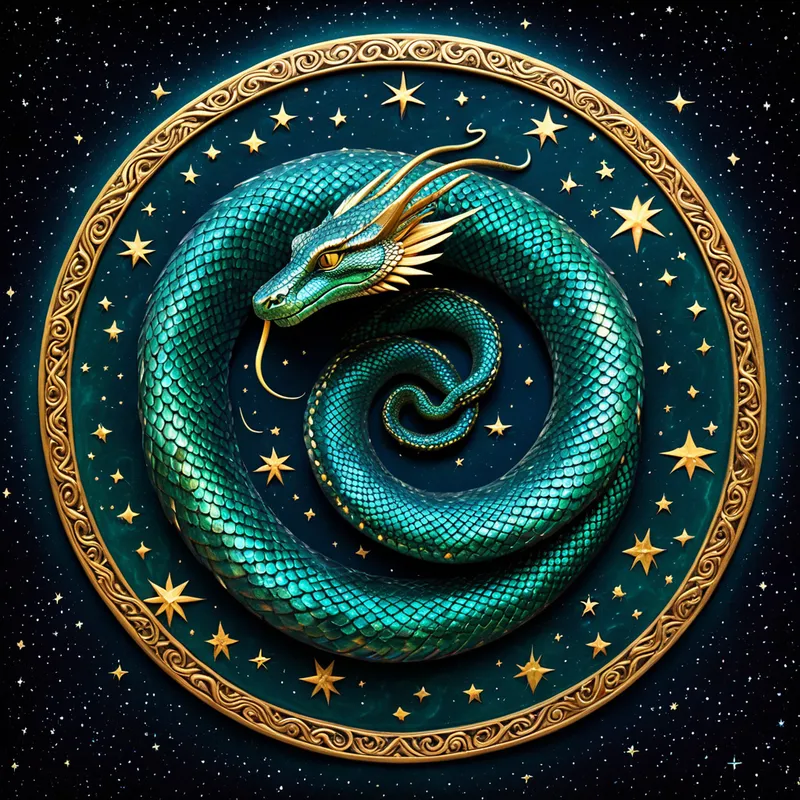
In the beginning, before the separation of the elements, there was only the One [Thing](/myths/thing “Myth from Norse culture.”/). And within that boundless potential, a shape stirred. Not born of mother or father, but from the very necessity of being, it awoke. It was the Worm [Ouroboros](/myths/ouroboros “Myth from Global/Universal culture.”/).
Feel the texture of its scales, cool and smooth as polished onyx, yet shimmering with the inner fire of all metals yet to be. Hear the profound silence that is not empty, but full—the silence of a process so complete it needs no witness. See it in the mind’s eye, not upon [the earth](/myths/the-earth “Myth from Hindu culture.”/) or in [the sky](/myths/the-sky “Myth from Persian culture.”/), but in the place that is both and neither: the [Prima Materia](/myths/prima-materia “Myth from Alchemical culture.”/).
Its body formed a perfect circle, a cosmos unto itself. Its head, crowned with a knowing that predates thought, sought its own tail. There was no hunt, no struggle, for the pursuit and the pursued were one. This was the first and only action: the turning. The jaws, capable of consuming worlds, closed with infinite gentleness upon the tip of its own being.
And as it consumed, so too was it created. From the tail, passing through [the alembic](/myths/the-alembic “Myth from Alchemical culture.”/) of its own body, new substance was endlessly woven. Destruction was not an end, but the forge of birth. The sound was the hum of the spheres, the taste was of salt and [sulfur](/myths/sulfur “Myth from Alchemical culture.”/) and quicksilver, the scent was of ozone after a lightning strike—the smell of transformation itself.
It knew no conflict with another, for it was all. Its drama was the drama of existence: the tension of holding the beginning in the same moment as the end. Its resolution was perpetual, a victory renewed with every completed circuit. It was the first symbol, the living glyph written upon [the void](/myths/the-void “Myth from Buddhist culture.”/), telling a tale without words: I am that which is, was, and will be. I am the cycle that sustains itself.
Cultural Origins & Context
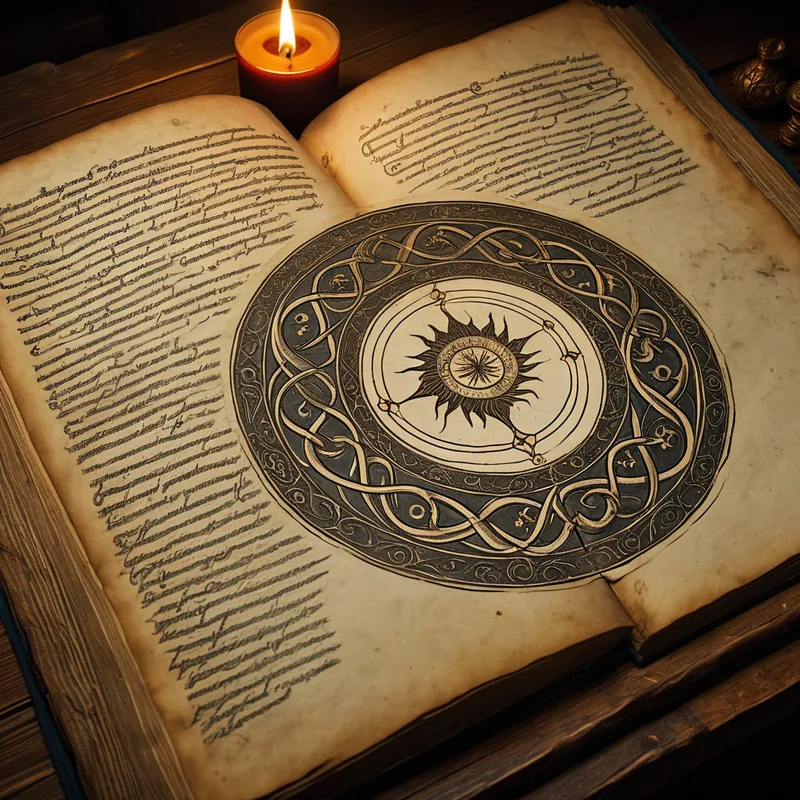
The image of the Ouroboros entered the Western esoteric tradition most prominently through the texts of Greek-Egyptian alchemy in Alexandria. It is famously inscribed in the Chrysopoeia of Cleopatra, a manuscript dating from the 2nd or 3rd century CE, where it is encircled by the words “Hen to Pan”—“The All is One.”
For [the alchemist](/myths/the-alchemist “Myth from Various culture.”/), this was not merely a decorative motif. It was a core diagram of their [Magnum Opus](/myths/magnum-opus “Myth from Alchemical culture.”/). The myth was passed down not through public epic poetry, but in the cryptic, illustrated manuscripts of adepts, shared in secrecy. Its societal function was hermetic—literally, sealed. It served as both a map and a reminder for the practitioner. The myth encoded the central axiom of their worldview: all processes of nature, from the cosmic to the psychic, are cyclical and self-sustaining. [The laboratory](/myths/the-laboratory “Myth from Alchemical culture.”/) work of turning lead into gold was the physical mirror of the internal work of turning the base soul into the refined spirit. [The Ouroboros](/myths/the-ouroboros “Myth from Alchemical culture.”/) was the perfect emblem of this closed, perfect process.
Symbolic Architecture
The [Ouroboros](/symbols/ouroboros “Symbol: An ancient symbol depicting a serpent or dragon eating its own tail, representing cyclicality, eternity, self-sufficiency, and the unity of opposites.”/) is the ultimate [symbol](/symbols/symbol “Symbol: A symbol can represent an idea, concept, or belief, serving as a powerful tool for communication and understanding.”/) of autopoiesis—a [system](/symbols/system “Symbol: A system represents structure, organization, and interrelated components functioning together, often reflecting personal or social order.”/) that creates and maintains itself. Its circular form represents [eternity](/symbols/eternity “Symbol: The infinite, timeless state beyond human life and measurement, often representing the ultimate or divine.”/), with no beginning or end, and the totality of existence. The [serpent](/symbols/serpent “Symbol: A powerful symbol of transformation, wisdom, and primal energy, often representing hidden knowledge, healing, or temptation.”/) itself is a profound and universal [symbol](/symbols/symbol “Symbol: A symbol can represent an idea, concept, or belief, serving as a powerful tool for communication and understanding.”/) of [life](/symbols/life “Symbol: The symbol of ‘Life’ represents a journey of growth, interconnectedness, and existential meaning, encompassing both the joys and challenges that define human experience.”/) force, wisdom, and the cyclical shedding of [skin](/symbols/skin “Symbol: Skin symbolizes the boundary between the self and the world, representing identity, protection, and vulnerability.”/) (transformation). By consuming itself, it embodies the paradoxical unity of opposites.
The dragon that slays itself is the only dragon that can be slain, and in that act of self-containment, it becomes immortal.
Psychologically, it represents [the self](/myths/the-self “Myth from Jungian culture.”/)-sustaining [nature](/symbols/nature “Symbol: Nature symbolizes growth, connectivity, and the primal forces of existence.”/) of the [psyche](/myths/psyche “Myth from Greek culture.”/). The “[tail](/symbols/tail “Symbol: A tail in dreams can symbolize instincts, connection to one’s roots, or the hidden aspects of personality.”/)” is the unconscious, instinctual, and unresolved [material](/symbols/material “Symbol: Material signifies the tangible aspects of life, often representing physical resources, desires, and the physical world’s influence on our existence.”/) of one’s past. The “head” is [consciousness](/symbols/consciousness “Symbol: Consciousness represents the state of awareness and perception, encompassing thoughts, feelings, and experiences.”/), [the ego](/myths/the-ego “Myth from Jungian culture.”/), the devouring intellect that seeks to understand, integrate, and assimilate. The act of consumption is the ego’s attempt to make the unconscious conscious. Yet, because the system is closed, this act of [integration](/symbols/integration “Symbol: The process of unifying disparate parts of the self or experience into a cohesive whole, often representing psychological wholeness or resolution of internal conflict.”/) simultaneously produces new unconscious [material](/symbols/material “Symbol: Material signifies the tangible aspects of life, often representing physical resources, desires, and the physical world’s influence on our existence.”/) from the processed experience. It is a model for the endless process of self-[knowledge](/symbols/knowledge “Symbol: Knowledge symbolizes learning, understanding, and wisdom, embodying the acquisition of information and enlightenment.”/): we are always digesting our own experience to create the substance of who we are becoming.
The Dreamer’s Resonance
When the Ouroboros appears in a modern dream, it rarely manifests as a literal serpent. More often, one dreams of being trapped in a loop—repeating the same argument, walking the same circular path, or witnessing a process where the end flawlessly connects back to the beginning. The somatic feeling is one of profound ambivalence: a sense of perfect, peaceful closure mixed with claustrophobic entrapment.
This dream signals a critical point in what depth psychology calls a numinous process. The dreamer is likely engaged in a deep, self-referential psychological work. They are “chewing on” a problem, a memory, or an aspect of their own character. The Ouroboros dream confirms that the process is internal and self-contained; the answer is not “out there,” but in the complete acceptance and integration of the pattern itself. It can feel like being stuck, but its deeper message is that the energy for transformation is already present within the system of the self—one must simply allow the cycle to complete its turn.
Alchemical Translation
In the alchemical journey of individuation—becoming the unique, integrated Self—the Ouroboros models the stage of [Nigredo](/myths/nigredo “Myth from Alchemical culture.”/) giving way to Albedo. The ego (the head) must turn inward and “devour” or confront its own shadow, its unresolved past, and its neurotic patterns (the tail). This is a painful, self-cannibalizing process where one feels consumed by one’s own introspection.
The Philosopher’s Stone is not found; it is the realized state of the seeker who has fully become the circle, containing their own beginning and end.
The [triumph](/myths/triumph “Myth from Roman culture.”/) of the myth is not in breaking the circle, but in realizing its perfection. The modern individual’s “transmutation” occurs when they stop resisting the cyclical nature of their growth. They understand that healing is not linear, that insights recur at deeper levels, and that the self is both the artifact and the artisan. The goal is to become like the Ouroboros: a self-contained, self-renewing system where opposition between conscious and unconscious, past and future, is resolved into a dynamic, eternal present. One becomes both the process and the product, the devourer and the devoured, achieving a state of psychic autonomy and timeless essence. The gold, then, is not a metal, but the wholeness of a life lived in conscious, cyclical return to itself.
Associated Symbols
Explore related symbols from the CaleaDream lexicon: