The World Myth Meaning & Symbolism
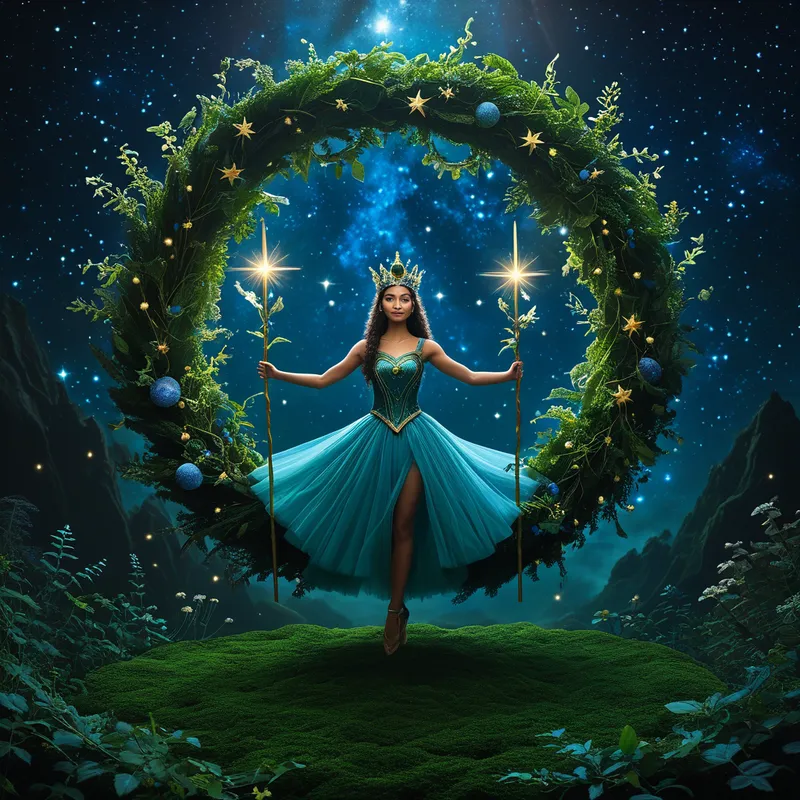
A crowned dancer, suspended in the cosmic mandala, embodies the sacred marriage of opposites and the soul's triumphant return to primal unity.
The Tale of The World
Listen. Beyond the last turning of the path, past the final trial of the moon, there is a place where the music of the spheres becomes a silence so profound it births a new kind of hearing. Here, in the womb of the cosmos, hangs a wreath woven not from laurel or olive, but from the living breath of completion. It is a circle unbroken, green and supple, threaded with the red ribbon of eternity—a serpent swallowing its own tail made manifest as a crown.
And within this crown, she dances. Or is it he? The figure is both and neither, a being of perfect balance, draped in a violet cloth that flows like liquid twilight. In one hand, a wand points to the heavens, in the other, a wand touches the earth; the body itself is the conduit, the axis mundi. There is no strain in this motion, only the effortless, spiraling grace of a galaxy turning. The eyes are closed, not in sleep, but in a vision turned inward to the source of all outward sight.
Witness the four corners of this holy stage. From the vault of air, the Angel of the Man watches with the gaze of intellect made compassionate. From the realm of water, the Eagle of Scorpio rises from the deep, its sight piercing all illusion. From the heart of fire, the Lion of the Sun roars a silent hymn of pure will. From the body of earth, the Bull of the Ox stands immovable, its strength the foundation of worlds. They are not guardians, but celebrants. They are the four pillars of reality singing the one who has become their master by becoming their servant.
This is not an ending, but a resolution so complete it sounds like a beginning. The long pilgrimage of the Fool finds its rest here, not in cessation, but in the center of the perpetual wheel. The dancer has drunk from every cup, wielded every sword, navigated every wand, and walked every coin of the kingdom. All has been gathered, all has been suffered, all has been loved. Now, it is synthesized. The music of the dance is the hum of the unified self, a note so true it holds the wreath in place and the stars in their courses. The story pauses here, in the eternal now, at the still point of the turning world.
Cultural Origins & Context
The image of The World, as Le Monde or Il Mondo, emerged from the rich symbolic soup of Renaissance Europe. It is a direct descendant of earlier cosmological diagrams, medieval depictions of the Globus Cruciger (the orb and cross signifying Christ's dominion over the world), and the allegorical figure of Anima Mundi—the World Soul. The card was not part of a single, codified myth told around fires, but was a visual teaching tool, a condensation of Hermetic, Neoplatonic, and Christian mystical thought into a single, potent icon.
Its primary "storytellers" were the artists and cardmakers of 15th-century Italy and France, who worked within secretive, guild-like environments. The card functioned as the final keystone in the narrative architecture of the Major Arcana. Its societal function was esoteric: to visually map the path of the initiate's return to divine source, a concept central to alchemical and mystical brotherhoods. It was a diagram of triumph meant to be meditated upon, not merely played in a game. The myth was transmitted silently, through contemplation of its symbolic geometry, teaching that true mastery is reintegration with the cosmos from which one came.
Symbolic Architecture
The myth of The World is the psyche's blueprint for wholeness. Every element is a facet of the completed Self.
The dancing figure is the Self realized. Its androgyny signifies the sacred marriage of conscious and unconscious, masculine and feminine principles within the individual. The two wands are the solved paradox; will and surrender, action and reception, are no longer in conflict but are the poles of a single, flowing energy.
The wreath is the ouroboros of the soul—a boundary that contains infinity, marking the sacred space where the personal becomes universal.
The four living creatures—Man, Eagle, Lion, and Ox—are the tetramorph, the stabilized four functions of consciousness (Thinking, Intuition, Feeling, Sensation) in Jungian terms. They are the wild, elemental powers of the psyche that once seemed like external adversaries or trials (as in the Wheel of Fortune), now integrated and oriented in harmonious service to the central, governing consciousness. Their presence transforms the card from a portrait of solitude to one of a complete, operational universe.
The Dreamer's Resonance
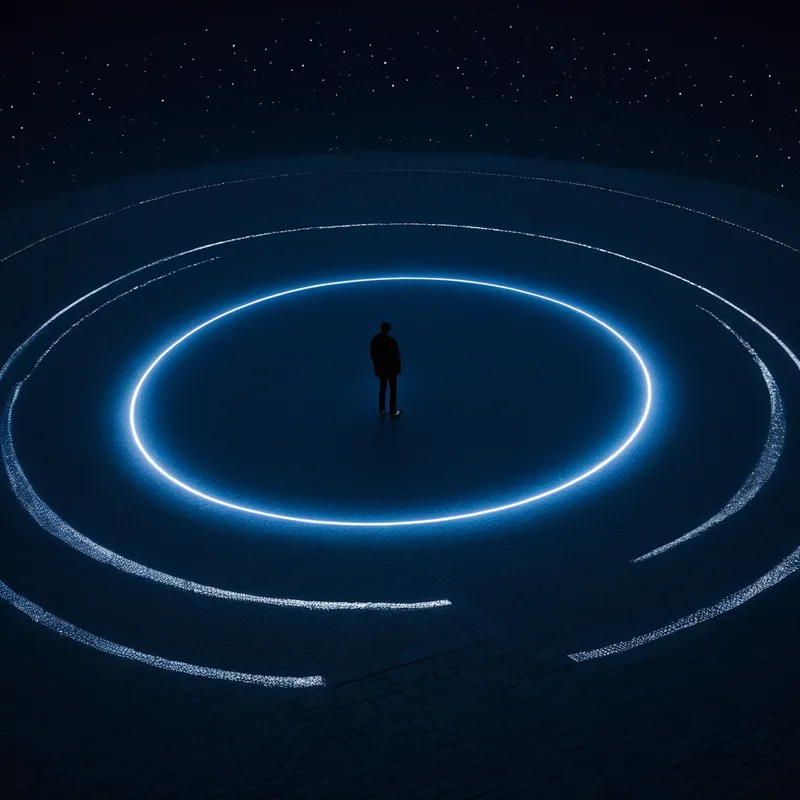
When this myth stirs in the modern dreamer, it often manifests not as a grand vision, but as a profound somatic and spatial experience. One may dream of finally arriving at the center of a labyrinth and finding it not empty, but perfectly, comfortably full—a feeling of "fitting" one's own skin completely. There is a sense of panoramic understanding, where previously conflicting life narratives suddenly coalesce into a single, coherent story.
Psychologically, this dream marks the resolution of a core, often lifelong, process of fragmentation. The somatic signature is one of deep, cellular relaxation and effortless breath, as if the body itself has remembered its original, unified blueprint. It can follow dreams of immense struggle or dismemberment (shadowed by cards like The Tower or The Devil), acting as the psyche's announcement that the period of arduous healing and re-assembly is complete. The dreamer awakens with a quiet, unshakable certainty, a feeling of being profoundly homed within their own existence.
Alchemical Translation
The alchemical process mirrored here is the Rubedo, the Reddening—the final stage of the Great Work where the purified matter achieves its final, glorious form: the Philosopher's Stone. The long journey of the Major Arcana is the alchemical opus: dissolution (Solutio), separation (Separatio), conjunction (Coniunctio), and finally, coagulation into gold.
The dancer in the wreath is the coagulated Lapis Philosophorum—the Self that is both the product of the work and the agent that performed it.
For the modern individual, this models the culmination of individuation. It is the point where one stops "working on oneself" as on a project and begins to inhabit oneself as a finished, yet eternally dynamic, creation. The struggle for identity ceases, replaced by the expression of identity. The neurotic tension between "who I am" and "who I should be" dissolves in the realization that the journey itself—with all its trials, follies, and lessons—has sculpted the perfect, unique form that now dances at the center. The world is not conquered, but recognized as oneself. The final transmutation is understanding that you were always the gold.
Associated Symbols
Explore related symbols from the CaleaDream lexicon: