The World Turtle Myth Meaning & Symbolism
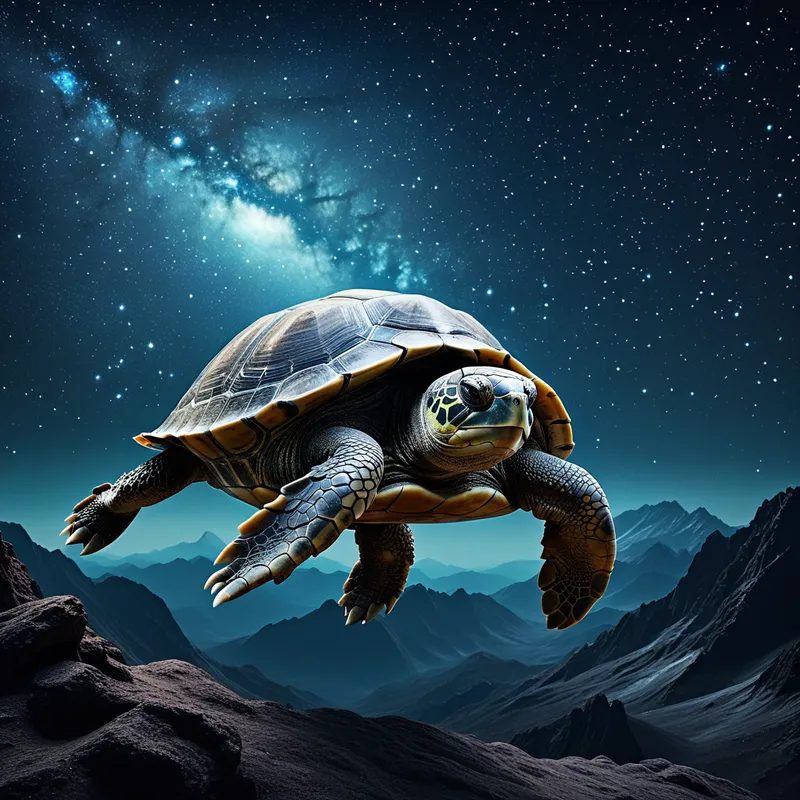
A cosmic turtle supports the world, embodying the enduring foundation of reality and the patient, grounding force within the human psyche.
The Tale of The World Turtle
Listen. In the time before time, there was only the endless, dark water. No land, no sky, only the deep and patient sea. From the silence of these primal depths, a great stirring began. Not a violent rupture, but a slow, inevitable rising. The mud of the abyss gathered itself, particle by patient particle, drawn by a will older than thought. It formed a shape vast beyond knowing—the shape of The Elder Turtle.
Its carapace was the first hard thing in all of creation, a dome of stone etched by the currents of eternity. Upon this impossible back, the other beings, who had been swimming lost in the featureless wet, saw a chance. “Here,” one said, its voice the rumble of a tectonic plate. “Here we can build.” They brought earth from the bottom of the sea, a speck in their claws, and placed it on the great shell. The turtle did not flinch. It accepted the burden.
More earth was brought, and more, until a great mound formed. The beings danced upon it, packing the soil with their feet, and from their dance grew grasses, then trees, then mountains that scraped the belly of the newly forming sky. The world was made. But it was not fixed. For the turtle lived, and a living thing must move. It began to swim.
The people on its back felt this first as a great quaking, the mountains trembling, the seas sloshing over the shores. They cried out in terror, fearing their world would be shaken apart. They did not understand the nature of their foundation. The great turtle heard their cries, not with ears, but with its very bones. It ceased its swimming and grew still, a stillness so profound it became the bedrock of reality itself. It anchored itself in the deep, not by root or chain, but by an act of infinite patience. It chose to be the foundation. And when the tremors ceased, the people learned: their world was not built on dead stone, but on the living, breathing will of a guardian. They learned to listen for the slow, steady beat of its heart, the pulse at the root of all things, and in that rhythm, they found their own.
Cultural Origins & Context
The motif of the World Turtle is not the property of a single culture, but a profound thought that has surfaced independently across continents and epochs. It appears in the cosmologies of several Indigenous nations of North America, most notably in the Haudenosaunee (Iroquois) creation story where the Earth is formed on the back of a great turtle, giving rise to the name Turtle Island. Variations echo in Hindu mythology, where the Kurma supports the mountain used to churn the ocean of milk, and in Chinese legend, where the turtle Ao carries the floating islands of the immortals.
This was not a myth confined to temple scrolls or priestly castes. It was a story told by firesides, carved into everyday objects, and woven into the very language of place. Its primary function was cosmological and ethical. It answered the fundamental, childlike question: “What does the world rest on?” with an answer that fostered ecological and social responsibility. The world rests not on an abstract principle or a vengeful deity’s whim, but on a living being. This instills a sense of reciprocal care; if the turtle is disturbed, the world is disturbed. The myth taught interdependence, immense temporal perspective (the turtle’s time is geological, not human), and the virtue of steadfastness.
Symbolic Architecture
Psychologically, the World Turtle is an archetypal image of the foundational Self, the bedrock of the psyche upon which the complex topography of the ego-consciousness is built. It represents the part of us that is ancient, patient, and utterly grounded in the instinctual and somatic realm.
The turtle does not strive to be the foundation; it is the foundation. Its power is in its being, not its doing.
The shell symbolizes the protective boundary of the psyche, the individuated Self that can bear the weight of the world—our responsibilities, traumas, and complexities—without collapsing. The endless water it swims through is the unconscious itself, the formless, potential-filled medium of all existence. The act of bringing earth to its back mirrors the ego’s task of building a coherent reality (consciousness) upon the supportive, yet dynamic, substrate of the unconscious. The myth’s central drama—the turtle’s movement causing quakes—illustrates the necessary, and sometimes disruptive, dialogue between the deep Self and the surface-level ego. Stability is not stagnation, but a dynamic, living equilibrium.
The Dreamer’s Resonance
When the World Turtle surfaces in modern dreams, it often signals a profound process of grounding or a crisis of foundation. The dreamer may be experiencing life as chaotic, unstable, or without support. To dream of standing on the back of a giant turtle, especially if feeling calm and secure, suggests a nascent connection to an inner stability that is being recognized. The somatic sensation is often one of deep, resonant calm, a slowing of the heart-rate, a feeling of being held.
Conversely, to dream of the turtle shaking, sinking, or being injured indicates that the dreamer’s psychological foundation is under threat. This could relate to a betrayal of core values, a physical illness challenging one’s bodily foundation, or a life transition that makes everything feel precarious. The dream is a direct message from the deep psyche: the foundational archetype is active and requires attention. It is an invitation to ask, “What in my life feels unsupported? What ancient, patient part of myself have I neglected?” The turtle does not scream; it rumbles. The dreamer feels it in their bones.

Alchemical Translation
The alchemical journey mirrored in this myth is not one of fiery transformation, but of the opus contra naturam—the work against one’s own restless, light-seeking nature—to embrace profound grounding. The prima materia is the chaotic, watery state of a life or psyche adrift. The first stage, the nigredo, is the descent into this chaos, the feeling of “bottomlessness.”
The turtle’s emergence is the albedo, the appearance of the first, solid, white (lunar) foundation. It is the realization that within oneself there exists a core of unshakable, instinctual wisdom. Building the world upon it is the conscious work of the ego (rubedo), taking responsibility for one’s reality. The final, often overlooked stage is the turtle’s conscious choice to become still. This is the true citrinitas or ultimate gold: the voluntary alignment of the ego’s actions with the slow, deliberate pace of the Self.
Individuation is not just about reaching heights, but about discovering the depths that can support those heights. The World Turtle teaches that the ultimate act of creation is to become a stable ground for one’s own existence.
For the modern individual, the myth instructs us to find our “turtle”—perhaps through somatic practices, engagement with nature, or honoring the body’s wisdom—and to listen for its rhythm. Our task is not to force this foundational Self to our will, but to learn its patient language, to build our world in harmony with its steady, world-bearing swim. In doing so, we do not escape the chaos of the deep, but we learn to carry it, and be carried by it, in perfect, poised balance.
Associated Symbols
Explore related symbols from the CaleaDream lexicon: