
The World Treefro Myth Meaning & Symbolism
A cosmic amphibian, the World Treefro, sings the world into being from the primordial mud, its life cycle mirroring the soul's descent and ascent.
The Tale of The World Treefro
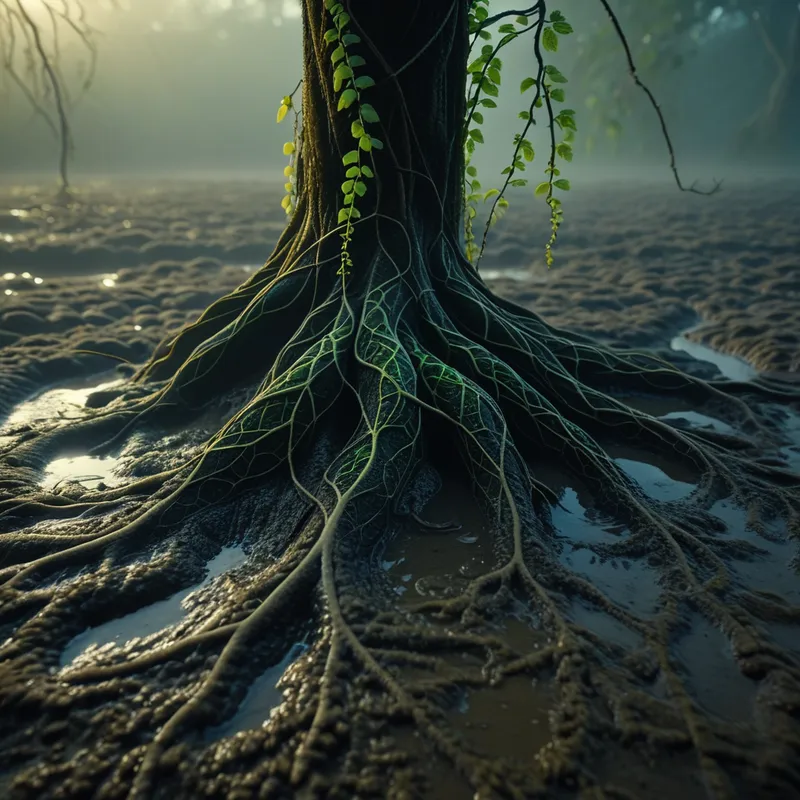
Listen. Before the first word, there was only the Mud—dark, warm, and silent. Not an emptiness, but a fullness waiting to be shaped. In that infinite softness, a pulse began. A slow, deep thrum that was not a sound but a potential for sound. From this pulse, the Mud stirred, and from its heart, a form emerged. Not descending from a heaven, but ascending from the deep. This was the World Treefro.
Its skin was not skin, but the texture of ancient bark, etched with the patterns of unborn rivers and mountain ranges. Its eyes held not pupils, but swirling nebulae. It drew a breath, and the Mud clung to its form. It opened its mouth, and from its throat came not a croak, but the First Note—a vibration so profound it crystallized the air into Time.
With that note, the Treefro began its climb. It did not walk upon the Mud, but into it, each movement a deliberate, sacred act. Where its webbed feet pressed, the Mud firmmed into root and stone. Where its belly grazed, valleys were carved. Its ascent was a slow, deliberate song, each movement a syllable in the grammar of creation. It climbed the very possibility of height, and as it climbed, a great trunk formed beneath it—the World Axis, both its path and its creation.
For ages it climbed, singing the world into solidity below it. It sang the green of leaves, the cold of snow, the heat of the sun. It sang the fish into the waters and the birds into the skies that now stretched above the Mud. Finally, it reached a place where the trunk broadened into a great canopy, a realm of luminous leaves and eternal twilight. Here, the Treefro rested. Its song softened to a hum, the sustaining rhythm of the living world.
But a cycle must complete itself. The great song of making exhausted its singer. The Treefro’s luminous eyes dimmed. Without a sound, it released its hold. It fell, not as a stone, but as a leaf, a seed, a sigh. Down through the layers of its own creation—past the high leaves, the sturdy branches, the solid trunk—it descended back into the welcoming embrace of the primordial Mud from which it came.
The Mud received it, enfolding the creator. Silence returned, but it was a different silence, pregnant with memory and form. And deep within the warm darkness, a new pulse began to stir, waiting to climb and sing the world anew.
Cultural Origins & Context
The myth of the World Treefro is not the property of a single tribe or nation, but a story that has emerged, with startling similarity, in disparate floodplain cultures, isolated highland communities, and coastal peoples. Anthropologists of narrative call it a “pan-human motif,” a story that seems to germinate from the shared soil of the human unconscious. It was never codified in a single sacred text; instead, it was carried in the oral traditions of shamans, grandmothers, and wandering bards. It was told not to explain astronomy or weather, but to answer the deeper, more terrifying question: How does something come from what seems like nothing?
Its societal function was foundational. It was recited during planting ceremonies, its imagery linking the seed in the mud to the cosmic ascent. It was invoked during death rites, framing mortality not as an end but as a return to the fertile Mud, a necessary phase in a greater cycle. The myth provided a model of creation that was intimate, embodied, and cyclical, contrasting with distant, sky-god narratives. The creator is not separate from its creation; it is of it, and ultimately returns to it.
Symbolic Architecture
The myth’s power lies in its dense, interwoven symbolism. The World Treefro itself is the ultimate symbol of the Creator Archetype, but one grounded in earth and process, not abstract command. As an amphibian, it is a creature of two realms—the formless Mud (the unconscious, the potential) and the structured World (consciousness, manifest reality). Its song is the Logos, the word that shapes chaos into cosmos.
The act of creation is not a command shouted from a distance, but a song breathed from within the very substance of the unformed.
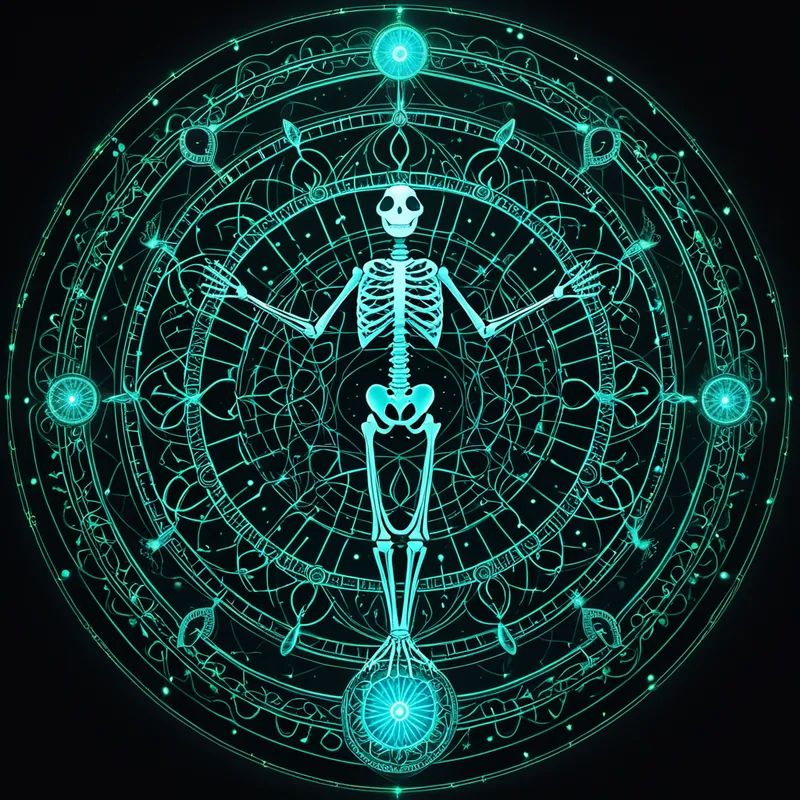
The climb up the World Axis represents the process of differentiation, the emergence of complexity from unity. The descent and dissolution back into the Mud symbolizes the necessary return to the source, the death that feeds new life. This completes the Ouroboros—the serpent eating its own tail. The myth asserts that creation and destruction are not opposites, but two phases of one continuous, breathing reality.
The Dreamer’s Resonance
When this myth stirs in the modern psyche, it often surfaces in dreams of profound transformation. To dream of a frog in a context of immense growth or cosmic scale—perhaps a tiny frog on your windowsill that, when you look again, has become a vast, starry presence—signals a somatic engagement with a creative or destructive cycle you are in.
The feeling is key: the slow, inevitable climb mirrors periods of diligent effort, career building, or self-actualization where each step feels foundational. The moment of release and falling mirrors life transitions—job loss, the end of a relationship, a health crisis—that feel not like failure, but like a terrifying, necessary return to a formless state. The dream may evoke the sensory memory of mud: its warmth, its resistance, its fertile smell. This is the psyche’s way of processing dissolution, reassuring the dreamer that this “return to mud” is not annihilation, but a phase of incubation within the Primordial Womb.

Alchemical Translation
For the individual on the path of Individuation, the World Treefro myth is a perfect map of psychic alchemy. The journey begins in the nigredo, the blackening: the Mud of our unresolved past, our shadow material, our latent potentials. This is not a place to despise, but the essential prima materia.
The climb is the arduous work of consciousness—bringing light to the dark, giving form to our chaos through therapy, art, relationship, and work. We “sing our world into being,” building our identity, our values, our life’s structure. Yet the ego, like the Treefro at the canopy, can believe this constructed self is the final, permanent achievement.
The ultimate alchemical act is not the climb to the heights, but the voluntary release back into the depths, trusting the Mud to transmute the spent self into new potential.
The myth then demands the most counter-intuitive step: the conscious descent. This is the alchemical mortificatio, the death of the ego’s rigid form. It is the midlife crisis embraced, the surrender of an outgrown identity, the willingness to be dissolved. We fall back into our own inner Mud—not to drown, but to be composted. From this fertile dissolution, a new, more integrated pulse—a new, more authentic note—can eventually begin to stir, initiating the next, wiser ascent. The cycle never ends, but with each turn, the song becomes richer, and the climber becomes more whole.
Associated Symbols
Explore related symbols from the CaleaDream lexicon: