The World Tree Slavic Myth Meaning & Symbolism
A sacred oak or ash tree connects the heavens, earth, and underworld, embodying the cosmos, fate, and the soul's perilous journey to wisdom.
The Tale of The World Tree Slavic
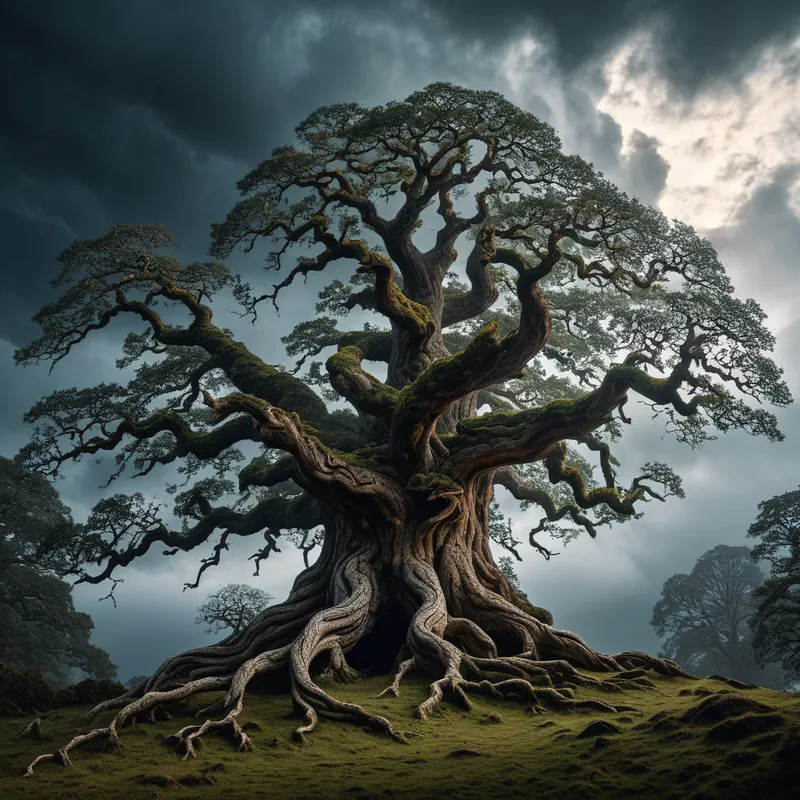
Listen. Before the first plow cut the black earth, before the first song was sung to the hearth fire, the Tree stood. It was not an oak of the forest, nor an ash of the glade, though it wore their forms. It was the axis of all that is, was, and will be. Its name was whispered by the wind but never spoken aloud.
Its roots, thick as river dragons, plunged deep into the cold, silent realm of Nav. There, in the perpetual damp, they drank from springs of memory and fate, twining around the bones of ancestors and the coils of the Zmey, who knew all secrets. From this dark soil, the first sorrows and the oldest promises fed the trunk.
That trunk, a tower of weathered bark and resilient heartwood, rose through our world, Yav. It stood in a clearing that was everywhere and nowhere. Bears made dens in its hollows, bees built kingdoms in its branches, and at its base, the people gathered. They felt its steadfast presence in the solid earth beneath their feet, in the cycle of sowing and reaping. It was the pillar of their reality.
And its crown… its crown shattered the sky. Branches heavy with leaves of shimmering light stretched into the luminous, eternal realm of Prav. Here, the great solar deity, Dazhbog, rested his gaze. An eagle, his messenger, made its nest in the highest fork, its cry echoing the thunder of the god Perun. Here lived the birds of prophecy, and here the stars hung like fruit on the celestial boughs.
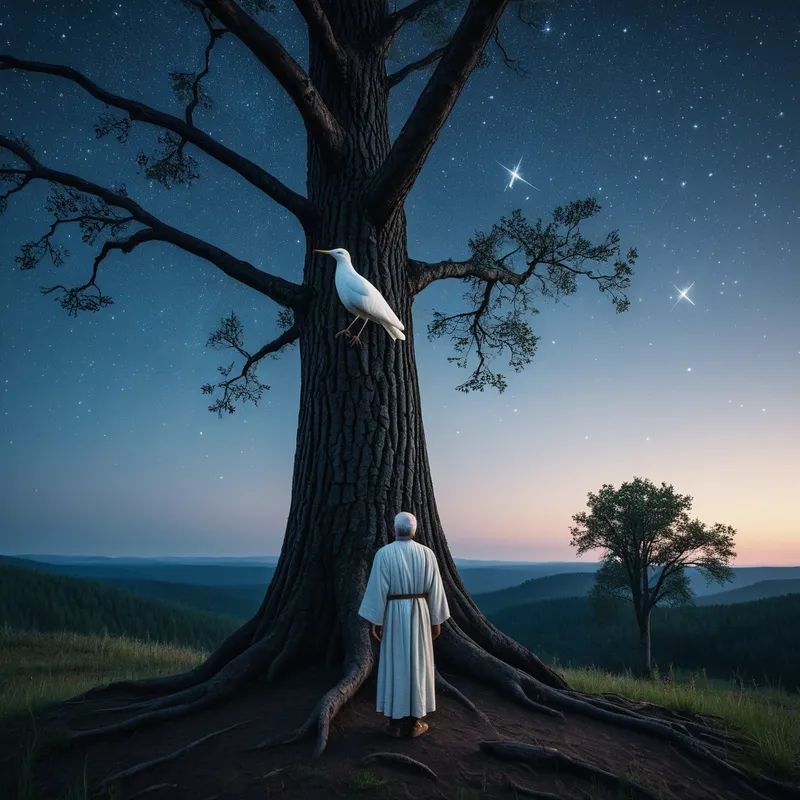
But the Tree was not a static monument. It was a road. The shaman, the volkhv, would come at the liminal hour—at dusk or dawn, at the solstice. Placing his hands upon the bark, he would begin a chant older than language. His soul would loosen its earthly ties and begin to climb. Not with hands and feet, but with will and longing.
Downward first, into Nav, to consult with the shades of the forefathers, to learn of origins and diagnose curses festering in the family root. Then, with effort that strained the very fabric of his being, he would ascend through the trunk of Yav, feeling the raw pulse of life—sap like blood, the groan of growth, the chatter of every living thing. Finally, if his heart was pure and his purpose true, he would burst into the blinding light of Prav. He would stand before the celestial powers, not as a slave, but as a petitioner of his people, seeking justice, forecasting the harvest, or pleading for healing rain. He would drink from the well of cosmic order and then make the terrible, necessary return, carrying a fragment of that light back into the world of mortals, into the waiting, anxious circle around the fire. The Tree stood. It connected. It allowed the journey. And in its silent, immense presence, the whole cosmos found its meaning.
Cultural Origins & Context
The myth of the World Tree is a pan-Slavic cosmological concept, reconstructed from a tapestry of folk tales, rituals, songs (byliny), embroidery patterns, and the stubborn remnants of pre-Christian belief that survived for centuries under the veneer of Orthodox Christianity. It was not a single, canonical story written in a sacred text, but a living, breathing framework etched into the landscape and the collective psyche.
It was told by grandmothers by the hearth, explaining why the oldest oak in the forest was never to be cut. It was sung by wandering minstrels who described the journeys of mythical heroes to “the land beyond the seventh sky.” It was enacted by the village volkhv or wise woman during pivotal transitions—birth, marriage, death, and the turning points of the agricultural year. The Tree’s primary societal function was one of orientation. It provided a sacred map of the universe, placing the human community at the center of a living, interconnected cosmos. It explained the structure of reality (the three worlds), sanctioned spiritual authority (the shaman’s journey), and encoded a moral and natural order (Prav) that governed both gods and humans. The Tree was the ultimate symbol of stability and continuity, its roots in the ancestral past and its branches in the divine future, holding the fragile present securely in between.
Symbolic Architecture
At its core, the Slavic World Tree is a symbol of the axis mundi—the central pillar that grounds and connects all levels of existence. Psychologically, it represents the structure of the Self in its totality.
The trunk is the conscious ego, rooted in the tangible world (Yav), experiencing the solid “I am” of daily life. The soaring crown is the superconscious—the realm of ideals, spirit, and transcendent meaning (Prav). The deep, tangled roots are the personal and collective unconscious (Nav), the dark, fertile soil from which our instincts, memories, and ancestral patterns emerge.
The myth presents a complete model of the psyche. The journey of the volkhv is the journey of consciousness itself, which must dare to descend into its own depths to integrate the shadow (meeting ancestors and the Zmey) before it can authentically ascend to its highest potential. The Dazhbog’s eagle and the chthonic serpent are not enemies, but complementary guardians of the poles of existence; the Self is whole only when it acknowledges both. The Tree itself symbolizes the dynamic process of individuation—the lifelong growth that requires nourishment from all three realms: instinct (roots), reality (trunk), and aspiration (crown).
The Dreamer’s Resonance
When the World Tree appears in a modern dream, it signals a profound moment of psychic reorientation. The dreamer is not merely having a fantasy; their unconscious is presenting the fundamental architecture of their soul.
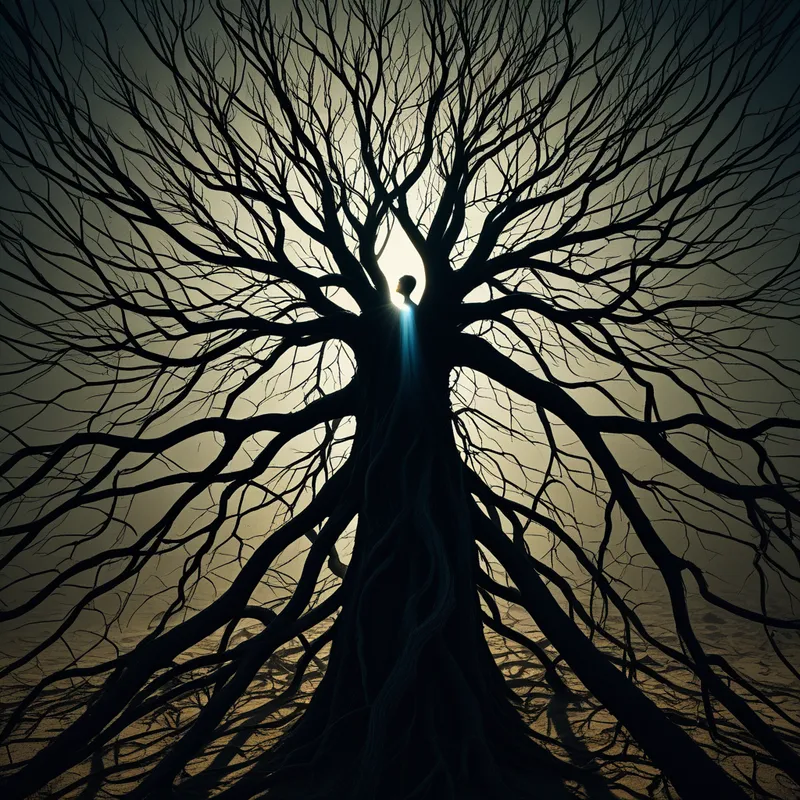
Dreaming of climbing the Tree often coincides with a conscious pursuit of knowledge, spirituality, or a higher purpose. The somatic feeling may be one of effortful ascent, exhilaration, or awe at the expanding view. Conversely, dreaming of descending the roots into dark, cavernous spaces points to a necessary, if daunting, process of shadow-work—facing repressed memories, familial patterns, or deep-seated fears (the serpent). The body may feel heavy, cold, or constricted. To dream of the Tree being damaged—struck by lightning, withering, or being cut—can reflect a crisis of meaning, a feeling of disconnection from one’s roots or highest values, a profound destabilization of the dreamer’s inner world. The Tree in a dream is a call to acknowledge the full vertical spectrum of one’s being, to cease living only in the “trunk” of mundane reality and to engage with the depths and the heights that give that reality its true context and vitality.
Alchemical Translation
The alchemical process mirrored in this myth is the opus magnum—the great work of creating the philosopher’s stone, which is a metaphor for the fully realized, integrated Self. The myth provides a precise map for this psychic transmutation.
The first stage, nigredo (blackening), is the descent into Nav. The seeker must willingly enter their own darkness, the “black earth” of the unconscious, to confront the primal serpent of instinct and the ancestral ghosts of personal and collective history. This is a dissolution of the ego’s certainties.
The ascent through the trunk of Yav represents albedo (whitening) and citrinitas (yellowing)—the purification and illumination gained by applying insights from the depths to the challenges of conscious, embodied life. It is the hard, steady work of growth and integration. Finally, reaching the crown of Prav symbolizes rubedo (reddening)—the culmination where the individual soul touches the universal, achieving a state of wisdom (Prav) and returning transformed. The volkhv’s return journey is critical; the gold of enlightenment must be brought back and made useful in the earthly realm. Thus, the alchemy is complete not in eternal escape to the heavens, but in the cyclical process of descent and return, which transmutes the base metal of fragmented experience into the gold of a soul that is rooted, resilient, and radiant—a true microcosm of the World Tree itself.
Associated Symbols
Explore related symbols from the CaleaDream lexicon:
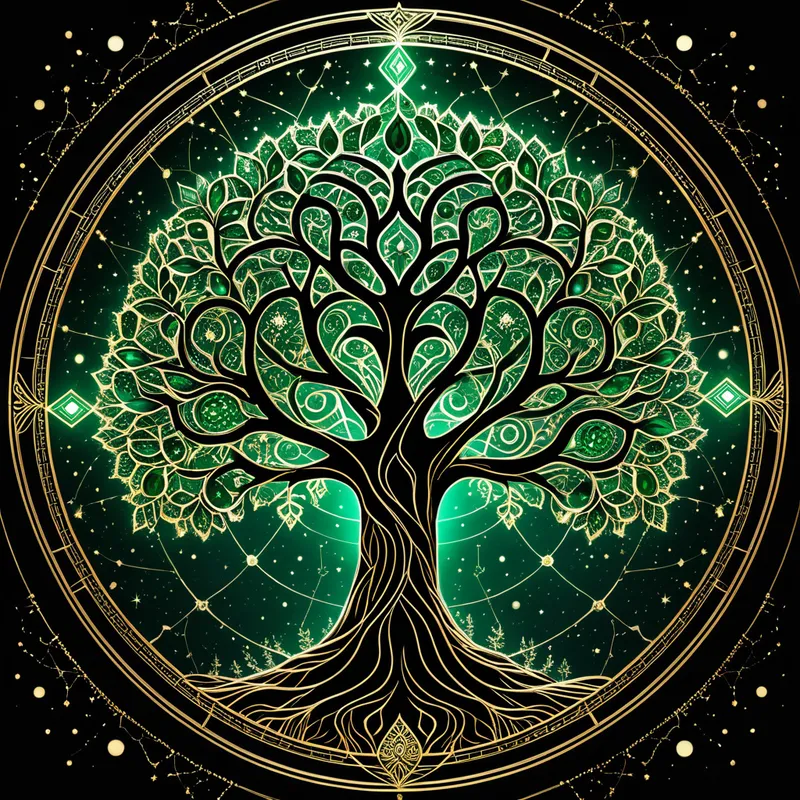
- Tree of Life — The ultimate archetypal expression of the World Tree, representing the interconnectedness of all creation, the flow of life force, and the structure of the cosmos.
- Root — Symbolizes connection to ancestry, the unconscious, and the foundational, often hidden, sources of nourishment and identity that ground the individual.
- Eagle — Represents the solar principle, lofty consciousness, divine perspective, and the soul’s aspiration to ascend to the realm of spirit and cosmic order (Prav).
- Serpent — Embodies the chthonic wisdom of the underworld, the guardian of secrets and life force, and the necessary, transformative energy of the deep unconscious (Nav).
- Journey — The central action of the myth, reflecting the soul’s obligatory passage through different states of being to achieve wholeness and wisdom.
- Ancestral Tree — Connects directly to the Tree’s roots in Nav, representing the lineage, inherited patterns, and the wisdom of the forefathers that feed the present.
- Cave — Analogous to the underworld realm of Nav reached by the roots, a place of descent, introspection, and confrontation with the contents of the deep psyche.
- Sky — The destination of the Tree’s crown, the realm of Prav, symbolizing transcendence, divine law, limitless potential, and the realm of archetypal forms.
- Bridge — Like the Tree itself, a connector between disparate realms (heaven/earth, conscious/unconscious), enabling the perilous but essential passage for the seeker.
- Order — The principle of Prav that the Tree upholds, representing cosmic harmony, natural law, and the inner structural integrity of a realized Self.
- Lightning — The fiery, disruptive power of Perun that can strike the Tree, symbolizing sudden divine insight, catalyzing transformation, or a crisis that tests the structure of one’s world.
- Stone — The enduring, foundational quality of the myth and the Tree’s symbolic role as the stable axis mundi, the unmoving center around which the chaos of life revolves.