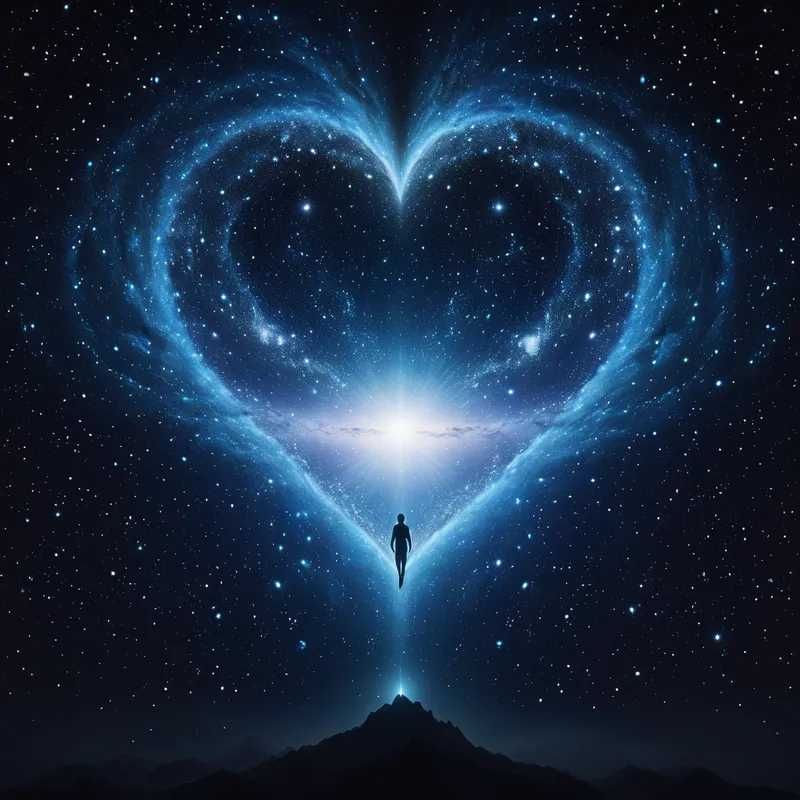
The World Soul Myth Meaning & Symbolism
The ancient story of a single, living consciousness woven through all creation, from which we are born and to which we ultimately return.
The Tale of The World Soul
Listen. Before the names of gods were spoken, before the first city was raised from clay, there was a breath. Not a wind, but the idea of wind. A sigh in the dark that was both question and answer. From this sigh, a warmth gathered—not a fire, but the longing for warmth. It pooled in [the void](/myths/the-void “Myth from Buddhist culture.”/) like honey, thick and golden with potential.
This was the first stirring of Anima Mundi.
It dreamed, and its dreaming was the seeding of stars. Its loneliness took form as the great, dark spaces between them. Its joy bubbled up as the first springs from deep stone, and its curiosity unfurled as the first green tendril seeking the light. All that is—the crushing depth of the ocean trench, the dizzying height of the mountain peak, the patient turning of the seasons—is but a facet of its single, endless meditation.
They say that in the oldest times, the wisest of humans could still hear its heartbeat in the silence between their own. A king, weary of gold and counsel, would walk into the deep forest, place his palm upon the bark of an ancient oak, and feel the steady, slow pulse of [the world](/myths/the-world “Myth from Tarot culture.”/)’s lifeblood thrumming upward. A shepherd, alone on the hills under a blanket of stars, would feel not smallness, but an expansion, as if the boundaries of his skin dissolved and he was the hill, the flock, the cold air, and the distant, watching lights.
But then came the Great Forgetting. Humanity learned to build walls, not of stone, but of [the self](/myths/the-self “Myth from Jungian culture.”/). The “I” became a fortress, and the connection became a forgotten rumor. The World Soul did not rage; it wept a single, silent tear that became the first morning’s dew. It retreated, not in anger, but in sorrow, becoming the background hum of existence, the ghost of a memory in a shared dream.
Yet, it is said, the connection was never severed, only obscured. It is the thread that pulls the hero toward their destiny, the inspiration that strikes the artist in the quiet hour, the profound recognition in the eyes of a stranger, and the unshakable feeling of belonging one finds in a wild, untouched place. The World Soul sleeps within the heart of the world, and within the heart of every living [thing](/myths/thing “Myth from Norse culture.”/), waiting to be remembered. Its story has no end, for it is the story of every beginning, and every ending is merely a return to its endless, dreaming embrace.
Cultural Origins & Context
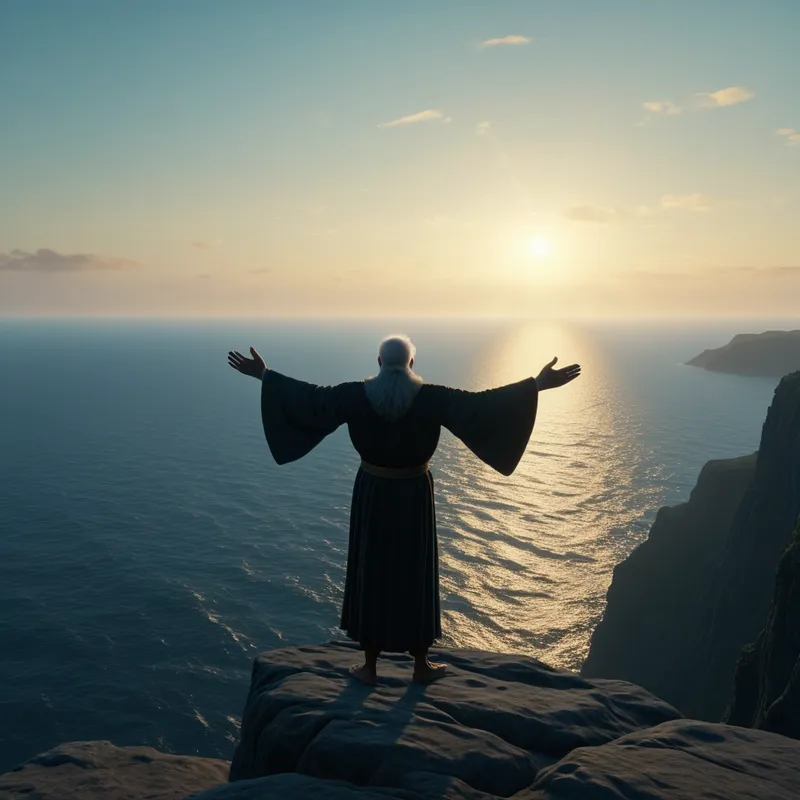
The myth of the World Soul is not the property of any single culture, but a profound intuition that has arisen independently across the globe, a testament to a shared depth in the human [psyche](/myths/psyche “Myth from Greek culture.”/). Its most famous philosophical articulation comes from Plato’s Timaeus, where he describes the Anima Mundi as a divine craftsman’s creation, a blending of the Same and the Other, stretched through the cosmos to bind it into a living, intelligent whole. This concept flowed into Hermetic, Neoplatonic, and later alchemical traditions, where the World Soul was the divine spirit ([spiritus mundi](/myths/spiritus-mundi “Myth from Alchemical culture.”/)) permeating all matter.
Yet, we find its echo far beyond the Greco-Roman world. In the Vedic concept of Brahman, the impersonal, all-encompassing reality from which all individual souls (Atman) arise and are ultimately identical. Indigenous animist traditions worldwide hold that mountains, rivers, forests, and animals are all ensouled participants in a great, interconnected web of life, a conscious community rather than a collection of objects. The myth was not merely told; it was lived—a framework for understanding humanity’s place within, not apart from, the cosmos. It was the sacred knowledge of [the shaman](/myths/the-shaman “Myth from Siberian culture.”/), the underlying principle of the healer, and the silent assumption of the farmer who knew his fate was tied to the land.
Symbolic Architecture
Psychologically, the World [Soul](/symbols/soul “Symbol: The soul represents the essence of a person, encompassing their spirit, identity, and connection to the universe.”/) represents the [archetype](/symbols/archetype “Symbol: A universal, primordial pattern or prototype in the collective unconscious that shapes human experience, behavior, and creative expression.”/) of totality, the [unus mundus](/myths/unus-mundus “Myth from Alchemical culture.”/) or one world of the alchemists. It symbolizes the fundamental, underlying unity of all psychic and [material](/symbols/material “Symbol: Material signifies the tangible aspects of life, often representing physical resources, desires, and the physical world’s influence on our existence.”/) phenomena, a state prior to the [fragmentation](/symbols/fragmentation “Symbol: The experience of breaking apart, losing cohesion, or being separated into pieces. Often represents disintegration of self, relationships, or reality.”/) of [consciousness](/symbols/consciousness “Symbol: Consciousness represents the state of awareness and perception, encompassing thoughts, feelings, and experiences.”/) into subject and object, self and other.
The World Soul is the psyche of the cosmos, and our individual psyche is but a localized inflection of its endless dreaming.
The “Great Forgetting” in the tale symbolizes the [birth](/symbols/birth “Symbol: Birth symbolizes new beginnings, transformation, and the potential for growth and development.”/) of [the ego](/myths/the-ego “Myth from Jungian culture.”/)—a necessary development for consciousness, but one that comes with the price of alienation. We construct a separate “I,” losing our felt sense of participation in the larger whole. The World Soul thus also represents the objective psyche, the [collective unconscious](/symbols/collective-unconscious “Symbol: The Collective Unconscious refers to the part of the unconscious mind shared among beings of the same species, embodying universal experiences and archetypes.”/) itself—the vast, impersonal sea from which our personal islands of consciousness emerge. Its retreat is not an [abandonment](/symbols/abandonment “Symbol: A dream symbol representing feelings of being left behind, isolated, or emotionally deserted, often tied to primal fears of separation and loss of support.”/), but the natural consequence of ego-formation; the [connection](/symbols/connection “Symbol: Connection symbolizes relationships, communication, and bonds among individuals.”/) becomes unconscious, a latent potential awaiting rediscovery through introspection, [crisis](/symbols/crisis “Symbol: A crisis symbolizes turmoil, urgent challenges, and the need for immediate resolution or change.”/), or profound experience.
The Dreamer’s Resonance
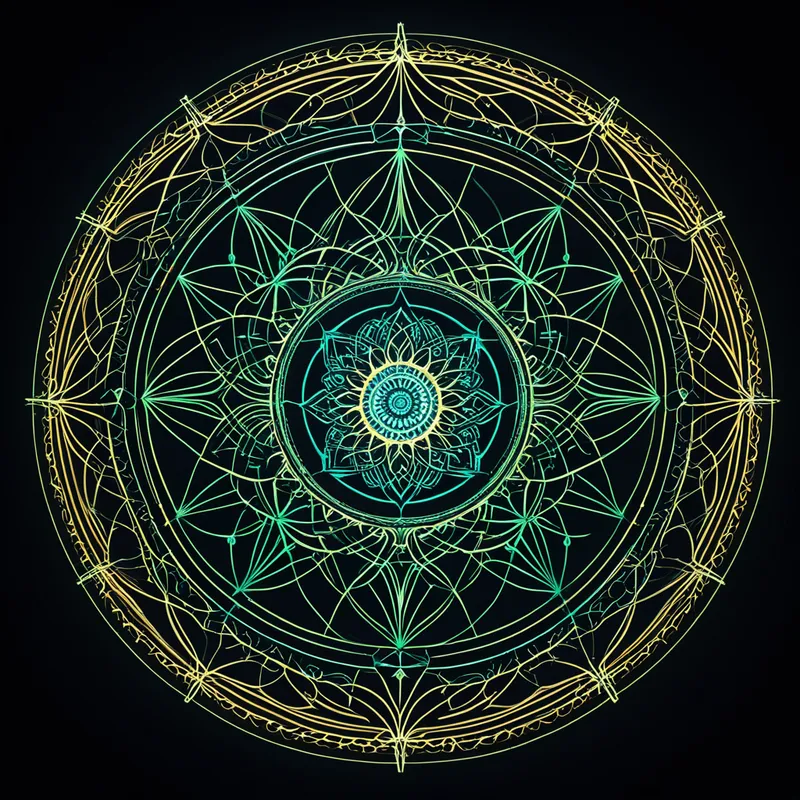
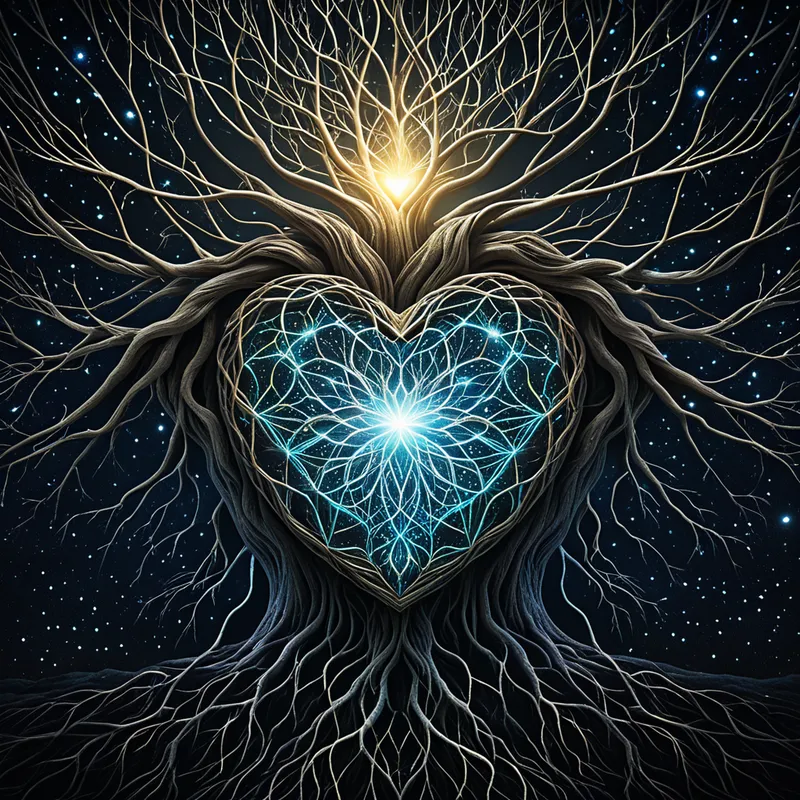
When this myth stirs in the modern dreamer, it often manifests not as a clear narrative, but as a profound somatic and symbolic experience. One may dream of vast, intricate networks—neural pathways that are also root systems, glowing cables that are also veins, connecting the dreamer to every person in a city, or to the planets themselves. There are dreams of merging: becoming the ocean, dissolving into light, or feeling one’s body turn to wind or forest.
These are dreams of de-integration of the ego-boundaries. The psyche is attempting to correct an imbalance of excessive separation, loneliness, or intellectual abstraction. The dreamer may be undergoing a process where the rational, differentiated self is being temporarily dissolved to allow a deeper, more holistic mode of being to communicate. It can be terrifying (a loss of self) or ecstatic (a gain of the world). The somatic feeling upon waking is key: a lingering sense of immense expansion, a deep peace, or a homesickness for a place one has never physically been. This is the psyche touching the waters of the Anima Mundi.
Alchemical Translation
The journey of the myth models the core of the individuation process: the move from a state of unconscious unity (participating in the World Soul without knowing it), through a necessary alienation and differentiation (the Great Forgetting/ego development), toward a conscious reunion. This is not a regression to infancy, but an alchemical achievement.
The goal is not to remain the isolated stone, nor to vanish back into the mountain, but to become the jewel that consciously reflects the entire mountain within itself.
The modern individual’s “hero’s task” is to undertake the inward journey to remember the connection. This is the work of depth psychology: to make the unconscious conscious. By engaging with dreams, active imagination, and the symbolic language of the psyche, one begins to trace the threads of the personal complex back to the archetypal pattern. Recognizing the anima or animus within is to find a piece of the World Soul personalized. Integrating the shadow is to reclaim disowned parts of this universal psyche.
The [triumph](/myths/triumph “Myth from Roman culture.”/) is the experience of synchronicity—those meaningful coincidences that feel like a wink from the universe. In these moments, the barrier between inner and outer, self and world, momentarily dissolves. One feels held within a pattern of intelligence larger than oneself. This is the lived, experiential proof of the myth. The individual soul, having fully realized its own nature, discovers it has, all along, been a unique expression of the World Soul, completing [the sacred circle](/myths/the-sacred-circle “Myth from Various culture.”/) from unity, through individuality, back to a conscious, creative participation in the whole.
Associated Symbols
Explore related symbols from the CaleaDream lexicon: