The Wisteria Maiden Myth Meaning & Symbolism
A celestial maiden descends, is bound by earthly love, and must sacrifice her freedom, leaving a legacy of transcendent beauty and sorrow.
The Tale of The Wisteria Maiden
Listen, and let the twilight settle. In a time when the mountains were the bones of [the earth](/myths/the-earth “Myth from Hindu culture.”/) and the rivers its silver veins, there lived a humble woodcutter. His name is lost to the whispering pines, but his heart was known to be as clear as a mountain spring. Each dawn, he would climb the steep, mist-wrapped paths, his axe singing a solitary song against the ancient trunks.
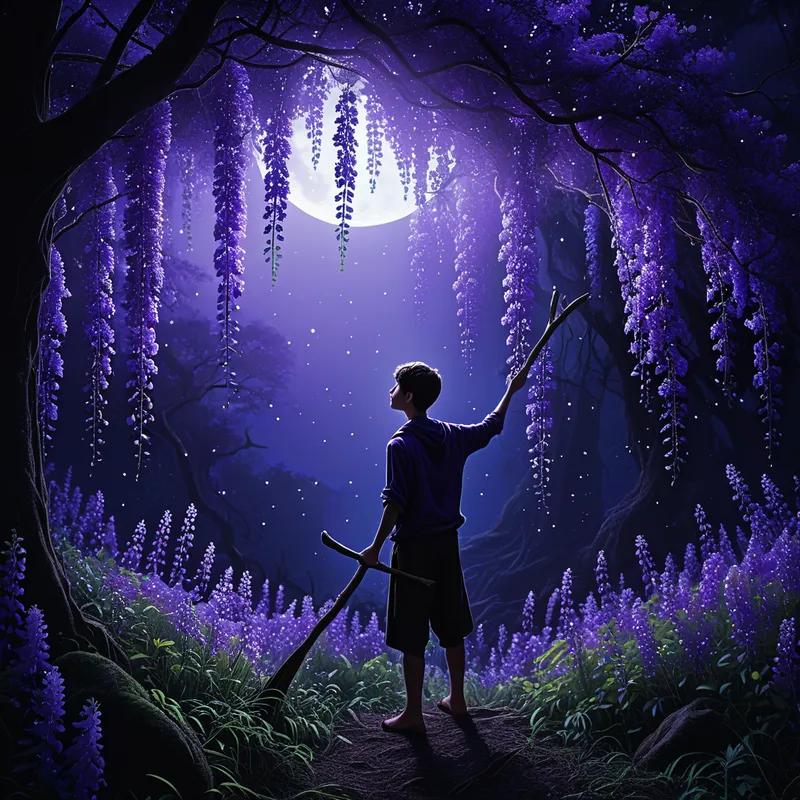
One evening, as the sun bled into indigo and the first stars pricked [the sky](/myths/the-sky “Myth from Persian culture.”/), he heard a sound unlike any other. It was not [the wind](/myths/the-wind “Myth from Various culture.”/) in [the bamboo](/myths/the-bamboo “Myth from Taoist culture.”/), nor the cry of a distant deer. It was music—a melody woven from falling [water](/myths/water “Myth from Chinese culture.”/) and chiming crystal, so sweet it made his heart ache. Drawn by its pull, he pushed through a final thicket and stumbled into a hidden clearing he had never seen before.
And there she was.
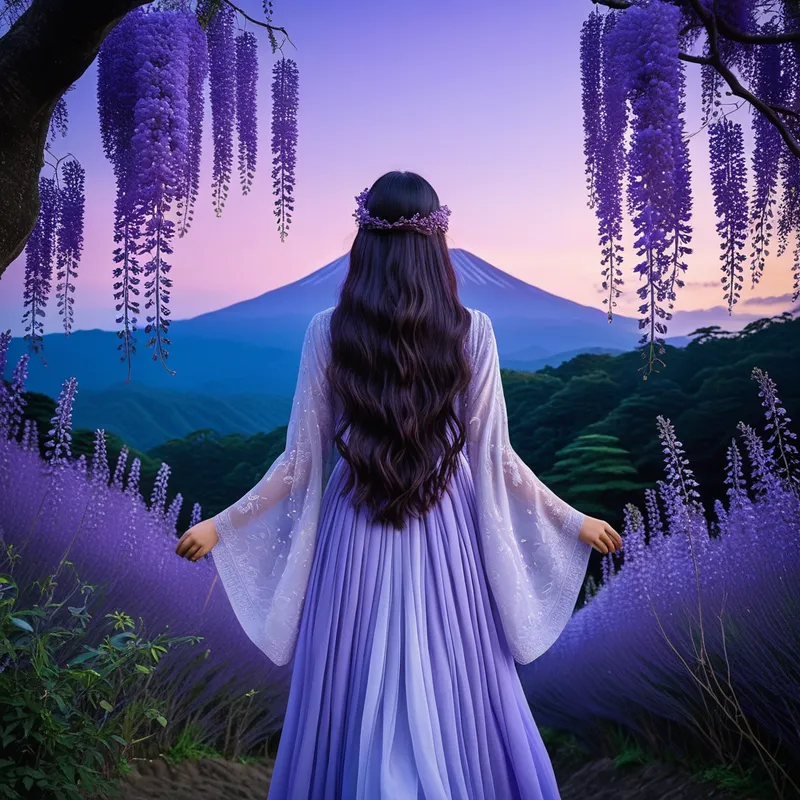
Bathed in the last light of day, a maiden danced beneath a colossal, ancient wisteria tree. Her robes were the color of the twilight sky, shimmering with the faint light of yet-unborn stars. Her hair, black as a moonless night, flowed like a river, twined with living sprays of purple wisteria blossoms that glowed with their own soft luminescence. She was the source of the music, her every movement a note, her very presence a hymn. She was a tennyo, a heavenly maiden, who had descended from the Takamagahara to bathe in the solitude of this earthly spring.
The woodcutter stood, rooted more firmly than any tree, his breath caught in his throat. In that moment, the vast loneliness of his life shattered, replaced by a longing so profound it was a physical pain. He watched, hidden, until the maiden finished her dance and, with a sigh that seemed to stir the very air, laid her feathered hagoromo, her celestial robe, upon a branch of the wisteria.
Seized by a force greater than reason, the woodcutter crept forward. His hand, calloused from years of labor, closed not around the rough bark of a tree, but around the impossibly soft, radiant fabric of the robe. As he lifted it, the music ceased.
The maiden turned. Her eyes, deep as forgotten wells, found his. There was no anger, only a profound, star-filled sadness. “You have taken my wings,” she said, her voice the sound of distant wind chimes. “Without my robe, I cannot return to my home in the heavens.”
The woodcutter, his heart pounding with a mixture of guilt and desperate hope, begged her to stay. He spoke of his lonely hut, his simple life, and the love that had bloomed in him like a sudden, impossible flower. He promised to care for her, to build a world for her here on the green earth. The Wisteria Maiden looked from his pleading face to the robe in his hands, and then to the earth at her feet—so solid, so real, so different from the drifting clouds of her home. A strange curiosity stirred within her, a feeling as foreign as gravity. With a nod that was both acceptance and a deep, unspoken farewell to the sky, she agreed.
Years passed. The woodcutter and the celestial maiden built a life. A child was born, a boy with his father’s sturdy frame and his mother’s luminous, knowing eyes. They were happy, in [the way](/myths/the-way “Myth from Taoist culture.”/) that humans measure happiness. Yet, the woodcutter would often find his wife standing in their garden, gazing at the wisteria vine he had planted for her, her face tilted towards the endless blue, utterly still. A silence would hang about her then, a silence that was not of this world.
One day, their son, now a curious child, was playing in the storage loft. Among the tools and forgotten things, he found a chest his father had always forbidden him to open. Inside, folded with desperate care, was a robe of unearthly beauty, woven from moonlight and starlight, still faintly smelling of high, cold air. Delighted, he brought it to his mother, draping it around her shoulders as a game.
The moment the fabric touched her skin, a memory older than mountains flooded back. The music returned, not as sound, but as a vibration in her very soul. Her eyes cleared of the soft haze of earthly life, regaining their celestial sharpness. She looked at her husband, who had rushed in, his face ashen with understanding. She looked at her son, who stared in wonder. Love for them was a tangible warmth in her chest, but it was now entwined with the irresistible pull of her true nature, the call of the vast, silent expanse from which she came.
The conflict was the story itself. To stay was to deny her essence; to leave was to break two hearts. With tears that fell like liquid amethyst, she knelt and embraced her son. She touched her husband’s cheek, a final blessing. Then, wrapping the hagoromo tightly around herself, she walked into the garden, beneath the blooming wisteria. As her family watched, her form began to shimmer and grow light. The wisteria blossoms glowed fiercely, and a wind from no earthly direction lifted her. She ascended, slowly at first, then faster, becoming a streak of violet light against the blue, until she was only a memory against the sun, and then, nothing at all. Behind, only the deeply purple, perpetually blooming wisteria remained, its scent a permanent sigh on the wind.
Cultural Origins & Context
The tale of the Tennyo, or Heavenly Maiden, is a pervasive archetype in Japanese folklore, with regional variations found from the snowy north of Hokkaido to the southern islands of Okinawa. The specific motif of the “Wisteria Maiden” ([Fuji Musume](/myths/fuji-musume “Myth from Japanese culture.”/)) often intertwines with these stories, as the wisteria (fuji) is a native plant whose breathtaking, cascading blooms have long been associated with the ethereal, the feminine, and transient beauty. These stories were not the property of a courtly elite but were folktales (mukashibanashi) told by village elders, traveling monks, and mothers at bedtime. They served as oral literature that explained the natural world—why a certain waterfall sounded like crying, or why a particular vine bloomed so profusely.
The myth functioned on multiple societal levels. On one hand, it was a aetiological tale explaining the beauty of the wisteria. On a deeper level, it reinforced core cultural values: the bittersweet nature of earthly attachment ([mono no aware](/myths/mono-no-aware “Myth from Japanese culture.”/)), the respectful distance humans must keep from the divine (kami), and the inevitable return of all things to their proper state. The woodcutter’s act, while born of love, is ultimately a transgression—he steals a piece of heaven for himself. The story’s resolution does not condemn him, but it does enforce a cosmic law: what belongs to the celestial realm cannot be permanently held in the terrestrial one.
Symbolic Architecture
At its [heart](/symbols/heart “Symbol: The heart symbolizes love, emotion, and the core of one’s existence, representing deep connections with others and self.”/), this is a myth of the irreducible [tension](/symbols/tension “Symbol: A state of mental or emotional strain, often manifesting physically as tightness, pressure, or unease, signaling unresolved conflict or anticipation.”/) between two fundamental states of being: the transcendent and the immanent. The Wisteria Maiden is the archetypal [symbol](/symbols/symbol “Symbol: A symbol can represent an idea, concept, or belief, serving as a powerful tool for communication and understanding.”/) of the [soul](/symbols/soul “Symbol: The soul represents the essence of a person, encompassing their spirit, identity, and connection to the universe.”/)’s pure, unbound essence—the Self in its celestial form. The woodcutter represents the earthly ego, the conscious [personality](/symbols/personality “Symbol: Personality in dreams often symbolizes the traits and characteristics of the dreamer, reflecting how they perceive themselves and how they believe they are perceived by others.”/) that seeks to capture, name, and make permanent the [fleeting moments](/symbols/fleeting-moments “Symbol: Fleeting Moments symbolize the transitory nature of experiences, highlighting the importance of cherishing each instant before it passes.”/) of numinous [beauty](/symbols/beauty “Symbol: This symbol embodies aesthetics, harmony, and the appreciation of life’s finer qualities.”/) and [connection](/symbols/connection “Symbol: Connection symbolizes relationships, communication, and bonds among individuals.”/) that grace our lives.
The hagoromo is not merely a garment; it is the symbol of wholeness. To lose it is to be cast into a state of fragmentation, where one’s essential nature is separated from one’s conscious existence.
Their [marriage](/symbols/marriage “Symbol: Marriage symbolizes commitment, partnership, and the merging of two identities, often reflecting one’s feelings about relationships and social obligations.”/) is the temporary, and always precarious, union of these two principles. It produces something new and beautiful—the [child](/symbols/child “Symbol: The child symbolizes innocence, vulnerability, and potential growth, often representing the dreamer’s inner child or unresolved issues from childhood.”/), symbolizing the creative potential that arises when [spirit](/symbols/spirit “Symbol: Spirit symbolizes the essence of life, vitality, and the spiritual journey of the individual.”/) and matter engage. Yet, the myth insists this union is not final. The call of the hagoromo, rediscovered by the innocent curiosity of the [child](/symbols/child “Symbol: The child symbolizes innocence, vulnerability, and potential growth, often representing the dreamer’s inner child or unresolved issues from childhood.”/) (the emerging, undivided Self), is irresistible. The Maiden’s [ascent](/symbols/ascent “Symbol: Symbolizes upward movement, progress, spiritual elevation, or striving toward higher goals, often representing personal growth or transcendence.”/) is not an [abandonment](/symbols/abandonment “Symbol: A dream symbol representing feelings of being left behind, isolated, or emotionally deserted, often tied to primal fears of separation and loss of support.”/), but a re-[integration](/symbols/integration “Symbol: The process of unifying disparate parts of the self or experience into a cohesive whole, often representing psychological wholeness or resolution of internal conflict.”/). She returns to her complete state, leaving behind not [emptiness](/symbols/emptiness “Symbol: Emptiness signifies a profound sense of void or lack in one’s life, often related to existential fears, loss, or spiritual quest.”/), but a transformed symbol—the wisteria. The [vine](/symbols/vine “Symbol: Represents connection, growth, entanglement, or suffocation. Often symbolizes relationships, life force, or binding emotions.”/), now rooted in [earth](/symbols/earth “Symbol: The symbol of Earth often represents grounding, stability, and the physical realm, embodying a connection to nature and the innate support it provides.”/) but blooming with unearthly beauty, becomes a permanent [mediator](/symbols/mediator “Symbol: A figure who resolves conflicts between opposing parties, representing balance, communication, and the integration of differences.”/) between the two realms, a living testament to the encounter.
The Dreamer’s Resonance
When this myth pattern stirs in the modern dreamer, it often manifests as a profound somatic and psychological crossroads. You may dream of finding a beautiful, forgotten object in an attic (the rediscovered hagoromo), of a partner or loved one preparing to leave on a journey you cannot follow, or of yourself feeling trapped in a beautiful, comfortable home while yearning for a vast, open sky.
These dreams signal a process of deep psychic reorientation. The “woodcutter” part of the [psyche](/myths/psyche “Myth from Greek culture.”/)—the part that built a stable life, career, or identity—may feel a terrifying, beautiful pull to release something it has long held. This is often not a literal relationship, but an outgrown self-concept, a defining role, or a long-cherished ambition that was, in truth, a “captured” piece of one’s spirit. The somatic experience can be one of simultaneous expansion and loss: a tightness in the chest (grief) alongside a feeling of lightness or opening in [the crown](/myths/the-crown “Myth from Various culture.”/) of the head (liberation). The dream is the soul’s way of rehearsing the ultimate sacrifice: the sacrifice of a familiar, smaller identity for the terrifying freedom of a larger, more authentic one.

Alchemical Translation
The alchemical process mirrored here is that of [separatio](/myths/separatio “Myth from Alchemical culture.”/) followed by a higher coniunctio. The initial, earthly marriage is a coniunctio of opposites (heaven/earth, spirit/matter), but it is flawed because it is based on possession and lack. The woodcutter possesses the robe; the Maiden lacks her freedom. The true alchemical marriage occurs only after the separatio—the painful, necessary splitting apart.
Individuation is not about acquiring wholeness, but about surrendering the ego’s claim to own it, allowing the Self to reclaim its celestial garment.
For the modern individual, the myth maps the journey of individuation. We all, in our youth or early adulthood, “capture” a piece of our potential—we become the “artist,” the “caregiver,” the “successful professional.” This identity becomes our robe, our defining feature. The [middle passage](/myths/middle-passage “Myth from African Diaspora culture.”/) of life, however, often brings the “child” of our own unconscious curiosity into the loft. We rediscover forgotten passions, latent talents, or a deep yearning for meaning that our current “robe” cannot contain. The crisis that follows is the Wisteria Maiden’s moment of choice.
The alchemical [triumph](/myths/triumph “Myth from Roman culture.”/) is to have the courage to don the rediscovered hagoromo—to reclaim one’s essential, perhaps long-suppressed, nature—and to ascend, even if it means leaving a beloved, familiar landscape of [the self](/myths/the-self “Myth from Jungian culture.”/). This is not a rejection of the life lived, but its transcendence. The “wisteria” left behind is the legacy of that life: the relationships deepened, the beauty created, the wisdom earned, now transformed from personal possessions into gifts for [the world](/myths/the-world “Myth from Tarot culture.”/). The individual no longer is the woodcutter or the captive maiden, but has become the living vine itself—rooted in human experience, yet perpetually in bloom with something that whispers of a far more ancient and boundless home.
Associated Symbols
Explore related symbols from the CaleaDream lexicon: