The Winged Horse Buraq Arabian
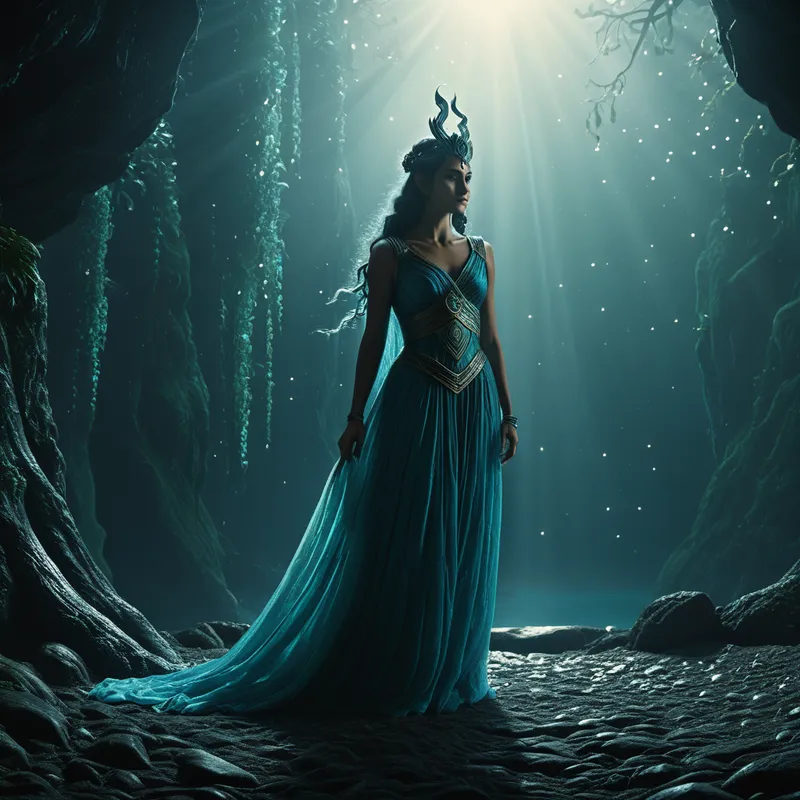
A magnificent winged horse from Arabian tradition, Buraq carried prophets on celestial journeys, bridging the earthly and divine realms with its ethereal grace.
The Tale of The Winged Horse Buraq Arabian
The night was not like other nights. In the sacred precinct of the [Kaaba](/myths/kaaba “Myth from Abrahamic culture.”/), the Prophet Muhammad, peace be upon him, rested. Then came the visitation, not with sound, but with a presence that stilled the very air. It was the Archangel Jibril ([Gabriel](/myths/gabriel “Myth from Biblical culture.”/)), and with him, a creature of such splendor that the mind struggled to hold its form. This was Buraq.
He was described as a radiant white being, smaller than a mule yet larger than a donkey, with a face of gentle nobility. But from his flanks sprang two mighty wings, feathers tipped with iridescent light. His hooves, of a lustrous [pearl](/myths/pearl “Myth from Chinese culture.”/), touched [the earth](/myths/the-earth “Myth from Hindu culture.”/) but lightly, as if always poised for ascent. With a single stride, his gaze could reach the farthest horizon; his step covered a distance beyond human sight. Jibril presented this celestial steed to the Prophet, and in that moment, the terrestrial world began to recede.
Mounted upon Buraq, the Prophet embarked on the Isra. The earth blurred beneath them, not as a landscape passing, but as a tapestry folding. Mountains became ripples, deserts became sheets of silk. They arrived in an instant at the Al-Aqsa Mosque in [Jerusalem](/myths/jerusalem “Myth from Biblical culture.”/). There, in that hallowed ground, the Prophet led a congregation of all previous prophets in prayer—a unity of divine messages across time.
But the journey had only begun. From the Noble Rock in Jerusalem, Buraq ascended. This was the Mi’raj. Together, rider and steed pierced [the veil](/myths/the-veil “Myth from Various culture.”/) of [the sky](/myths/the-sky “Myth from Persian culture.”/). They ascended through seven heavens, each a realm of increasing luminescence and profound revelation. At each gate, they were met by prophets of old—Adam, Yusuf ([Joseph](/myths/joseph “Myth from Biblical culture.”/)), Musa ([Moses](/myths/moses “Myth from Biblical culture.”/)), Isa ([Jesus](/myths/jesus “Myth from Christian culture.”/))—each in their celestial station. Buraq carried his rider through gardens of paradise and witnessed sights of the unseen, finally approaching the ultimate Divine Presence, where the command for the five daily prayers was bestowed.
Throughout, Buraq was more than a mount; he was the perfect vessel for this liminal voyage. He was the bridge that did not break, the wing that did not tire, the humble servant whose very form was a testament to the possibility of journeying from the dust of Mecca to [the Lote Tree of the Utmost Boundary](/myths/the-lote-tree-of-the-utmost-boundary “Myth from Islamic culture.”/). He carried the human towards the Divine and returned him, transformed, to the human world, his task complete but his legend eternal.
Cultural Origins & Context
The figure of Buraq is woven into the foundational narrative of Islam, primarily through the Hadith literature which details the events of the Isra and Mi’raj. His description, while consistent in its core elements—a white, winged equine—bears the imprint of older symbolic traditions that flowed through the Arabian Peninsula. Scholars of comparative mythology often note resonances with ancient Near Eastern and Zoroastrian imagery of divine or heroic steeds that traverse cosmic realms, such as the [Pegasus](/myths/pegasus “Myth from Global/Universal culture.”/) of Greek myth or the [Simurgh](/myths/simurgh “Myth from Persian culture.”/)-like creatures of Persian epic.
However, Buraq is distinctly Islamic in his theological integration. He is not a god, nor a independent mythical beast, but a miraculous creation (one of the mukharraqat, the “burning ones” or “illuminated ones”) made by God for a specific, supreme purpose. His existence serves the prophecy and confirmation of Muhammad’s status. The journey itself is a profound affirmation of the spiritual connection between Mecca, Jerusalem, and the celestial realms, establishing a vertical axis of faith that complements the horizontal axis of the Hajj pilgrimage. Buraq, therefore, emerges at the confluence of deep archetypal memory and a revolutionary monotheistic revelation, becoming the embodied link between the Abrahamic prophetic lineage and its final, universal manifestation.
Symbolic Architecture
Buraq is a living [symbol](/symbols/symbol “Symbol: A symbol can represent an idea, concept, or belief, serving as a powerful tool for communication and understanding.”/) of the liminal—[the threshold](/myths/the-threshold “Myth from Folklore culture.”/) state where opposites meet and transformation occurs. His very anatomy is a [dialogue](/symbols/dialogue “Symbol: Conversation or exchange between characters, representing communication, relationships, and narrative flow in games and leisure activities.”/) of dualities: equine (earthly, powerful, journeying) and avian (celestial, spiritual, transcendent). He is of the [earth](/symbols/earth “Symbol: The symbol of Earth often represents grounding, stability, and the physical realm, embodying a connection to nature and the innate support it provides.”/) but not bound by it; he touches the ground with his hooves yet his wings are perpetually open to the sky.
He represents the activated soul itself, that aspect of human consciousness which, when properly oriented and guided by divine command (Jibril), can traverse the vast inner distances between mundane awareness and revelatory truth.
His immense stride speaks to the [quantum](/symbols/quantum “Symbol: Represents fundamental uncertainty, interconnectedness, and the collapse of possibilities into reality. It signifies the observer’s role in shaping existence.”/) leaps of [consciousness](/symbols/consciousness “Symbol: Consciousness represents the state of awareness and perception, encompassing thoughts, feelings, and experiences.”/) required in spiritual awakening. The [journey](/symbols/journey “Symbol: A journey in dreams typically signifies adventure, growth, or a significant life transition.”/) is not gradual but instantaneous between stations; understanding comes in flashes of [insight](/symbols/insight “Symbol: A sudden, deep understanding of a complex situation or truth, often arriving unexpectedly and illuminating hidden connections.”/), not merely [linear](/symbols/linear “Symbol: Represents order, predictability, and a direct, step-by-step progression. It symbolizes a clear path from cause to effect.”/) accumulation. The white color signifies purity, primordial light, and the receptive state necessary for such a voyage—a [soul](/symbols/soul “Symbol: The soul represents the essence of a person, encompassing their spirit, identity, and connection to the universe.”/) unburdened by the darker attachments that would weigh down the [ascent](/symbols/ascent “Symbol: Symbolizes upward movement, progress, spiritual elevation, or striving toward higher goals, often representing personal growth or transcendence.”/). Buraq’s obedience and gentle [nature](/symbols/nature “Symbol: Nature symbolizes growth, connectivity, and the primal forces of existence.”/), despite his unimaginable power, underscore that this transcendent journey is one of submission (islam) and trust, not of egoic conquest.
The Dreamer’s Resonance
To encounter Buraq in [the imaginal realm](/myths/the-imaginal-realm “Myth from Various culture.”/)—whether in dream, vision, or deep meditation—is to receive a summons to a profound inner journey. Psychologically, he appears when the [psyche](/myths/psyche “Myth from Greek culture.”/) is poised for a major transition, a “night journey” from an old state of being to a new, more integrated one. He is the symbol of a calling that feels both terrifying and majestic, requiring the dreamer to mount and trust a power greater than their own ego.
The ride on Buraq often correlates with experiences of sudden, non-linear psychological growth—breakthroughs that feel miraculous, insights that arrive from “beyond,” and a compelling urge to bridge disparate parts of [the self](/myths/the-self “Myth from Jungian culture.”/) (the earthly personality and the higher Self or transpersonal realm). The ascent through heavens mirrors the process of confronting and integrating different levels of the psyche, meeting internalized “prophets” or archetypal figures (wise guides, inner authorities, healing presences) at each stage. The ultimate return to earth is crucial; it signifies that such transcendent experiences are meant to inform and transform one’s life in [the world](/myths/the-world “Myth from Tarot culture.”/), not to facilitate a permanent escape from it.
Alchemical Translation
In the alchemy of the soul, Buraq is the volatile spirit made tangible—the [Mercurius](/myths/mercurius “Myth from Alchemical culture.”/) in its role as [the psychopomp](/myths/the-psychopomp “Myth from Various culture.”/) and the fiery, agile vehicle for the opus. The journey from Mecca (the black, [nigredo](/myths/nigredo “Myth from Alchemical culture.”/) stage of primal matter and confusion) to Jerusalem (the white, [albedo](/myths/albedo “Myth from Alchemical culture.”/) stage of purification and prayerful unity) and through the heavens (the multi-colored [cauda pavonis](/myths/cauda-pavonis “Myth from Alchemical culture.”/) and culminating [rubedo](/myths/rubedo “Myth from Alchemical culture.”/)) is a perfect allegory for the alchemical process.
The winged horse is the conjunction of the fixed and the volatile, the body and the spirit. His flight is the sublimation—the lifting of the heavy, leaden consciousness into the golden light of understanding, only to return it, redeemed, to its earthly vessel.
The celestial revelations received during the Mi’raj are akin to the illuminatio, the divine illumination that grants [the philosopher’s stone](/myths/the-philosophers-stone “Myth from Alchemical culture.”/) of true self-knowledge. Buraq’s service reminds us that this supreme work is not done by the solitary ego. It requires a surrendered partnership with the transcendent function, the guiding, angelic principle (Jibril) within, which provides the means (Buraq) for the journey. The entire myth is an alchemical recipe for the transformation of the human into a fully realized vessel of divine will.
Associated Symbols
Explore related symbols from the CaleaDream lexicon:
- Journey — The fundamental movement from one state of being to another, encompassing both physical travel and profound inner transformation.
- Bridge — A structure that connects separated realms, enabling passage across a chasm, whether physical, spiritual, or psychological.
- Sky — The realm of the transcendent, the celestial, and the infinite; the destination of ascension and the source of divine messages.
- Vision — A revelatory seeing that pierces ordinary reality, granting access to prophetic insight or higher truths.
- Winged Angel — A messenger or guide from a divine realm, embodying the intersection of spirit and motion, often facilitating transitions between worlds.
- Prophet — One who serves as a conduit for divine communication, bridging the human and the ultimate, often through ordeals of journey and revelation.
- Light — The primordial substance of revelation and purity, illuminating the path of the journey and defining the essence of the celestial realms.
- Door — A threshold or portal between dimensions, states of consciousness, or stages of life, marking the point of decisive transition.
- Mirror — A surface for reflection, revealing not just the outer form but the inner truth, and sometimes acting as a portal to other realms of being.
- Hero — The one who answers the call to a transformative journey, faces the unknown, and returns with a boon or wisdom for their community.
- Ascension — The act of rising from a lower to a higher state, often spiritual or conscious in nature, implying purification and elevation.
- Veiled Prophecy — A truth or glimpse of destiny that is partially concealed, requiring a journey or inner awakening to be fully understood and integrated.