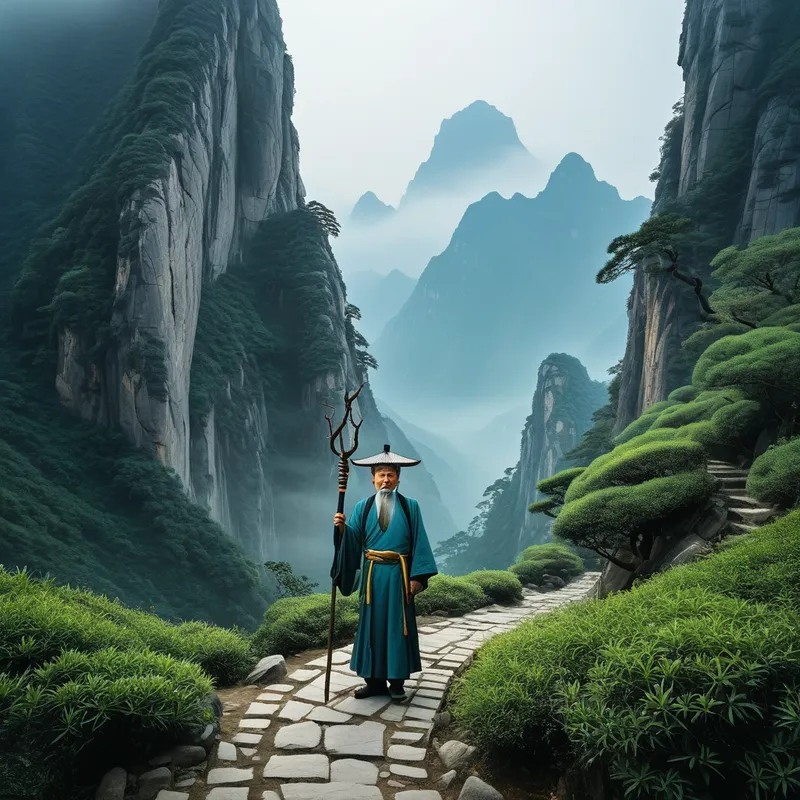
The Winding Path Myth Meaning & Symbolism
A myth of a sage who learns that the true way is not a straight line, but a meandering path of yielding to the inherent nature of the world.
The Tale of The Winding Path
In the age when mountains were young and rivers still remembered their names, there lived a seeker named Lao. His heart burned with a singular desire: to find the Ultimate Way, the straight and true road to perfect understanding. He had studied the scrolls of the Celestial Bureaucracy, mastered the rituals of alignment, and could chart the straightest course from any point to any other. Yet, a profound emptiness echoed within his polished knowledge.
One twilight, as he meditated in his austere chamber, a whisper came on the wind, not in words, but as a feeling—the scent of distant rain on stone, the sound of water finding a crack. It spoke of a hermit, a true master, who dwelt beyond the Ninefold Peaks, in the heart of the Uncarved Block. This master, it was said, knew the secret path that led to the source of all things.
At first light, Lao set out. He consulted his charts and compass. The most efficient route was clear: a direct line over the Lesser Ridge, a ford at the Narrow River, and a climb up the Steep Face. He marched with purpose, his staff striking the earth in a steady, relentless rhythm. But the world resisted his straight line. The Lesser Ridge was a sheer cliff of crumbling shale. The ford at the Narrow River was choked with a fallen, ancient Bodhi tree. The Steep Face was shrouded in a perpetual, slick mist. Each direct approach became a battle. He exhausted himself moving stones, his robes tore on thorns he tried to cut through, and the mist left him shivering and lost.
Broken, thirsty, and filled with the bitter ash of frustration, Lao collapsed at the edge of a wild, forgotten grove. As he lay there, defeated, his eye caught a movement. It was a stream, no wider than his hand, trickling down from the heights. It did not fight the rock. It did not carve a straight line. It wandered. It flowed over a root, pooled gently, slipped sideways under a fern, disappeared into gravel only to emerge laughing on the other side, and spiraled slowly around a mossy stone. It moved with a lazy, intelligent grace, following the path of least resistance, yet inevitably, inexorably, downward.
A humility, soft as the moss, touched Lao’s heart. He rose, not to conquer, but to follow. He abandoned his straight line and began to walk where the land invited him. He followed the deer trail that switchbacked gently up the ridge. He drank from the stream’s quiet pools. When the path forked, he did not consult his compass; he paused, listened to the sigh of the pines, and took the way that felt most easy, not most direct. The winding path led him through hidden valleys blooming with silent flowers, past caves that hummed with deep earth songs, and under waterfalls that washed the dust of striving from his soul.
He did not climb the mountain; the path lifted him. He did not find the hermit’s dwelling; he arrived at it, as naturally as a leaf settling on a pond. Before a simple cave hung with vines stood the master, an old man whose eyes held the patience of eroded stone and the spark of flowing water. He said nothing. He simply looked at Lao’s peaceful face, his robes now soft with forest dew, and smiled. Lao understood. He had been on the Ultimate Way all along. It was not a line to be drawn, but a current to be joined. The winding path was not a detour; it was the destination.

Cultural Origins & Context
The narrative of The Winding Path is not a single, codified myth from a canonical text like the <abbr title="The fundamental text of Taoism, attributed to Laozi">Tao Te Ching</abbr>, but rather a pervasive archetypal story that permeates Taoist philosophy and Chinese folk wisdom. It is a “teaching tale,” likely passed down orally by masters to disciples, and later recorded in various <abbr title="A collection of anecdotes, parables, and philosophical writings from the Warring States period">Zhuangzi</abbr>-style anecdotes. Its societal function was antidotal. In a culture increasingly shaped by Confucian ideals of order, rectitude, and purposeful action (wei), this myth served as a vital reminder of the counter-principle of `wu wei*. It was told not to build institutions, but to dissolve rigid thinking; not to guide public conduct, but to cultivate private, natural alignment. It validated the experience of the farmer following the lay of the land, the artist following the grain of the wood, and the individual feeling their way through life’s complexities without a forced plan.
Symbolic Architecture
The myth’s power lies in its stark, embodied symbolism. The seeker, Lao, represents the conscious ego—the part of us that believes in willpower, linear planning, and forceful attainment. His straight line is the archetype of the <abbr title="The masculine, active, penetrating principle in Taoist cosmology">Yang</abbr> impulse: direct, bright, and hard.
The straight path is the ego’s fantasy of control; the winding path is the soul’s reality of conversation.
The wilderness that resists him is not a malicious obstacle, but the complex, living reality of the <abbr title="The feminine, receptive, yielding principle in Taoist cosmology">Yin</abbr> world—the unconscious, the body, the unpredictable patterns of life and relationship. The critical turning point is not an action, but a surrender: the observation of the stream. The stream symbolizes the <abbr title="The ultimate, ineffable source and principle of the universe">Tao</abbr> itself—the way of nature that flows without effort, adapting perfectly to every contour, wearing down the hardest rock through gentle persistence. By following the winding path, Lao does not abandon his journey; he shifts his identity from the walker of the path to a part of the path’s flow. The hermit at the end is not a giver of external wisdom, but a mirror reflecting back the transformation Lao has already undergone. The hermit is the integrated Self, the state of being where one’s conscious direction is in harmony with the unconscious current.

The Dreamer’s Resonance
When this myth activates in the modern dreamer, it often manifests as a profound somatic and psychological crossroads. You may dream of being hopelessly lost in a labyrinthine building of your own design—a endless university library, a shifting office complex—desperately seeking an exit that doesn’t exist. This is the psyche’s depiction of rigid, linear thinking leading to existential gridlock. The body may feel heavy, frantic, or suffocated.
Alternatively, the dream may present the turning point: a wall in your planned route melts into a garden gate; a locked door you’ve been pounding on is gently opened from the other side by an unseen force; or you find yourself effortlessly floating down a slow, meandering river. These images signal the unconscious initiating the process of surrender. The psychological process is the ego’s capitulation to a broader intelligence. It is the moment we stop pushing our life and start listening to it. The anxiety of the straight line gives way to the curious engagement of the winding way. The dream is an invitation to trade the map for the compass of the body’s intuition and the heart’s quiet knowing.

Alchemical Translation
The myth of The Winding Path is a masterful blueprint for psychic alchemy—the transmutation of leaden, ego-driven striving into the gold of authentic being. The core struggle is the heroic ego’s battle with the <abbr title="In Jungian psychology, the unconscious opposite of the presented personality">Shadow</abbr>, represented by the stubborn, uncooperative landscape. The ego sees the Shadow as an obstacle to be defeated. The alchemical revelation is that the Shadow is not the enemy, but the very substance of the path.
Individuation is not the straight-line conquest of the self, but the winding, dialogical discovery of the Self.
The triumph is not reaching a predetermined goal, but undergoing a fundamental reorientation of consciousness. The lead of “I must make it happen” is transmuted into the gold of “I will allow it to unfold.” This is the essence of <abbr title="The Jungian process of integrating the conscious and unconscious to become a whole, individual self">Individuation</abbr>. It is not about becoming a perfectly planned, linear individual, but about becoming a uniquely coherent expression of life’s non-linear flow. The modern individual, besieged by optimization culture and five-year plans, is invited to practice this alchemy daily. It is the decision to take the conversationally interesting detour, to honor the body’s need for rest over productivity, to follow the thread of a creative whim without a guaranteed outcome. In doing so, we cease being soldiers on a forced march and become water finding its way to the sea—winding, patient, and ultimately, unstoppable.
Associated Symbols
Explore related symbols from the CaleaDream lexicon: