
The Will-o'-the-Wisp Myth Meaning & Symbolism
A spectral light that dances over marshes, leading the curious and the desperate into the deep mire, a trickster spirit of the liminal wilds.
The Tale of The Will-o’-the-Wisp
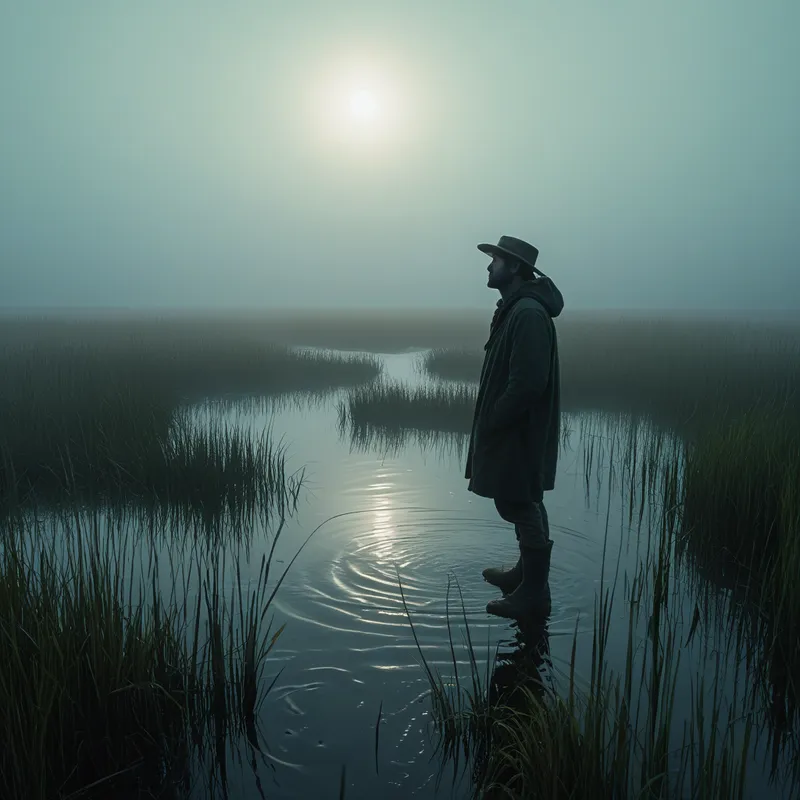
Listen, and I will tell you of the lights that are not stars, of the guides that lead you astray. In the places where the land grows soft and sighs—the fens, the marshes, the peat bogs where the water is black as a raven’s eye and the ground remembers every footstep with a hungry swallow—there, when the day bleeds into night and the mist rises like a ghost from the cold earth, they appear.
First, it is a single pinprick of light, a cool, blue-green flicker like foxfire on rotten wood. It dances. It does not hold still. It beckons. To a traveler, weary from a long road, its gentle glow promises a cottage window, a lantern held by a friend, a safe path through the treacherous ground. The heart lifts. The feet turn from the known, hard track.
The light retreats, just a little, bobbing like a cork on a dark sea. You follow. It leads you away from the whispering reeds and the firm tussocks, out onto the gleaming, deceptive flats. Your boot sinks with a wet gasp. The light dances on, merry, indifferent. Another step, and the cold water kisses your knee. You call out—“Hello? Who’s there?”—but only the croak of a distant frog answers. The light seems to laugh in its silent, shimmering way.
Deeper you go, drawn by the promise now twisted into a compulsion. The air grows colder. The mist thickens, until the world is only you, the sucking mud, and that unwavering, elusive spark. It is beautiful. It is the most beautiful and terrible thing you have ever seen. Your mind fills with stories: perhaps it is a fairy lantern, and a kingdom of splendour awaits. Perhaps it is a lost soul, and you are its salvation. The stories are its bait.
Then, the moment of knowing. The water is at your chest. The firm world is a memory behind you in the dark. The light hovers, just an arm’s length away, over a pool of liquid blackness that has no bottom. It does not warm you. It does not save you. It simply is—a perfect, captivating, and utterly hollow thing. As you realize you cannot move forward and cannot find your way back, the light winks out. Not with a pop, but a fade, as if it was never there at all. In the sudden, absolute dark, you hear only the slow drip of water from your own sleeves, and the vast, patient silence of the marsh, which has claimed another fool.
Cultural Origins & Context
The Will-o’-the-Wisp is a myth without a single birthplace, a story whispered by peat-cutters in England, shepherds in Wales, farmers in the Low Countries, and villagers across Scandinavia and Eastern Europe. Its names are a litany of the lost: Jack-o’-Lantern, Hinkypunk, Irrlicht, Feu Follet, Lyktgubbe. This is not the myth of a temple or a court, but of the liminal spaces between settlements. It was told at hearthsides to warn children from the marshes, and shared between travelers as a chilling piece of practical advice.
Its primary function was ecological and social navigation. These stories served as vital, non-cartographic maps, marking certain areas as spiritually and physically dangerous. The tale was often attributed to specific, local phenomena—the ignition of marsh gases like methane, or the bioluminescence of fungi—but its power lay in the personification. By making the hazard a conscious trickster, the story embedded the danger more deeply in the community’s mind than a simple “here be bogs” ever could. It was a narrative fence around a deadly place.
Symbolic Architecture
Psychologically, the Will-o’-the-Wisp is the quintessential symbol of the seductive shadow. It represents not a monster, but a mesmerizing illusion. Its light is not evil, but it is profoundly indifferent to human fate. It symbolizes any all-consuming desire that promises fulfillment but leads only into a mire: obsession, addiction, infatuation, the lure of quick wealth, or the siren call of an idealized future that blinds us to the solid ground of the present.
The light you follow is not the light you need. It is the mirror of your own longing, given form and set adrift to lead you into yourself.
The myth masterfully illustrates the danger of the positive aspect of the shadow. It is not a snarling beast, but a beautiful, promising light. The traveler is not attacked; he is invited to his own demise. The conflict is not between hero and villain, but between the conscious mind and its own capacity for self-deception. The bog is the unconscious itself—fertile, deep, preserving, but fatal to the ego that stumbles into it unprepared and unguided.
The Dreamer’s Resonance
To dream of a Will-o’-the-Wisp is to dream of a crossroads in the psyche. The dreamer often finds themselves in a familiar yet altered landscape—a city street that dissolves into a swamp, or a office that opens onto a misty moor. The light appears, and the dreamer feels a powerful somatic pull: a tightening in the chest, a quickening of the pulse, a compulsion to follow.
This dream signals a process of fascination with a psychological complex. The light is the glittering, attractive “hook” of that complex—the initial promise of relief, excitement, or answers it offers. The following is the ego being drawn into the complex’s orbit. The eventual sinking or betrayal in the dream is the somatic recognition of the complex’s true, entrapping nature. The dream is a warning from the deep self: “You are being led by a fascinating illusion. Stop and re-orient. The ground beneath you is not what it seems.” It is an invitation to ask, in waking life: “What beautiful light am I chasing that is actually leading me into a quagmire?”

Alchemical Translation
The alchemical journey mirrored in this myth is not one of conquering a dragon, but of discerning true gold from fool’s gold. The initial stage is nigredo, the blackening: the traveler is lost in the dark, a state of confusion and despair. The appearance of the light is a false albedo, a pseudo-whitening that promises clarity and salvation but is actually a trick of the prima materia itself.
The true work begins at the moment the light vanishes, leaving the ego in the black bog. This is the crucial, transformative despair. To be saved is not to be pulled out by an external hand, but to stop struggling against the mire, to feel its cold embrace fully, and from that stillness, to begin the slow, internal work of finding one’s own footing. The marsh is the vas of transformation.
Individuation is not following a light, but learning to see in the dark. The bog that swallows you is the very substance from which you must rebuild your ground.
The triumph is not escape, but reclamation. The traveler who integrates this experience does not become someone who fears all lights, but one who has learned to distinguish between the lantern of consciousness—held steady, casting light on solid ground—and the phantom lantern of the complex, which dances only to lead you deeper into the unknown parts of yourself. The Will-o’-the-Wisp, integrated, becomes a humbling part of the self’s geography—a reminder that the most captivating paths are often the ones that lead not out, but in, and down, into the fertile, dangerous, and ultimately transformative dark.
Associated Symbols
Explore related symbols from the CaleaDream lexicon: