The Widow's Oil Myth Meaning & Symbolism
A prophet's command reveals a hidden abundance within a widow's last possession, turning her despair into a river of oil that redeems her family.
The Tale of The Widow’s Oil
The sun was a hammer on the rooftops of Zarephath, beating the hope from the land. In a house where the dust lay thick on the floor and the air tasted of want, a woman moved like a ghost. She was a widow, her name lost to [the wind](/myths/the-wind “Myth from Various culture.”/), her life pared down to the bone of a single, terrible truth: the jar of meal was nearly empty, the cruse of oil held but a final, shining drop. With her son’s large eyes watching, hollow with a hunger too old for his years, she gathered two sticks for a fire. It would be the last. A final meal of bread, and then the slow, silent surrender to the debt that pressed at her door, a creditor coming to claim her son into servitude. [The world](/myths/the-world “Myth from Tarot culture.”/) had shrunk to the size of a handful of flour.
A shadow fell across her threshold. It was the man of Elohim, Elisha, his cloak smelling of desert and almond wood. “Fetch me, I pray thee, a little [water](/myths/water “Myth from Chinese culture.”/) in a vessel, that I may drink,” he said. And as she turned to obey, he called after her, “Bring me, I pray thee, a morsel of bread in thine hand.”
Her heart, a dry well, cracked. “As YHWH thy Elohim liveth,” she whispered, the oath bitter on her tongue, “I have not a cake, but a handful of meal in a barrel, and a little oil in a cruse: and, behold, I am gathering two sticks, that I may go in and dress it for me and my son, that we may eat it, and die.”
But the prophet’s eyes held not pity, but a fierce, unshakable certainty. “Fear not,” he commanded, his voice cutting through her despair like a clean knife. “Go and do as thou hast said: but make me thereof a little cake first, and bring it unto me, and after make for thee and for thy son.” He spoke a promise that defied the empty jar, the silent oil cruse. “For thus saith YHWH Elohim of Israel, The barrel of meal shall not waste, neither shall the cruse of oil fail, until the day that YHWH sendeth rain upon [the earth](/myths/the-earth “Myth from Hindu culture.”/).”
The widow stood at the precipice of her world. To obey was to give away the very substance of her last breath, her final act of care for her child, to a stranger on a word. The sticks felt heavy in her hand. She looked from the prophet’s steady gaze to her son’s fearful face. Then, with a resolve that felt like falling, she turned. She did not hoard her ending. She baked the small cake from the last of the meal, anointed with the last of the oil, and gave it to the man of Elohim.
The fire crackled. They ate. And then, a miracle of quietness. The next morning, the jar was not empty. A gentle mound of meal lay within. The cruse yielded a slow, golden trickle of oil. Day followed parched day. The widow would reach into the barrel, and her fingers would find flour. She would tilt the cruse, and oil would gleam upon the lip. It did not overflow in spectacle; it simply did not fail. It was a daily, mundane defiance of arithmetic.
But the debt remained. The creditor’s shadow still loomed. The prophet returned. “Go,” he said to her, “borrow thee vessels abroad of all thy neighbours, even empty vessels; borrow not a few. And when thou art come in, thou shalt shut the door upon thee and upon thy sons, and shalt pour out into all those vessels.”
Now came the greater test of nerve. To go into the street, to ask for not food, but emptiness—dozens of jars, pots, bowls—to invite the curiosity and perhaps the ridicule of the town, all on this same impossible word. She did it. Her sons carried in the borrowed void, a chorus of hollow clay. She shut the door, sealing herself and her children in a private sanctuary with the one small jar of oil. Her hands trembled as she lifted it.
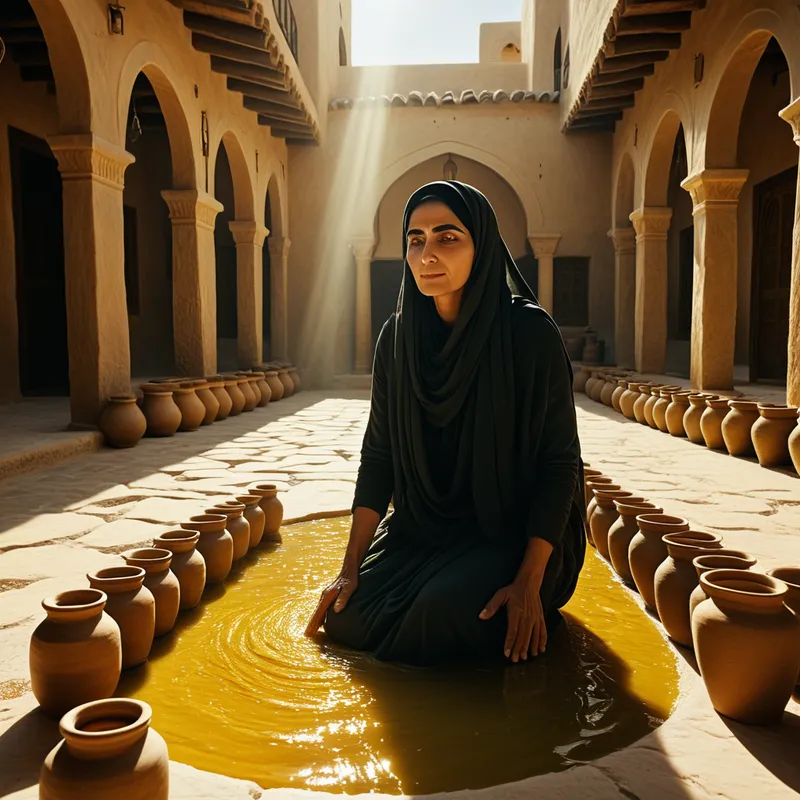
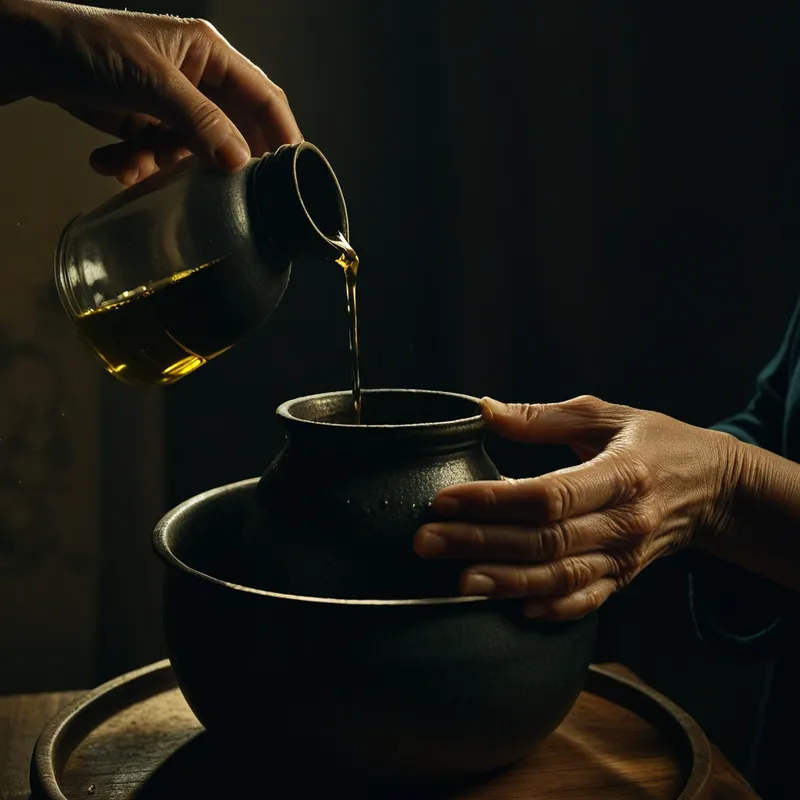
She poured. A thin, golden stream kissed the bottom of the first borrowed pot. It filled to the brim. Her heart hammered against her ribs. She moved to the next vessel. The oil flowed, steady and unceasing. Pot after pot, jar after jar, the liquid light from her one small cruse filled the emptiness. “Bring me yet a vessel,” she whispered to her son, her voice trembling with awe. “And he said unto her, There is not a vessel more.” And the oil stayed. The flow ceased only when there was no more emptiness left to receive it.
She stood in a room transformed, a forest of vessels crowned with liquid gold, the air rich with the scent of olives and miracles. The prophet’s final word was her emancipation: “Go, sell the oil, and pay thy debt, and live thou and thy children of the rest.” The threat was dissolved, not by evasion, but by a created abundance that flowed from her own faithful hand.
Cultural Origins & Context
This narrative is preserved in the Second Book of Kings (Chapter 4), a text that forms part of the Deuteronomistic history, a grand theological compilation reflecting on the covenant between YHWH and Israel. It belongs to the cycle of stories about Elisha, who succeeded the fiery Elijah. Unlike the national dramas of kings and battles, this is a domestic tale, told and retold in the intimate spaces of home and hearth.
Its societal function was multifaceted. For a culture where debt-slavery was a grim social reality (Exodus 21:2-11, Deuteronomy 15:12-18), the story served as a potent theological assertion: YHWH is not only a god of armies but a defender of the most vulnerable—the widow, the orphan, [the stranger](/myths/the-stranger “Myth from Biblical culture.”/). It validated the role of the prophet as a conduit of divine intervention in the concrete crises of daily life. Furthermore, it reinforced a core covenantal principle: trust in YHWH’s provision, even when it demands a counter-intuitive, sacrificial first step. The story was a narrative anchor of hope, teaching that divine providence often works through the existing, seemingly inadequate resources of the faithful, multiplied in response to obedience.
Symbolic Architecture
At its [heart](/symbols/heart “Symbol: The heart symbolizes love, emotion, and the core of one’s existence, representing deep connections with others and self.”/), this myth is an alchemical map of transformation operating on multiple levels. The widow represents the [human](/symbols/human “Symbol: The symbol of a human represents individuality, complexity of emotions, and social relationships.”/) [soul](/symbols/soul “Symbol: The soul represents the essence of a person, encompassing their spirit, identity, and connection to the universe.”/) in a state of existential depletion, facing the “creditors” of [fate](/symbols/fate “Symbol: Fate represents the belief in predetermined outcomes, suggesting that some aspects of life are beyond human control.”/), [obligation](/symbols/obligation “Symbol: A perceived duty or responsibility imposed by social norms, relationships, or internalized expectations, often involving a sense of being bound to act.”/), and [despair](/symbols/despair “Symbol: A profound emotional state of hopelessness and loss, often signaling a need for transformation or surrender to deeper truths.”/). Her last jar of oil is the symbolic seed of [the Self](/myths/the-self “Myth from Jungian culture.”/)—the final, irreducible core of one’s [spirit](/symbols/spirit “Symbol: Spirit symbolizes the essence of life, vitality, and the spiritual journey of the individual.”/), talent, or [life](/symbols/life “Symbol: The symbol of ‘Life’ represents a journey of growth, interconnectedness, and existential meaning, encompassing both the joys and challenges that define human experience.”/)-force that seems insufficient to meet the demands of the world.
The miracle does not begin with the filling of the vessels, but with the pouring out of the last drop. Abundance is unlocked not by hoarding the remnant of the self, but by risking it in an act of radical trust.
The [prophet](/symbols/prophet “Symbol: A messenger or seer who receives divine revelations, often warning of future events or guiding moral direction.”/) Elisha functions as the catalyst or the personification of the inner [archetype](/symbols/archetype “Symbol: A universal, primordial pattern or prototype in the collective unconscious that shapes human experience, behavior, and creative expression.”/) of the sage. He does not bring the oil; he sees the potential already present and issues the command that activates it. His instructions are the symbolic steps of the [ritual](/symbols/ritual “Symbol: Rituals signify structured, meaningful actions carried out regularly, reflecting cultural beliefs and emotional needs.”/): first, the sacrifice of the [remnant](/symbols/remnant “Symbol: A fragment or leftover piece of something larger that once existed, often carrying emotional or historical weight from what has been lost or transformed.”/) (the small cake), which represents the [death](/symbols/death “Symbol: Symbolizes transformation, endings, and new beginnings; often associated with fear of the unknown.”/) of a [scarcity](/symbols/scarcity “Symbol: A dream symbol representing lack, limitation, or insufficient resources, often reflecting fears of deprivation or unmet needs.”/) mindset. Second, the gathering of “empty vessels”—the conscious preparation of one’s life to receive. Third, the shutting of the [door](/symbols/door “Symbol: A door symbolizes transition, opportunity, and choices, representing thresholds between different states of being or experiences.”/), a critical [movement](/symbols/movement “Symbol: Movement symbolizes change, progress, and the dynamics of personal growth, reflecting an individual’s desire or need to transform their circumstances.”/) into the [temenos](/myths/temenos “Myth from Greek culture.”/), a private, focused [space](/symbols/space “Symbol: Dreaming of ‘Space’ often symbolizes the vastness of potential, personal freedom, or feelings of isolation and exploration in one’s life.”/) where the soul’s work is done away from the judging eyes of the outer world. Finally, the pouring itself, the active engagement of one’s core resource.
The oil, in ancient Near Eastern [symbolism](/symbols/symbolism “Symbol: The use of symbols to represent ideas or qualities, often conveying deeper meanings beyond literal interpretation. In dreams, it’s the language of the unconscious.”/), is rich with meaning: it is for anointing (consecration), for healing, for light (in lamps), and for sustenance. Its miraculous flow signifies the grace that multiplies when the individual’s small, dedicated offering meets the prepared space of need.

The Dreamer’s Resonance
When this myth stirs in the modern unconscious, it often manifests in dreams of hidden reservoirs, endless corridors with rooms to fill, or discovering a secret, inexhaustible faucet in one’s own home. One may dream of paying off a vast, shadowy debt with a single, unexpected treasure found in the basement.
Somatically, this can correlate with a feeling of constriction in the chest (the debt, the scarcity) giving way to a sudden, deep breath or a sensation of warmth flowing through the limbs (the oil). Psychologically, the dreamer is likely navigating a life transition where they feel their internal resources are exhausted—facing financial strain, creative burnout, or emotional caretaker fatigue. The dream is not a promise of external rescue, but a revelation of an inner process. It signals that the [psyche](/myths/psyche “Myth from Greek culture.”/) is initiating its own ritual of multiplication. The “empty vessels” in the dream represent new capacities, unexplored potentials, or supportive relationships that the dreamer’s conscious mind has not yet recognized as containers for their grace. The act of pouring in the dream is the somatic metaphor for the psyche beginning to invest its remaining energy into these new vessels of possibility.

Alchemical Translation
For the modern individual on the path of individuation, the Widow’s Oil is a masterclass in psychic transmutation. The “creditor” is the complex—perhaps an inner critic, a pattern of self-sabotage, or a legacy of familial obligation—that threatens to enslave one’s vitality. The conscious ego is the widow, feeling powerless and resource-poor.
The alchemical operation follows the myth’s precise sequence. First, [Nigredo](/myths/nigredo “Myth from Alchemical culture.”/): Acknowledging the despair, the “last meal.” This is the dark night, the confrontation with limitation. Second, Ablutio/Sacrifice: The offering of the “little cake first.” This is the crucial, counter-intuitive step where one must give attention, care, or creative energy (the oil) to something beyond the immediate ego-survival—to art, to service, to the inner guide (the prophet)—even when it feels like the last of it. This sacrifice breaks the identification with scarcity.
The psyche’s abundance is not stored in a vault, but generated in the circuit of giving and receiving. The flow begins only when the circuit is closed by an act of faith.
Third, Albedo: Gathering the “empty vessels.” This is the conscious work of analysis, therapy, skill-building, or relationship-mending—preparing the structures of the personality to hold more light, more life. Fourth, [Rubedo](/myths/rubedo “Myth from Alchemical culture.”/): Shutting the door and pouring. This is the focused, often solitary, work of application. It is writing the book, practicing the instrument, doing the deep emotional work. Here, in that protected interiority, the individual discovers that their core gift, when applied consistently to the prepared vessels of their life, does not diminish but multiplies. The final stage is Projectio: “Sell the oil, and pay thy debt.” The transformed substance—now a tangible skill, a healed perspective, a body of work—is brought into the world. It resolves the old complexes (pays the debt) and creates a surplus of meaning and vitality from which to live (“the rest”). The myth thus charts the journey from a psychology of scarcity to one of generative, flowing abundance, rooted in the courageous expenditure of the soul’s last, best treasure.
Associated Symbols
Explore related symbols from the CaleaDream lexicon: