The Widow's Mite Myth Meaning & Symbolism
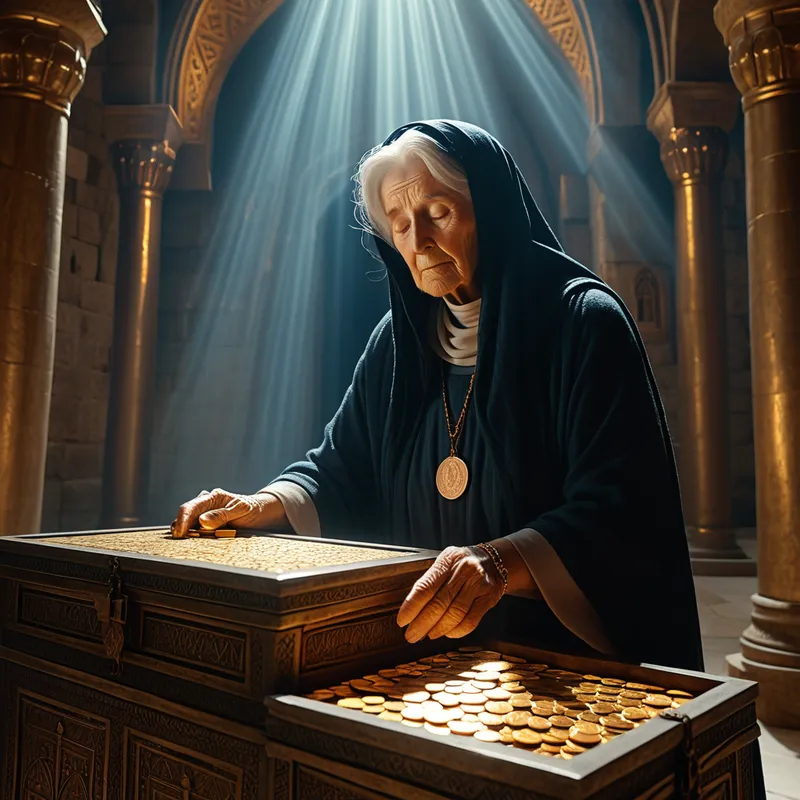
A poor widow gives her last two coins, offering her entire livelihood, and in doing so, enacts a sacred inversion of worldly value.
The Tale of The Widow’s Mite
Hear now a story whispered on the breath of the sacred, a tale not of kings or prophets, but of a moment so quiet it thunders in the chambers of eternity.
The air in the Temple was thick with the smell of incense and sacrifice, a cacophony of devotion. The wealthy came, their robes a rustle of fine linen, their offerings a conspicuous clatter of silver and gold as they fed the great bronze mouths of the treasury chests. It was a theater of piety, a display measured in weight and sheen.
Then she entered.
A figure of shadows and silence, a widow clothed in the grey hues of poverty. The fabric of her garment was thin, worn to the memory of threads. In the hollow of her hand, she carried not a purse of abundance, but her entire world: two lepta, mites so small and thin the light shone through them. They were the last of her bios—her life, her livelihood. To hold them was to hold the fragile boundary between existence and hunger.
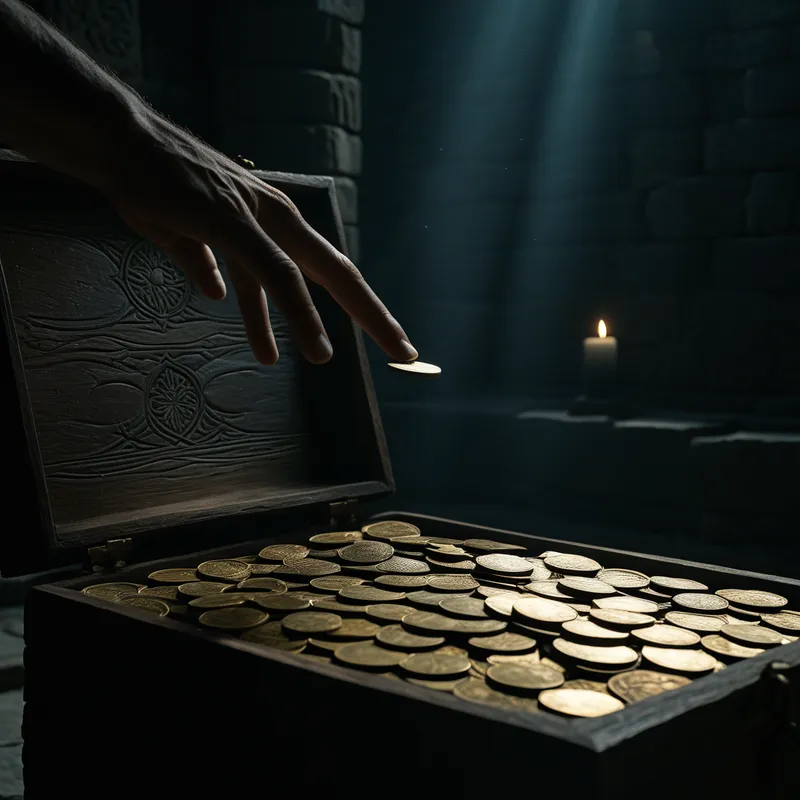
She did not hesitate. There was no drama in her movement, only a final, irrevocable surrender. The coins, those two slivers of copper, fell from her fingers. Their sound was not a clang of [triumph](/myths/triumph “Myth from Roman culture.”/) but a soft, almost inaudible tink against the heaped wealth within the chest. A sound swallowed by the grandeur of the place. Having given this, her purse was empty, her future unsecured. She turned and vanished back into the stream of the crowd, seemingly unnoticed.
But a witness saw. Yeshua sat opposite the treasury, his gaze not on the spectacle, but on the essence. He called his students close, his voice cutting through the spiritual noise. “Truly I tell you,” he said, pointing to where the widow had stood, “this poor widow has put in more than all the others. For they all gave out of their surplus, but she, out of her poverty, has put in all she had to live on.”
In that declaration, the universe tilted. The ledger of heaven was rewritten not in sums, but in sacrifice. The greatest offering was not what was given from excess, but what was given from [the void](/myths/the-void “Myth from Buddhist culture.”/) itself. The myth was sealed not with a miracle of multiplication, but with a revelation of measure—a sacred mathematics where two coins outweighed a mountain of gold.
Cultural Origins & Context
This narrative is embedded within the Biblical tradition, specifically in the synoptic gospels of Mark and Luke. It is presented not as a parable crafted by Yeshua, but as an observed event, a living parable enacted by an anonymous woman. This grounds it in a specific historical and cultural moment: the Second Temple period, with its complex economic and religious hierarchies.
The story functioned as a critical commentary within early Pharisaic and emerging Christian communities. It directly challenged prevailing notions of piety and patronage. In a culture where large donations often brought public honor and were seen as securing divine favor, the tale performs a radical inversion. It was transmitted orally by disciples as a teaching moment, a “kenosis” (emptying) that revealed the heart of divine economy. Its societal function was subversive: to redefine worth, to champion the invisible faithful over the publicly righteous, and to locate holiness not in the amount given, but in the cost to the giver.
Symbolic Architecture
At its core, the myth dismantles the [architecture](/symbols/architecture “Symbol: Architecture in dreams often signifies structure, stability, and the framing of personal identity or life’s journey.”/) of transactional value and rebuilds it on the [foundation](/symbols/foundation “Symbol: A foundation symbolizes the underlying support systems, values, and beliefs that shape one’s life, serving as the bedrock for growth and development.”/) of existential commitment. The symbols are stark and potent.
The Two Mites are not merely [money](/symbols/money “Symbol: In dreams, money often represents power, self-worth, and the desire for security or freedom, reflecting our relationship with value in life.”/); they are the condensed [symbol](/symbols/symbol “Symbol: A symbol can represent an idea, concept, or belief, serving as a powerful tool for communication and understanding.”/) of all she had to live on (Greek: holon ton bion autēs). They represent the totality of her resources, her [security](/symbols/security “Symbol: Security denotes safety, stability, and protection in one’s personal and emotional life.”/), her future. They are the final [boundary](/symbols/boundary “Symbol: A conceptual or physical limit defining separation, protection, or identity between entities, spaces, or states of being.”/) of [the self](/myths/the-self “Myth from Jungian culture.”/).
The [Temple](/symbols/temple “Symbol: A temple often symbolizes spirituality, sanctuary, and a deep connection to the sacred aspects of life.”/) Treasury symbolizes the collective institution of religion, the sanctioned [receptacle](/symbols/receptacle “Symbol: A container that holds, receives, or stores something, often symbolizing the capacity to accept, contain, or process experiences, emotions, or resources.”/) for devotion. It is impersonal, demanding, and associated with the display of the wealthy.
The true symbolic [hero](/symbols/hero “Symbol: A hero embodies strength, courage, and the ability to overcome significant challenges.”/), however, is the act itself: The Total Offering. This is not charity; it is a [ritual](/symbols/ritual “Symbol: Rituals signify structured, meaningful actions carried out regularly, reflecting cultural beliefs and emotional needs.”/) of complete self-dispossession.
The ultimate sacrifice is not of something you have, but of the having itself. It is the surrender of the mechanism of survival.
Psychologically, the widow represents the [Caregiver](/symbols/caregiver “Symbol: A spiritual or mythical figure representing nurturing, protection, and unconditional support, often embodying divine or archetypal parental energy.”/) [archetype](/symbols/archetype “Symbol: A universal, primordial pattern or prototype in the collective unconscious that shapes human experience, behavior, and creative expression.”/) in its most absolute, self-annihilating form. But more deeply, she embodies [the ego](/myths/the-ego “Myth from Jungian culture.”/) at the point of its own [dissolution](/symbols/dissolution “Symbol: The process of breaking down, dispersing, or losing form, often representing transformation, release, or the end of a state of being.”/). Her offering is a symbolic [death](/symbols/death “Symbol: Symbolizes transformation, endings, and new beginnings; often associated with fear of the unknown.”/)—a relinquishing of [the ego](/myths/the-ego “Myth from Jungian culture.”/)‘s resources for an unknown [outcome](/symbols/outcome “Symbol: Outcome symbolizes the results of actions or decisions, often reflecting hopes, fears, and the consequences of choices.”/). The conflict is between the instinct for self-preservation and the [impulse](/symbols/impulse “Symbol: A sudden, powerful urge or drive that arises without conscious deliberation, often linked to primal instincts or emotional surges.”/) toward absolute trust or devotion. Her triumph is not in gaining anything, but in the integrity of the giving itself, which in the myth’s [logic](/symbols/logic “Symbol: The principle of reasoning and rational thought, often representing order, structure, and intellectual clarity in dreams.”/), redefines her [poverty](/symbols/poverty “Symbol: A state of lacking material resources or essential needs, often symbolizing feelings of inadequacy, vulnerability, or spiritual emptiness in dreams.”/) as the greatest spiritual [wealth](/symbols/wealth “Symbol: Wealth in dreams often represents abundance, security, or inner resources, but can also symbolize burdens, anxieties, or moral/spiritual values.”/).
The Dreamer’s Resonance
When this myth stirs in the modern unconscious, it rarely appears as a Biblical scene. Instead, it manifests as the feeling of the widow’s choice. One might dream of giving away a priceless heirloom to a stranger, of emptying one’s bank account into a bottomless well, or of offering one’s last bite of food. The somatic sensation is often one of terrifying lightness, a vertigo of having nothing left to hold onto.
This dream pattern signals a profound psychological process: the ego’s confrontation with its own necessary “poverty.” It arises when an individual is clinging to a depleted form of security—a job, a relationship, an identity, a set of beliefs—that has become a lifeless husk. The dream is the [psyche](/myths/psyche “Myth from Greek culture.”/)‘s enactment of the myth, pressing the dreamer toward an existential offering. The anxiety is not about losing a [thing](/myths/thing “Myth from Norse culture.”/), but about losing the self as defined by that thing. The process underway is the alchemical solve: the dissolution of an old, outworn structure of the personality to make way for an unknown newness. The dream asks: What are you hoarding that is costing you your life? And what would it mean to offer it up, not from your surplus energy, but from your last reserves?
Alchemical Translation
The journey of the Widow’s Mite is a map for psychic transmutation, a model of individuation through radical surrender. The alchemical stages are clear.
First, Recognizing the Leaden Coin ([Nigredo](/myths/nigredo “Myth from Alchemical culture.”/)). This is the conscious acknowledgment of one’s “poverty”—not necessarily material, but spiritual or psychological. It is the feeling of being down to one’s last inner resource: hope, patience, faith, strength. This is the dark, leaden state of confusion and despair.
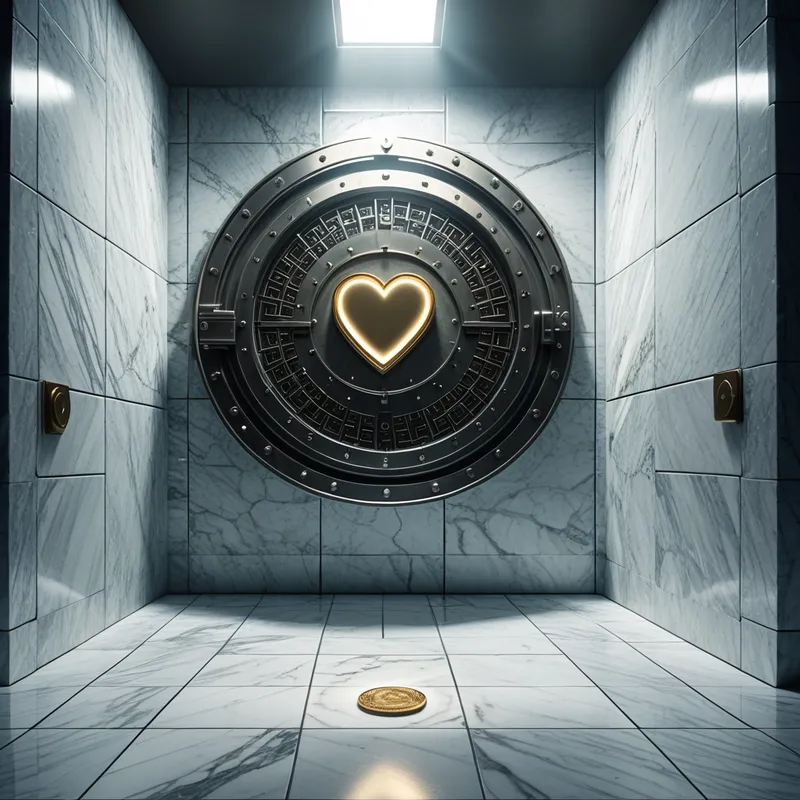
Second, The Offering ([Solutio](/myths/solutio “Myth from Alchemical culture.”/)). This is the critical, voluntary act. It is the decision to pour that last resource—the final bit of trust, the last claim to a old identity, the ultimate control—into [the vessel](/myths/the-vessel “Myth from Alchemical culture.”/) of the unknown. This is a dissolution in the waters of trust. It is not a rational transaction; it is a ritual of faith in the process itself.
The alchemical gold is not found in the treasury; it is forged in the moment the hand opens and lets go of the final coin.
Finally, The Inversion (Albedo/[Rubedo](/myths/rubedo “Myth from Alchemical culture.”/)). The myth does not show the widow being rewarded with money. The transformation is in the valuation. Her inner state is “whitened” (albedo) and “reddened” (rubedo)—purified and enlivened—by the act itself. The psychic transmutation is the realization that true wealth is the freedom from attachment to security. The self that clung to two coins dies, and a new, more essential self is born—one that exists in a state of openness and trust, no longer defined by what it possesses, but by the integrity of its offering. For the modern individual, this translates to the courage to invest one’s last emotional or creative resource into a genuine feeling, a true art, or an authentic relationship, even when—especially when—there is no guarantee of return. It is the alchemy that turns the lead of desperate survival into the gold of liberated being.
Associated Symbols
Explore related symbols from the CaleaDream lexicon: