The Widow's Cruse Myth Meaning & Symbolism
A prophet asks a destitute widow for her last meal. In giving it, she unlocks a miracle: her jar of oil and cruse of meal never fail.
The Tale of The Widow’s Cruse
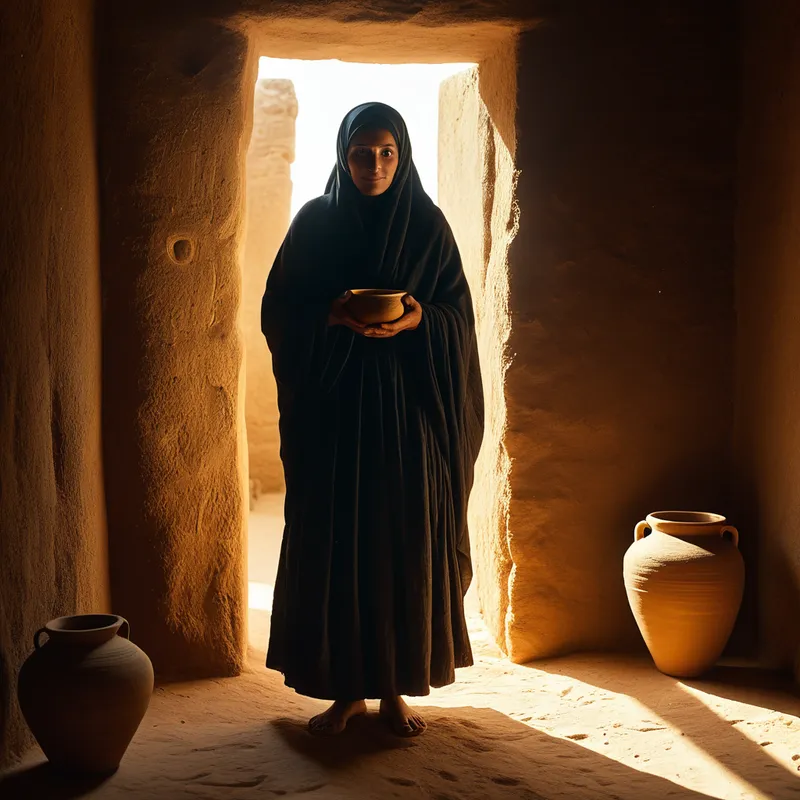
The sun was a hammer on the land of Zarephath, beating [the earth](/myths/the-earth “Myth from Hindu culture.”/) into dust and despair. The rains had forgotten their song, and the brooks whispered only memories of [water](/myths/water “Myth from Chinese culture.”/). In this crucible of drought, a woman moved through the shadows of her home—a widow, her name lost to all but the silence. Her world had shrunk to the weight of a single jar and a small cruse. In the jar, a handful of oil, slick and precious. In the cruse, a dusting of meal, the ghost of a harvest.
This was her end. The final act. She gathered two sticks, her movements slow with the gravity of last things, to build a final fire. She would make one last cake for herself and her son. They would eat it, and then they would lie down and wait for the hunger to take them, as it had taken everything else.
But a voice broke the silence of her resignation. A stranger stood at her gate, a man named Elijah, his cloak smelling of wilderness and prophecy. His request was not a greeting, but a demand that cut to the bone of her survival. “Fetch me, I pray thee, a little water in a vessel, that I may drink.” And as she turned to obey this small mercy, his voice followed her. “Bring me, I pray thee, a morsel of bread in thine hand.”
The widow stopped. The air grew thin. She turned back, and her confession was a dry leaf rustling in the stillness. “As the LORD thy God liveth, I have not a cake, but an handful of meal in a barrel, and a little oil in a cruse: and, behold, I am gathering two sticks, that I may go in and dress it for me and my son, that we may eat it, and die.”
The prophet’s eyes held no pity, only a terrifying certainty. “Fear not,” he said, and the words were an anchor in her storm. “Go and do as thou hast said: but make me thereof a little cake first, and bring it unto me, and after make for thee and for thy son.” He spoke a promise that defied the empty jar, the dry cruse, the logic of the dying land. “For thus saith the LORD God of Israel, The barrel of meal shall not waste, neither shall the cruse of oil fail, until the day that the LORD sendeth rain upon the earth.”
What did she hear in that moment? The madness of a starving man? Or the echo of a deeper law, one that governed not grain, but grace? Her hands, which moments before were instruments of a final ritual, now moved in faith. She took her end—the last of the oil, the final dust of flour—and she gave it away. She baked a small cake not for her son, but for [the stranger](/myths/the-stranger “Myth from Biblical culture.”/). She placed her absolute scarcity into the hands of the unknown.
And then she returned to her jar. She peered inside. The oil was there. She measured from the cruse. The meal was there. She baked again. And again. The jar yielded its slick treasure. The cruse gave up its fine powder. Day followed parched day, and the widow, her son, and the man of God ate. [The vessel](/myths/the-vessel “Myth from Alchemical culture.”/) did not fail. The cruse did not waste. In the heart of a famine, in a house of poverty, a miracle unfolded not as a sudden bounty, but as a sustained, gentle defiance. The end became a beginning that did not end.
Cultural Origins & Context
This story is preserved in the First Book of Kings (Chapter 17). It emerges from the volatile world of the Northern Kingdom of Israel under King Ahab, a time of political strife and religious syncretism. The prophet Elijah is a central, disruptive figure, challenging the royal court and the cult of Baal. This specific tale, however, takes place not in Israel, but in Zarephath, a Phoenician town in the region of Sidon—the very homeland of Queen Jezebel, Ahab’s wife and a patron of Baal worship.
This geographical detail is crucial. The story was told and recorded by the Israelite scribal tradition, not as a universal fable, but as a theological polemic. It demonstrates the power of YHWH not only in His own land but in the heart of “enemy” territory, providing for a Gentile widow when the local deities, presumably including Baal who was associated with storms and fertility, had failed to bring rain. It served to bolster faith in YHWH’s sovereignty and provision during national crisis. It was a story for a people feeling spiritually and physically besieged, a reminder that their God’s care could transcend ethnic boundaries and material logic.
Symbolic Architecture
At its core, the myth is an alchemical diagram of a psychological and spiritual law. The cruse and the [barrel](/symbols/barrel “Symbol: A barrel often symbolizes containment, storage, and the preservation of resources, representing both abundance and potential loss.”/) are not merely vessels for sustenance; they are symbols of the [human](/symbols/human “Symbol: The symbol of a human represents individuality, complexity of emotions, and social relationships.”/) [soul](/symbols/soul “Symbol: The soul represents the essence of a person, encompassing their spirit, identity, and connection to the universe.”/), the personal [reservoir](/symbols/reservoir “Symbol: A contained body of water representing stored resources, emotions, or potential, often signifying controlled or suppressed aspects of the self.”/) of [life](/symbols/life “Symbol: The symbol of ‘Life’ represents a journey of growth, interconnectedness, and existential meaning, encompassing both the joys and challenges that define human experience.”/)-force, creativity, and hope.
The miracle is not that the vessel is suddenly full, but that in the act of pouring out from its perceived emptiness, it discovers it is connected to an infinite source.
The widow represents the orphaned [psyche](/myths/psyche “Myth from Greek culture.”/) at its most extreme—bereft of support (widowed), facing the [death](/symbols/death “Symbol: Symbolizes transformation, endings, and new beginnings; often associated with fear of the unknown.”/) of its future (her son), and utterly depleted. Her plan to use her last resources for a final, terminal act is the [psyche](/myths/psyche “Myth from Greek culture.”/) in a state of [despair](/symbols/despair “Symbol: A profound emotional state of hopelessness and loss, often signaling a need for transformation or surrender to deeper truths.”/), preparing to capitulate to its own annihilation.
Elijah, the [prophet](/symbols/prophet “Symbol: A messenger or seer who receives divine revelations, often warning of future events or guiding moral direction.”/), symbolizes the disruptive [arrival](/symbols/arrival “Symbol: The act of reaching a destination, marking the end of a journey and the beginning of a new phase or state.”/) of the Self, the central [archetype](/symbols/archetype “Symbol: A universal, primordial pattern or prototype in the collective unconscious that shapes human experience, behavior, and creative expression.”/) of order. His demand is outrageous because [the Self](/myths/the-self “Myth from Jungian culture.”/) does not operate on [the ego](/myths/the-ego “Myth from Jungian culture.”/)‘s economy of [scarcity](/symbols/scarcity “Symbol: A dream symbol representing lack, limitation, or insufficient resources, often reflecting fears of deprivation or unmet needs.”/). It demands the very [thing](/myths/thing “Myth from Norse culture.”/) [the ego](/myths/the-ego “Myth from Jungian culture.”/) clings to for survival. The “little cake first” is the ultimate act of symbolic sacrifice—not of something extra, but of the ego’s identified last resort. It is the surrender of the final [defense](/symbols/defense “Symbol: A protective mechanism or barrier against perceived threats, representing boundaries, security, and resistance to external or internal challenges.”/).
The endless oil and [meal](/symbols/meal “Symbol: A meal often symbolizes nourishment, not just physically but emotionally and spiritually, representing the aspects of sharing and community.”/) represent the psychic [energy](/symbols/energy “Symbol: Energy symbolizes vitality, motivation, and the drive that fuels actions and ambitions.”/) (libido) that flows when one acts from a center beyond the anxious, calculating ego. When the widow invests her last bit of conscious [energy](/symbols/energy “Symbol: Energy symbolizes vitality, motivation, and the drive that fuels actions and ambitions.”/) not in self-preservation, but in an act of radical hospitality (a supreme form of the [Caregiver](/symbols/caregiver “Symbol: A spiritual or mythical figure representing nurturing, protection, and unconditional support, often embodying divine or archetypal parental energy.”/)), she aligns herself with a different order of [reality](/symbols/reality “Symbol: Reality signifies the state of existence and perception, often reflecting one’s understanding of truth and life experiences.”/). The [vessel](/symbols/vessel “Symbol: A container or structure that holds, transports, or protects something essential, representing the self, emotions, or life journey.”/) becomes a [conduit](/symbols/conduit “Symbol: A passage or channel that transfers energy, information, or substance from one place to another, often hidden or structural.”/), not a container.
The Dreamer’s Resonance
When this myth stirs in the modern unconscious, it often manifests in dreams of paradoxical provision. A dreamer may find themselves in a barren, empty house—a symbol of a depleted inner life. They may discover a small, forgotten cupboard, and inside, a simple, humble object like a mug, a bowl, or a lamp. From this object, something essential endlessly flows: water, food, light, or even a soothing sound.
Somatically, the dreamer may be experiencing burnout, creative block, or emotional exhaustion—the feeling of having “nothing left to give.” The dream is not a promise of external rescue, but an image of the internal shift required. The psychological process is one of inversion. The ego, which hoards to feel safe, is being shown that its safety lies in a courageous expenditure. The dream invites the dreamer to identify what they are emotionally or spiritually “making their last meal.” What is the final resource they are afraid to spend? The dream suggests that the act of spending it—on creativity, on connection, on a leap of faith—may not lead to emptiness, but to the revelation of an inner wellspring.

Alchemical Translation
The process modeled here is the alchemical [nigredo](/myths/nigredo “Myth from Alchemical culture.”/) transforming into the albedo, but through a specific operation: sacred expenditure. In psychological terms, it is the journey from an ego-consciousness founded on lack to an alignment with the Self, which is founded on sufficiency.
Individuation often requires the sacrifice of what we believe is essential to our survival, only to reveal that our true essence is that which survives the sacrifice.
The “handful of meal” is our identified talent, our time, our love, our energy. We believe it is finite. We ration it, protect it, and see its expenditure as loss. The alchemical instruction of the myth is to take that precisely measured, hoarded resource and give it away to the unknown. The prophet—the inner voice of the Self—does not offer a plan or a guarantee the ego can understand. It simply says, “Feed me first.”
This is the crux of psychic transmutation. When we invest our last bit of conscious effort not in shoring up our failing ego-structures, but in service to a deeper, unknown imperative (the inner prophet, the call of the soul, a genuine act of love without guarantee), we initiate a different circuit. The libido, no longer bound up in anxious conservation, begins to circulate. The cruse does not fail because we have stopped seeing it as a closed container and have allowed it to become an open channel. The miracle is the sustained flow itself—the daily renewal of courage, insight, and vitality that comes from living from the center, not from the storehouse. We discover we are not a reservoir to be drained, but a wellspring connected to the deep aquifer of being.
Associated Symbols
Explore related symbols from the CaleaDream lexicon: