The White Stone Myth Meaning & Symbolism
A myth of a flawed king, a hidden stone, and the fiery ordeal that reveals the ultimate treasure of the soul.
The Tale of The White Stone
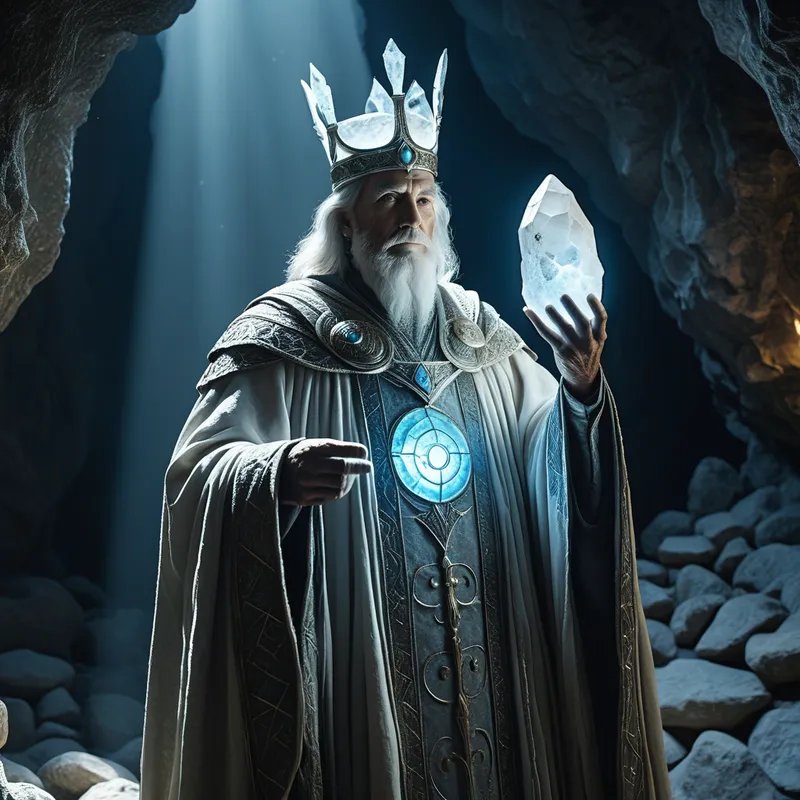
In the forgotten age, when the earth’s veins ran with molten truth and the sky was a mirror to the soul, there reigned a king in a kingdom of metal and shadow. His name was Rex Plumbum, and his crown was not of gold, but of cold, dull lead—a crown that grew heavier with every lie spoken in his court, with every injustice left un-mended. His palace, a grand edifice of polished brass and dark marble, echoed with a hollow splendor. The people prospered in body but starved in spirit, for the light in their sovereign’s eyes had long been clouded by the dross of worldly rule.
One night, as a comet scarred the velvet sky, an ancient Spirit of the Furnace appeared to him not in dream, but in the waking embers of his hearth. Its voice was the crackle of flame and the sigh of cooling slag. “Your kingdom is a reflection of your soul, O King,” it intoned. “You rule over lead because you are ruled by it. The treasure you seek—the light that would make your people whole—lies not in deeper mines, but in the heart of your own darkness. You must seek the Prima Materia within your very throne.”
Driven by a despair he could no longer name, Rex Plumbum descended. He left his brass palace and walked down, down into the fundament of the world, into the Nigredo. Here, in a cavern where the air tasted of salt and old blood, he found his throne-room’s counterpart: a rough, natural seat of unworked stone before a vast, silent forge. The Spirit was there, a silhouette in the geothermal glow. “The crown,” it said simply.
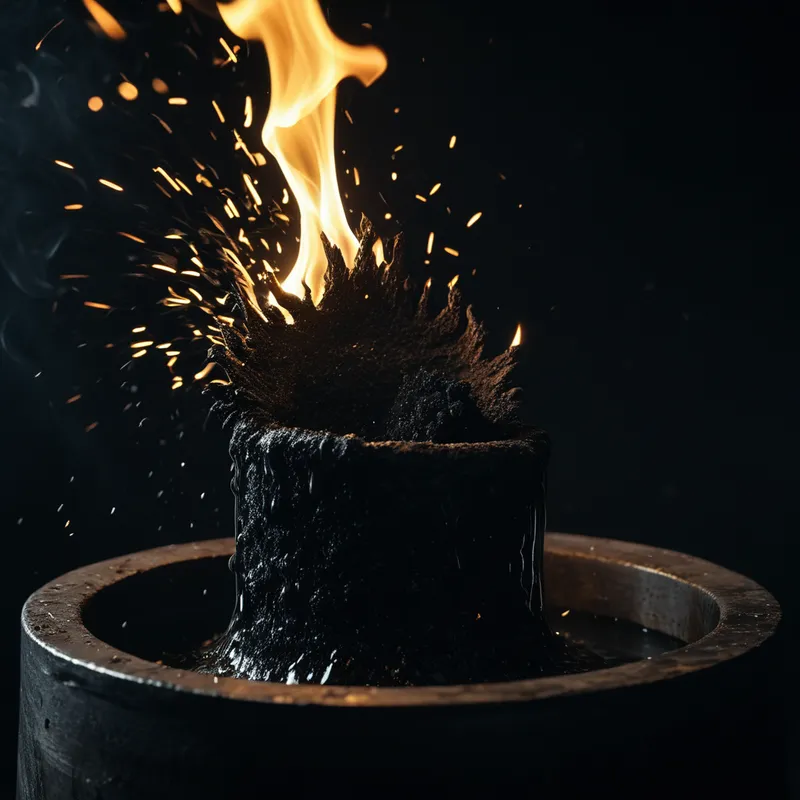
With hands that shook not from fear, but from the weight of a lifetime, the king removed his leaden crown. He beheld it—the symbol of his burden, his identity, his power. It was ugly, misshapen, and cold. Without a word, he cast it into the heart of the forge. The Spirit breathed, and a fire like the sun’s core erupted—the Calcination. The king watched as his crown, his very self, melted. It did not become liquid gold, but a seething, black, and foul-smelling chaos. He wept tears that sizzled on the hot stone, for he saw in that bubbling mass every failed decree, every cowardice, every hidden vanity.
For days and nights uncounted, the fire burned. The black mass whitened—the Albedo. It was washed in his own tears and the distilled waters of a hidden spring that wept from the cavern wall. Then, a color bloomed within the white—a glorious, royal crimson, the Rubedo. The fire gentled. At last, the Spirit reached into the forge with hands of light and withdrew not a crown, but a single, ovoid stone. It was small enough to fit in the palm, yet it held the density of a star. Its surface was flawless, milky white, and it glowed with a soft, internal radiance—the Lapis Philosophorum, the White Stone.
The Spirit placed it in the king’s soot-stained hand. It was neither hot nor cold, but alive with a humming peace. “This is not a crown for a king,” said the Spirit, its voice now like a clear bell. “It is the touchstone for a human. Rule now from this.”
Cultural Origins & Context
The myth of the White Stone is not a folktale with a single origin, but a core narrative that permeated the esoteric undercurrent of European alchemical culture from the late medieval period through the Renaissance. It was never a story for the masses, but a coded instruction, passed in whispered conversations, in cryptic illustrations in illuminated manuscripts, and in the allegorical writings of adepts. Its tellers were not bards, but philosophers and practitioners who saw in the laboratory processes a mirror for the soul’s journey.
Societally, its function was subversive and integrative. In a world of rigid hierarchies and dogmatic religion, it proposed that the greatest sovereignty was self-sovereignty, achieved not through divine right, but through a harrowing, personal ordeal of purification. It served as a map for initiates, a promise that the base materials of a conflicted human life—the lead of one’s flaws and burdens—could, through the disciplined fire of introspection and suffering, be transformed into the incorruptible stone of wisdom and integrity.
Symbolic Architecture
The myth is a perfect analog for the process of individuation. Rex Plumbum is the conscious ego, identified with its heavy, burdensome role (“the crown”). His prosperous yet hollow kingdom represents a life of outward success but inner poverty.
The furnace is not a punishment, but a sacred vessel. The heat is not inflicted from without, but generated by the tension between who we are and who we sense we could become.
The descent into the Nigredo cavern is the courageous plunge into the unconscious, the confrontation with the shadow. The melting of the crown is the dissolution of the ego’s rigid identity. The subsequent Albedo and Rubedo stages symbolize the purification of emotion and the integration of spirit and passion, leading to the birth of a new center of personality. The White Stone itself is the Self. It is not the ego, but what the ego serves once it has been humbled and refined. It represents a state of being that is simple, whole, and radiantly authentic.
The Dreamer’s Resonance
When this myth stirs in the modern psyche, it often manifests in dreams of intense pressure, purification, or discovery. A dreamer might find themselves in a vast, industrial laundry, washing a garment that is impossibly stained (the Albedo). They might dream of losing a job title, a house, or a relationship that formed their identity—a symbolic melting of the crown. Dreams of finding a smooth, white pebble on a path, or holding a cool, dense stone that brings immense calm, are direct visitations of the Lapis.
Somatically, this process can feel like a “burnout” that is actually a profound initiation—a fatigue of the old self. Psychologically, it is the process of “hitting bottom” not in despair, but in truth, where all false supports are incinerated, leaving only the essential core. The dreamer is undergoing a recalibration of their center of gravity from the external persona to the internal Self.
Alchemical Translation
For the modern individual, the myth models the ultimate act of psychic transmutation: turning suffering into substance, and burden into bedrock. Our “lead” is our neuroses, our inherited traumas, our addictive patterns, and our outgrown identities. The “forge” is the container of our conscious attention and our willingness to feel and examine these things without fleeing.
The king does not find the Stone by searching for it; he creates it by sacrificing what he already has. The treasure is forged in the act of letting go.
The process is non-linear and often feels like ruin. A career crisis, the end of a marriage, a period of depression—these can be the fires of Calcination. Therapy, meditation, or creative expression can be the cleansing waters of Albedo. The final integration (Rubedo) is not a permanent state of bliss, but the capacity to hold the full spectrum of one’s humanity with compassion and stability. The “White Stone” is the hard-won result: an unshakable inner foundation. It is the quiet knowledge of who one is beyond roles and achievements, the ability to act from integrity rather than fear, and the radiant, simple peace of being truly, undeniably, oneself. One does not rule from it; one rests upon it, and from that rest, authentic life flows.
Associated Symbols
Explore related symbols from the CaleaDream lexicon: