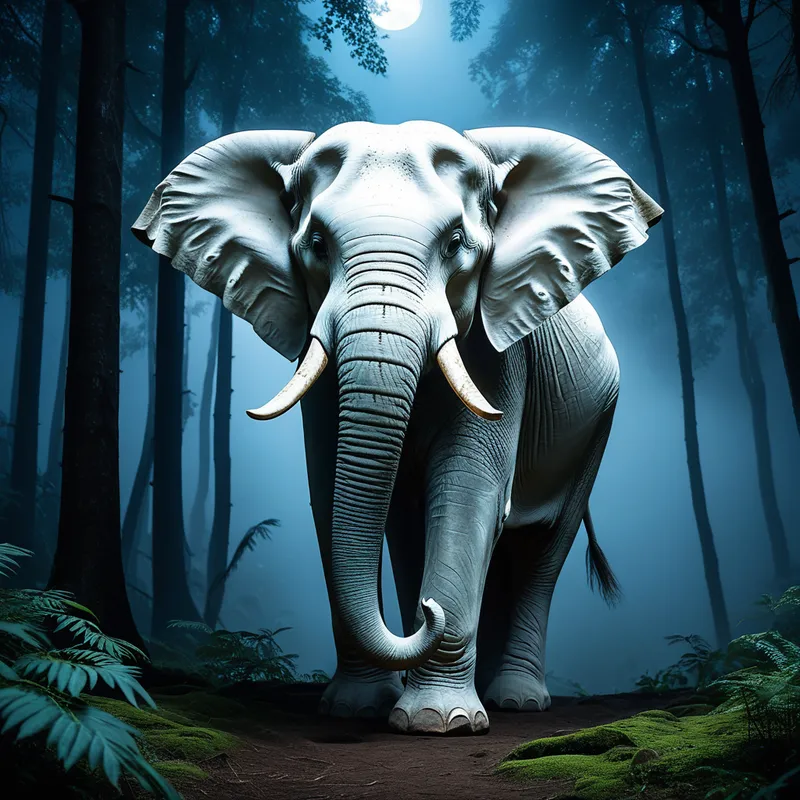
The White Elephant Myth Meaning & Symbolism
A magnificent white elephant, a Bodhisattva in animal form, makes a supreme sacrifice to end a devastating drought and save a kingdom.
The Tale of The White Elephant
Listen. In the high, silent reaches of the Himalayas, where the air is thin and the snow never melts, there lived a king. But he was no ordinary king of beasts. He was Chaddanta, the Great Six-Tusked Elephant, his hide the color of bleached moonlight, his form radiating a calm so deep it stilled the wind. His six ivory tusks, tipped with gold, were not weapons but ornaments of his perfected nature. He ruled a paradise—a hidden lake of lotus blossoms, trees heavy with sweet fruit, a kingdom of eighty thousand elephants who lived in harmony, guided by his boundless compassion.
Yet, far below the mist-shrouded peaks, in the kingdom of Kashi, a shadow fell. The rains failed. The earth cracked like old pottery. The rivers shrank to muddy threads. Crops withered, cattle died, and a dust of despair settled on the people. The human king, desperate, consulted his brahmins. They scoured the ancient texts and their divinations whispered a single, impossible hope: the heart of a six-tusked white elephant, offered in a sacred ritual, would summon the rains.
A party of hunters, led by a man named Sonuttara, was dispatched. For months they climbed, through treacherous passes and tangled forests, driven by a king’s promise of reward and a kingdom’s thirst. When they finally breached Chaddanta’s celestial grove, they faltered. This was no mere animal; this was a sovereign presence. How could they harm such a being? Sonuttara, cunning, devised a plan. He would not attack. He would wait.
Disguising himself in the ochre robes of an ascetic, he positioned himself on a path he knew the elephant king walked daily. When Chaddanta approached, seeing a holy man, he knelt in reverence. In that moment of pure, trusting devotion, Sonuttara drew a poisoned arrow and let it fly. The sting was sharp, a betrayal that echoed in the silent grove. Chaddanta’s herd roared in fury, ready to trample the hunter to dust. But the white elephant raised a pacifying trunk. He saw not an enemy, but a man acting from a desperate, misguided duty. He asked, his voice like distant thunder, “Why have you done this?”
Trembling, Sonuttara confessed the drought, the suffering, the royal decree. A profound stillness settled over Chaddanta. He looked past the hunter, past the mountains, seeing in his mind’s eye the parched fields and pleading faces of Kashi. A resolve, vast and calm as the ocean, filled him. Here was the ultimate test of his paramitas.
He instructed Sonuttara. “Take what you have come for. Do not saw my tusks; that would take too long and my herd’s grief may overcome their patience. Use your axe. I will help you.” And then, the unthinkable act of grace: the magnificent elephant knelt, laid his head upon the earth, and guided the hunter’s axe to the correct spot on his own skull. As the blow fell, the earth did not shake in anger, but seemed to hold its breath. The elephant king offered his life, not in defeat, but as a conscious, compassionate gift. His last act was to ensure the hunter’s safe passage down the mountain with the sacred heart.
When the offering was made in Kashi, the skies, which had been iron for so long, broke. Not with a storm, but with a gentle, life-giving rain that washed the dust from the leaves and hope back into the hearts of the people. The myth ends not with the hunter’s reward, but with the quiet, seismic fact of the sacrifice. The white elephant was gone, but the rain he summoned continued to fall, a perpetual testament written in water.

Cultural Origins & Context
This tale is a Jataka, one of the 547 stories that form the Jataka Atthakatha. These are not mere fables but sacred biography, each one a past life of Shakyamuni Buddha on his long journey to enlightenment. The White Elephant story, often called the Chaddanta Jataka, is among the most revered, frequently depicted in the frescoes of Ajanta and Ellora and across Southeast Asian temple art.
Told by the Buddha himself to his monks, these stories served a dual purpose. For the monastic community, they were lessons in the cultivation of the perfections (paramitas)—in this case, the perfection of generosity (dana) and compassion (karuna) pushed to its absolute limit. For the laity, they were accessible, memorable sermons. Told in villages and at court by bards and monks, they transmitted core Buddhist values without complex philosophy. The elephant, a symbol of royal power and mental strength in Indian culture, here becomes the ultimate vehicle for a spiritual truth: true sovereignty lies not in dominion over others, but in mastery over one’s own attachments, even the attachment to life itself. The myth functioned as a cultural lodestone, orienting society toward an ideal of selfless responsibility.
Symbolic Architecture
The White Elephant is not an animal but an archetype made flesh. Its whiteness signifies purity, a consciousness unstained by the defilements of greed, hatred, and delusion. The six tusks often symbolize the transcendence of the six senses, or the six realms of samsara. It is a being that inhabits the borderlands—between the celestial Himalayas and the human world, between animal form and Buddha-nature.
The ultimate sacrifice is not the loss of the self, but the conscious offering of the self for a purpose greater than its own continuity.
The drought represents a collective spiritual aridity, a crisis of meaning and sustenance. The human kingdom’s solution—violence to procure a magical object—reflects the ego’s desperate, often destructive attempts to fix a problem from the outside. The hunter in ascetic’s robes is a profound symbol of spiritual corruption, of using the guise of holiness to serve a worldly, violent end. Yet, the myth’s genius is that this betrayal becomes the very instrument of grace. Chaddanta’s response transmutes the act of murder into an act of supreme giving. He sees the need behind the violence. His death is not a passive submission but an active, deliberate bestowal of life. The resulting rain is the symbolic fruit of this alchemy: compassion, when enacted absolutely, nourishes the world at its roots.
The Dreamer’s Resonance
When this myth stirs in the modern psyche, it often surfaces in dreams of profound responsibility or impossible choices. To dream of a white elephant may signal that the dreamer is carrying a “sacred burden”—a role, a duty, or a care that feels both majestic and exhausting. It is the parent who gives everything for a child, the leader who bears the weight of a community’s survival, the healer who absorbs the pain of others.
The somatic experience can be a feeling of immense, gentle pressure—the weight of the world, but borne with a strange, resigned strength. Psychologically, the dreamer is at the crossroads of the caregiver archetype, facing its shadow: the potential for martyrdom and the erosion of self. The dream asks the critical question: Is your giving an expression of empowered compassion, or a slow self-annihilation? The figure of the hunter may appear as a person or a situation that feels like a betrayal of trust, demanding a sacrifice the dreamer is not sure they can or should make. The dream is an invitation to examine the purity of one’s motive. Is the “water” you seek to provide—be it love, support, or solutions—coming from a well of infinite compassion, or from a draining reservoir of obligation?

Alchemical Translation
The individuation process modeled here is the alchemy of the caregiver archetype. It moves from unconscious, perhaps resentful duty to conscious, volitional sacrifice. The first stage is the “Kingdom of Kashi”—a state of psychic drought where old patterns (the ego’s rule) have led to aridity and suffering. The ego’s solution is the “hunter”: a forceful, extractive plan to fix things by taking something precious (often from one’s own deeper Self or from others).
The psychic transmutation occurs in the moment one ceases to be a victim of circumstance and becomes the author of one’s offering.
The “ascent to the Himalayas” is the journey inward, to the high, quiet place of the Self (the Self), symbolized by the majestic, integrated white elephant. The critical alchemical fire is the voluntary nature of the sacrifice. Chaddanta is not caught. He sees the whole picture—the drought, the fear, the misguided hunter—and chooses. This is the leap from being compelled to give, to electing to give. It transforms the act from one of loss to one of profound empowerment and connection.
For the modern individual, this translates to those moments where we consciously choose to let go of a cherished identity, a deeply held grievance, or a personal ambition for the sake of a greater whole—be it a relationship, a community, or our own future growth. We “strike the earth” with that decision, and the psychic rain that follows is a flood of meaning, release, and renewed connection to life. The myth teaches that the highest form of power is not in preservation, but in purposeful, compassionate relinquishment. The white elephant dies, but the water flows forever.
Associated Symbols
Explore related symbols from the CaleaDream lexicon: