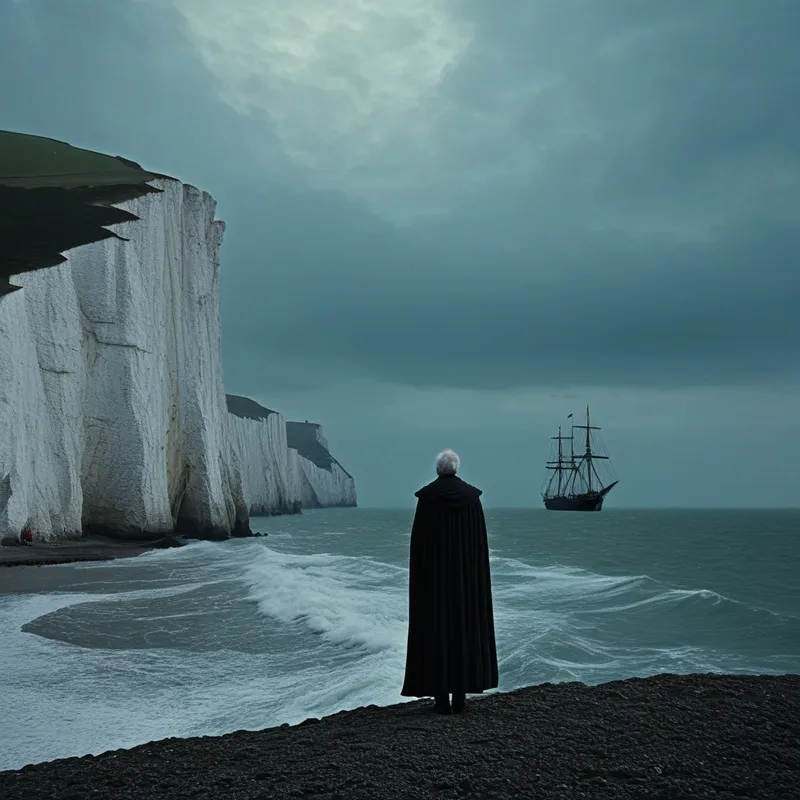
The White Cliffs of Dover in the story of Theseus Myth Meaning & Symbolism
A grieving Theseus, returning from Crete, raises white sails of victory, forgetting his promise and causing his father's fatal leap from the cliffs.
The Tale of The White Cliffs of Dover in the story of Theseus
Hear now the tale of a homecoming that was a funeral, of victory that tasted of ash. The story does not end in the dark belly of the [Labyrinth](/myths/labyrinth “Myth from Various culture.”/), with the beast slain. It ends on the sun-bleached, wind-scoured edge of [the world](/myths/the-world “Myth from Tarot culture.”/), where hope waits and shatters.
[Theseus](/myths/theseus “Myth from Greek culture.”/), son of Aegeus, had gone to Crete as tribute, one of the fourteen youths and maidens fed to the horror born of a queen and a bull. His father, old and weary with the burden of kingship, clung to him at the harbor. “My son,” he whispered, his voice raw with a fear deeper than [the sea](/myths/the-sea “Myth from Greek culture.”/), “if you return victorious, if you live, show me a sign. Let the ship come home under white sails. Let the black sails of mourning be left in the deep. I will watch every day from the highest cliff. White for life. Black for death.”
Theseus swore it. He descended into the stone throat of [the Labyrinth](/myths/the-labyrinth “Myth from Greek culture.”/), following the thread gifted by Ariadne, and did the bloody work. [The Minotaur](/myths/the-minotaur “Myth from Greek culture.”/) fell. He emerged, reeking of sweat and sacred violence, gathered the Athenian youths, and fled with Ariadne. But the gods are fickle, and fate is a tangled thread. On the isle of Dionysus, Ariadne was taken, and Theseus, in a grief-stricken stupor or a hubristic daze—the bards disagree—set sail for home.
And in his [triumph](/myths/triumph “Myth from Roman culture.”/), he forgot. The elation of survival, the weight of kingship now within his grasp, the salt spray washing the stench of the Labyrinth from his skin—it all conspired to erase the old man’s plea from his mind. The black sails, the sails of the ship that had carried him to his supposed death, remained hoisted. They billowed like a bruise against the blue sky as the ship cut through the Aegean toward Attica.
High on the white cliffs of Sounion—the precipice we now call the White Cliffs of Dover in the soul’s geography—Aegeus kept his vigil. Day after day, his eyes scoured [the horizon](/myths/the-horizon “Myth from Various culture.”/), a frail sentinel against despair. Then, a speck. A ship. His heart, a dry leaf, trembled. As it drew nearer, the shape of the sails clarified. Not the pure white of hope, but the deep, consuming black of loss.
The old king did not cry out. The truth was a physical blow, a final, absolute subtraction. The sea had taken his son. His line was ended. Athens was doomed. In that moment, the cliff was not a lookout post but an altar. He offered his body to the rocks and the hungry sea below, and the waters that were named for him—the Aegean Sea—swallowed him whole. Theseus sailed into harbor a hero, to be met not by his father’s embrace, but by a kingdom shrouded in a silence more profound than any he had found in the Labyrinth.
Cultural Origins & Context
This poignant coda to the [Minotaur](/myths/minotaur “Myth from Greek culture.”/) saga is primarily preserved in the works of later mythographers like Pseudo-Apollodorus and in the tragic sensibility of Athenian drama. It functions as a crucial narrative counterweight. In a culture that celebrated the arete of the hero, this myth served as a solemn reminder of the human cost of heroism. It was a story told not just to glorify Theseus, the founding hero-king of Athens, but to complicate him.
The setting of the cliff is key. High places in Greek myth are sites of revelation, sacrifice, and communication with the divine (or the finality of death). Aegeus’s watch-post transforms into a place of tragic anagnorisis. The myth was a cultural meditation on memory, the fragility of the old order, and the unintended consequences of the new. It asked [the polis](/myths/the-polis “Myth from Greek culture.”/): what is lost in the moment of our greatest victory? The father, representing the old ways and paternal lineage, is literally obliterated by the son’s forgetful success.
Symbolic Architecture
The myth’s power lies in its devastatingly simple symbolic [architecture](/symbols/architecture “Symbol: Architecture in dreams often signifies structure, stability, and the framing of personal identity or life’s journey.”/). The [Labyrinth](/symbols/labyrinth “Symbol: The labyrinth represents a complex journey, symbolizing the intricate path toward self-discovery and understanding one’s life’s direction.”/) represents the complex, monstrous challenge of the unconscious or a [life](/symbols/life “Symbol: The symbol of ‘Life’ represents a journey of growth, interconnectedness, and existential meaning, encompassing both the joys and challenges that define human experience.”/) [crisis](/symbols/crisis “Symbol: A crisis symbolizes turmoil, urgent challenges, and the need for immediate resolution or change.”/). The thread is the guiding [insight](/symbols/insight “Symbol: A sudden, deep understanding of a complex situation or truth, often arriving unexpectedly and illuminating hidden connections.”/) or [connection](/symbols/connection “Symbol: Connection symbolizes relationships, communication, and bonds among individuals.”/) that leads us through. But the return, the [integration](/symbols/integration “Symbol: The process of unifying disparate parts of the self or experience into a cohesive whole, often representing psychological wholeness or resolution of internal conflict.”/) of that victory into the fabric of [the self](/myths/the-self “Myth from Jungian culture.”/) and [community](/symbols/community “Symbol: Community in dreams symbolizes connection, support, and the need for belonging.”/), is where the deeper work—and the greater [danger](/symbols/danger “Symbol: The symbol of ‘Danger’ often indicates a sense of threat or instability, calling for caution and awareness.”/)—lies.
The Black and White Sails are not just signals; they are states of being. Black is the color of the unresolved past, of mourning, of the [identity](/symbols/identity “Symbol: Identity represents the sense of self, encompassing personal beliefs, cultural background, and social roles.”/) forged in confrontation with [death](/symbols/death “Symbol: Symbolizes transformation, endings, and new beginnings; often associated with fear of the unknown.”/). White is the color of purified return, of conscious integration, of life reaffirmed. Theseus, carrying the unconscious black sail of his traumatic victory, fails to consciously raise the white sail of his transformed self.
The greatest labyrinth is not the one we escape, but the one we carry back with us, unacknowledged.
The White Cliffs themselves are [the threshold](/myths/the-threshold “Myth from Folklore culture.”/) of home, the [precipice](/symbols/precipice “Symbol: A steep cliff edge representing a critical boundary between safety and danger, often symbolizing life transitions, fear of the unknown, or existential risk.”/) of the known world. They symbolize the [psyche](/myths/psyche “Myth from Greek culture.”/)’s edge, where hope and identity are most vulnerable. Aegeus standing there is the “old [consciousness](/symbols/consciousness “Symbol: Consciousness represents the state of awareness and perception, encompassing thoughts, feelings, and experiences.”/),” the prior self, waiting to see what [version](/symbols/version “Symbol: Version refers to the different adaptations or interpretations of a narrative or concept.”/) of his son—what version of his own future—will return. The failure of the signal is a failure of communication between the transformed [hero](/symbols/hero “Symbol: A hero embodies strength, courage, and the ability to overcome significant challenges.”/) and the world he left behind.
The Dreamer’s Resonance
When this myth pattern stirs in modern dreams, it often manifests not as a classical narrative, but as a somatic and emotional landscape. The dreamer may find themselves:
- On a high place, watching for a sign that never comes, or comes in the wrong form. This speaks to anxiety about a crucial outcome, a feeling of being disconnected from a result you cannot control.
- Realizing, with gut-wrenching horror, that they have forgotten a vital promise or task, often just as it is too late. This is the psyche highlighting a neglected duty to the self—a forgotten aspect of one’s own well-being or integrity.
- Seeing a loved one turn away and fall from a height after the dreamer’s own success. This can symbolize the psychological “death” of an old relationship or internalized parental voice that cannot survive the dreamer’s new, empowered state.
The somatic process is one of anticipatory hope collapsing into irrevocable loss. The dreamer is working through the guilt of progress, the fear that their growth or triumph inherently damages their past connections or their own innocent self.
Alchemical Translation
In the alchemical vessel of individuation, this myth models the peril of the coniunctio—the sacred return. The heroic descent ([nigredo](/myths/nigredo “Myth from Alchemical culture.”/)) into the labyrinthine shadow is only the first half of the work. The triumphant slaying of the inner monster (the Minotaur) must be followed by the careful, conscious journey back to the surface.
Theseus’s fatal error is alchemical failure. He achieves the albedo (purification) in killing the beast but neglects the crucial act of displaying it—of integrating and communicating his whiteness. He remains identified with the blackness of the ordeal. The old king, the former ruling principle of the psyche (Aegeus), cannot recognize or accommodate this unresolved, shadow-carrying victor and must die.
Individuation requires that we not only conquer our monsters, but also learn the language to describe the battle to the parts of us that stayed behind.
For the modern individual, the alchemical instruction is clear: after your great ordeal, after your victory in the dark, you must consciously change your sails. You must perform the ritual of return. You must find a way to signal to your own “Aegeus”—your old identities, your responsibilities, your inner parent—that you have changed, that you live, and that you return not just as a conqueror, but as an integrated being. Otherwise, you risk becoming a king in a land defined by your first, most devastating oversight, forever ruling in [the shadow](/myths/the-shadow “Myth from Jungian culture.”/) of a cliff where your own past leapt into the sea.
Associated Symbols
Explore related symbols from the CaleaDream lexicon: