The Wheel of Fortune in mediev Myth Meaning & Symbolism
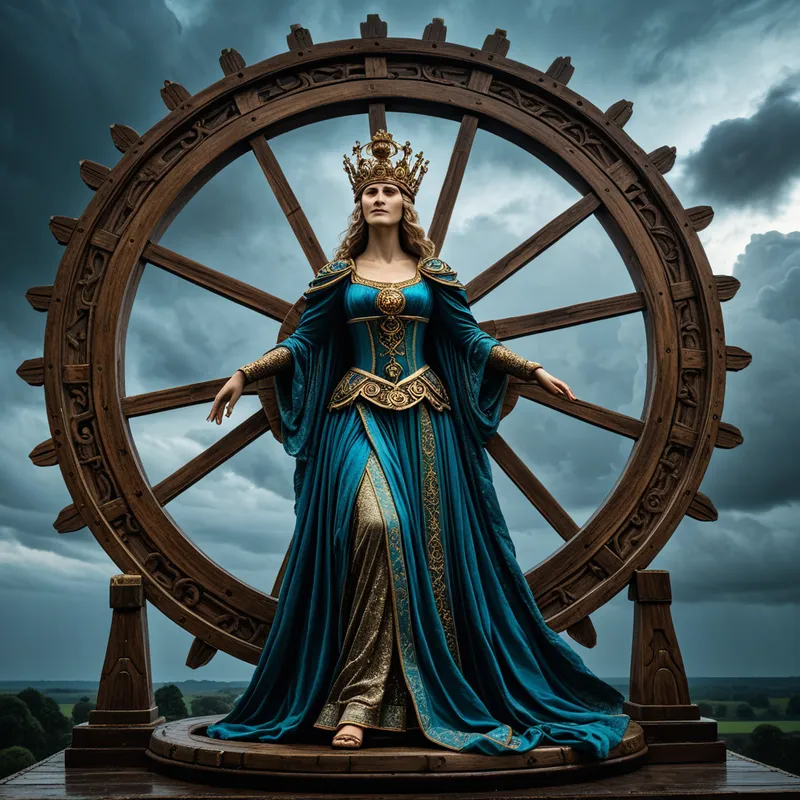
The goddess Fortuna spins her great wheel, raising kings to glory and casting them into ruin, teaching the eternal lesson of impermanence and grace.
The Tale of The Wheel of Fortune in mediev
Hear now the turning of the world, the groaning of the axle upon which all mortal hopes are hung. In a realm beyond time, where the air smells of cold stone and damp earth, she waits. She is Fortuna, and her eyes are veiled. Not in sleep, but in a terrible, impartial wakefulness that sees not persons, only patterns. In her hands rests a wheel, vast as the year, heavy as history.
Listen to the creak of the oak, the rasp of the iron rim. Upon its circumference, four souls are bound. At the zenith, a figure crowned in gold, Rex. His robes are purple, his face flushed with the wine of authority. He believes the sun rises at his command. To his right, ascending the curve, is one whose eyes are wide with hunger—Regnabo. His fingers claw at the splintering wood, straining for the crown he can almost taste.
Below, in the dark of the nadir, lies a figure in the mud—Sum sine regno. His regalia is torn, his crown long lost to the mire. He weeps not for his kingdom, but for the memory of its warmth. And to the left, beginning the slow, inevitable slide from glory, is Regnavi. His scepter slips from a trembling hand; his eyes hold the dawning horror of the descent.
Fortuna’s hands, neither cruel nor kind, begin to turn. The wheel moves with a sound like a mountain sighing. The king at the peak throws back his head to laugh, but the laugh becomes a gasp as the world tilts. The sky, once a canopy of blue above him, becomes a wall, then a ceiling. The golden throne becomes a precipice. He falls, not with a crash, but with the soft, sickening whisper of velvet dragging through filth.
As he falls, the one who was climbing feels the wood rise to meet his feet. The strain leaves his muscles. The crown, tumbling from the fallen king’s brow, lands roughly in his lap. The cold gold burns his thighs. He looks up, and where there was sky, there is now only the next arc of the wheel, waiting. The one in the mud feels a tug, a slow, grinding lift. The cold earth releases him. He rises, empty-handed, cleansed by despair, looking not up at the crown but out at the vast, indifferent landscape through which the wheel travels.
And Fortuna turns. And turns. The only constant is the groan of the axle, the whisper of the rim through eternity, and the four Latin sighs that mark the stations: Regnabo, Regno, Regnavi, Sum sine regno—I shall reign, I reign, I have reigned, I am without reign. The wheel does not stop. It is the only truth she knows.
Cultural Origins & Context
This potent allegory found its most vivid expression in the High and Late Middle Ages, though its roots dig deep into the soil of classical antiquity, into the temples of the Roman Fortuna and the Greek Tyche. It was medieval scholars, poets, and preachers who welded this pagan symbol to a Christian worldview, creating a central metaphor for the human condition. It was depicted in illuminated manuscripts like the Carmina Burana, carved into cathedral facades, and recited in morality plays.
Its primary societal function was didactic and consolatory. For the powerful, it was a memento mori—a stark reminder that earthly power is fleeting and pride precedes a fall. For the suffering and the lowly, it offered a grim but potent hope: no state is permanent. The wheel turns. Your suffering, too, shall pass. It was a narrative tool to explain the brutal vicissitudes of life in an era of plague, war, and political upheaval, teaching a stoic humility and a focus on the eternal rather than the temporal.
Symbolic Architecture
The myth’s power lies in its stark, geometric symbolism. The Wheel is the perfect symbol of cyclical time, fate, and the inherent instability of all worldly constructs. It represents the archetypal pattern of rise and fall, success and failure, that governs not only kingdoms but individual lives.
To be bound to the wheel is to be identified with one’s station. To witness its turning from the center is to achieve the soul’s liberation.
The four figures are not individuals but psychic positions. Regnabo is Ambition, the ego’s future-projecting desire. Rex is Inflation, the ego identified wholly with its power and prestige. Regnavi is the Shadow of Loss, the painful dissolution of that identity. Sum sine regno is the Naked Self, the ego stripped bare, lying in the humus of humility. Fortuna herself is not fate as a predetermined script, but as the principle of radical contingency—the unpredictable, amoral context of life that our egoic plans inevitably encounter.
The Dreamer’s Resonance
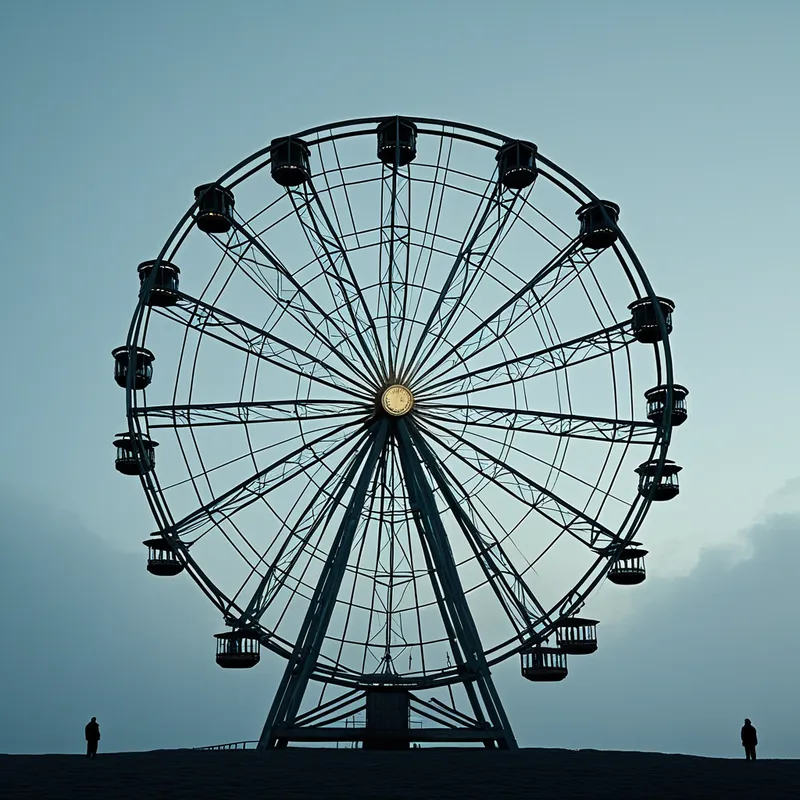
When the Wheel appears in modern dreams, it often signals a profound encounter with the archetype of impermanence. The dreamer may be riding high in a gondola that suddenly plummets, or desperately clinging to a spinning carnival wheel. The somatic experience is one of vertigo, loss of control, and gravitational terror.
Psychologically, this dream motif surfaces when one is overly identified with a temporary state—be it a professional success, a social role, or a state of misery. The unconscious is presenting the turning of the wheel, forcing the dreamer to experience the relativity of their position. It is a call to dis-identify. The anxiety in the dream is the ego’s protest against this enforced movement, this death of a cherished self-image. The dream is not predicting a literal downfall, but initiating a necessary psychic correction, preparing the consciousness for a coming transition it may be resisting in waking life.
Alchemical Translation
The individuation process modeled here is the mortificatio and sublimatio of the ego. The hero’s journey in this myth is not to stop the wheel, but to move from its circumference to its still center—to the hub where Fortuna’s hands rest.
The alchemical gold is not the crown at the top, but the peace at the center. It is the self that observes Rex and Sum sine regno with the same compassionate detachment.
The initial state is identification with Regnabo or Rex—the ego’s striving and triumph. The necessary nigredo, or dark night, is the devastating fall to Sum sine regno. This is not a failure, but the crucial dissolution of the persona. In the mud of ruin, all attachments are stripped away. The psychic transmutation occurs when, from this state of humility, one ceases to fight the turning and instead asks: Who is the ‘I’ that is being raised and cast down? This inquiry leads inward, to the hub. The integrated individual learns to participate in the world of the wheel—to reign, to strive, to lose—but from a ground of being that is no longer subject to its rotations. They achieve the “grace under pressure” that comes from knowing all positions are temporary, and that true sovereignty is an inner, not an outer, condition.
Associated Symbols
Explore related symbols from the CaleaDream lexicon: