The Wheel of Fate Myth Meaning & Symbolism
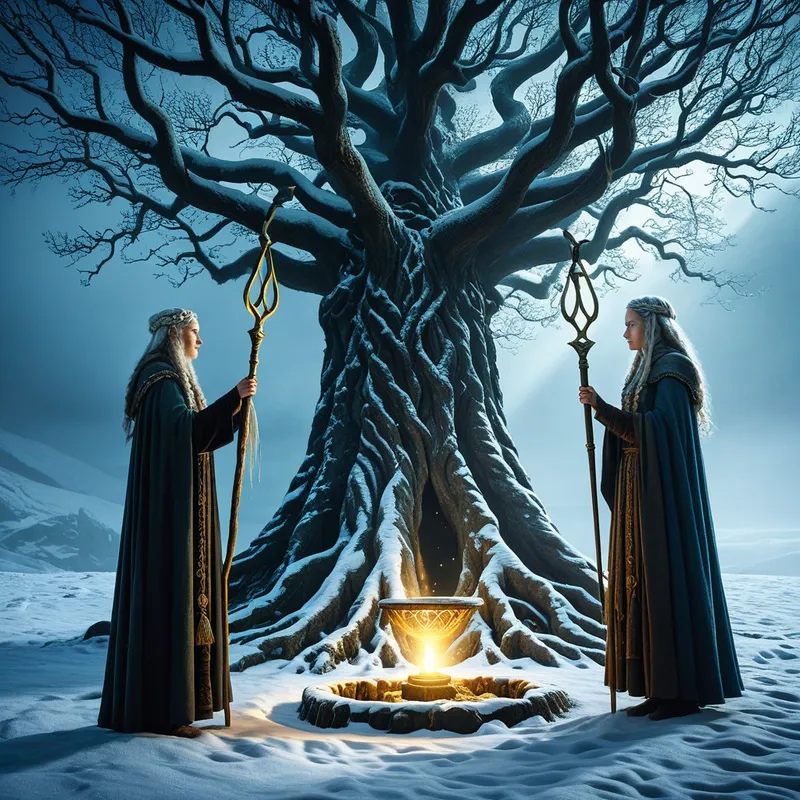
The Norns spin the threads of fate at the Well of Urd, weaving the destinies of gods and mortals into an unbreakable cosmic tapestry.
The Tale of The Wheel of Fate
Listen, and hear the whisper from the roots of [the world](/myths/the-world “Myth from Tarot culture.”/). Not a wheel that turns, but a loom that weaves. Beneath the great [Yggdrasil](/myths/yggdrasil “Myth from Global/Universal culture.”/), where its three mighty roots drink from three separate springs, there lies the most sacred well: Urdarbrunnr. Its waters are memory, and its surface is time.
Here, in the perpetual twilight at the foot of all things, dwell [three sisters](/myths/three-sisters “Myth from Native American culture.”/). They are not goddesses of Æsir or Vanir. They are older, deeper, colder. Urd, whose name is Fate. Verdandi, whose name is Becoming. [Skuld](/myths/skuld “Myth from Norse culture.”/), whose name is Debt. Each day, they draw [water](/myths/water “Myth from Chinese culture.”/) from the well and mix it with the sacred white clay that gathers at its rim. They sprinkle this mixture over Yggdrasil’s roots, to keep the great ash from rotting.
But this is not their primary work. From [the mist](/myths/the-mist “Myth from Celtic culture.”/) that rises from the well, they draw forth threads. Urd, with hands that remember everything, spins the raw thread of being onto a great spindle. Verdandi, with a gaze that sees the unfolding moment, measures the thread’s length, her fingers feeling its texture—strong here, weak there, knotted with choice and consequence. And Skuld, who carries a shears of impossible sharpness, waits. She does not smile. She does not frown. She is necessity.
They weave. Not on a horizontal loom, but into the very fabric of the tree’s bark, into the soil of [the nine worlds](/myths/the-nine-worlds “Myth from Norse culture.”/), into the breath of the gods and the heartbeat of [the worm](/myths/the-worm “Myth from Biblical culture.”/). The thread of a king is thick and golden, but may be cut short. The thread of a poet is silver and shimmering, tangled with many colors. The thread of Odin All-Father is a complex cable of countless strands, some dark as a [raven](/myths/raven “Myth from Haida culture.”/)’s wing, some bright with stolen wisdom. They weave the ørlög—the primal layers of law laid down at creation—and the wyrd of every being that lives beneath the branches.
Even the gods come here, in awe and in dread. For they know the threads are fixed. The pattern, once woven, cannot be unwoven. The great tapestry hangs in the hall of time, and its final image is [Ragnarök](/myths/ragnark “Myth from Norse culture.”/)—the twilight where all threads, even those of the gods, are finally, cleanly, severed by Skuld’s shears. This is the silent, eternal work at the root of reality: the spinning, the measuring, the cutting. The wheel is not of fortune, but of necessity. And its hub is the well of all that was, and all that ever will be.
Cultural Origins & Context
The concept of [the Norns](/myths/the-norns “Myth from Norse culture.”/) and their decree is not a single, codified myth from a sacred text, but a pervasive, underlying truth woven throughout the Poetic Edda and the later Prose Edda. It was a foundational pillar of the Norse worldview, passed down not in temples by priests, but in halls by skalds and around hearths by elders. This was a culture intimately acquainted with harsh necessity—the unforgiving sea, the lean winter, the finality of the blade. The myth of [the Norns](/myths/the-norns “Myth from Norse culture.”/) provided a framework for this reality, transforming blind chance into a solemn, if grim, order.
The societal function was profound. It fostered a specific type of courage: not the hope of changing fate, but the resolve to meet it well. A man’s wyrd was his to navigate, but his ørlög was fixed. This created a heroic ethos centered on dignity in the face of the inevitable. The myth removed the burden of ultimate control, while placing the weight of honorable conduct squarely on the individual. To go “to meet one’s fate” was the highest expression of agency within a predetermined cosmos.
Symbolic Architecture
The [Norns](/myths/norns “Myth from Nordic culture.”/) represent the tripartite [structure](/symbols/structure “Symbol: Structure in dreams often symbolizes stability, organization, and the framework of one’s life, reflecting how one perceives their environment and personal life.”/) of time itself—Past (Urd), Present (Verdandi), and Future (Skuld)—not as a [linear](/symbols/linear “Symbol: Represents order, predictability, and a direct, step-by-step progression. It symbolizes a clear path from cause to effect.”/) [sequence](/symbols/sequence “Symbol: The symbol of ‘sequence’ often signifies the order of events and the progression towards a desired outcome or goal.”/), but as interdependent forces actively creating the now. [The Well of Urd](/myths/the-well-of-urd “Myth from Norse culture.”/) is the unconscious, the deep pool of [memory](/symbols/memory “Symbol: Memory symbolizes the past, lessons learned, and the narratives we construct about our identities.”/), experience, and ancestral inheritance from which the raw [material](/symbols/material “Symbol: Material signifies the tangible aspects of life, often representing physical resources, desires, and the physical world’s influence on our existence.”/) of our being is drawn.
The thread is not your life’s path; it is the inherent pattern of your psyche, spun from the clay of your origins and the water of your experience.
The spinning is the process of becoming, of bringing latent potential into form. The measuring is [consciousness](/symbols/consciousness “Symbol: Consciousness represents the state of awareness and perception, encompassing thoughts, feelings, and experiences.”/)—the act of [perception](/symbols/perception “Symbol: The process of becoming aware of something through the senses. In dreams, it often represents how one interprets reality or internal states.”/), [choice](/symbols/choice “Symbol: The concept of choice often embodies decision-making, freedom, and the multitude of paths available in life.”/), and [evaluation](/symbols/evaluation “Symbol: A process of assessment, judgment, or measurement of worth, performance, or quality, often implying external scrutiny.”/) that gives the thread its current meaning and [tension](/symbols/tension “Symbol: A state of mental or emotional strain, often manifesting physically as tightness, pressure, or unease, signaling unresolved conflict or anticipation.”/). The cutting by Skuld is not merely [death](/symbols/death “Symbol: Symbolizes transformation, endings, and new beginnings; often associated with fear of the unknown.”/), but every necessary ending: the closing of chapters, the death of old selves, the sacrifices required for growth. Skuld’s name, “[Debt](/symbols/debt “Symbol: A symbolic representation of obligations, burdens, or imbalances that extend beyond financial matters into psychological and moral realms.”/),” speaks to the inescapable law of psychic cause and effect; every [choice](/symbols/choice “Symbol: The concept of choice often embodies decision-making, freedom, and the multitude of paths available in life.”/) incurs a [debt](/symbols/debt “Symbol: A symbolic representation of obligations, burdens, or imbalances that extend beyond financial matters into psychological and moral realms.”/) that must be paid, integrating its consequences into the whole self.
The Dreamer’s Resonance
When this myth stirs in the modern unconscious, it often manifests not as three women, but as the feeling of an inexorable process. One might dream of vast, impersonal machinery—gears, looms, or clocks—operating in a deep, subterranean chamber. There may be a sense of being measured, of a thread being pulled taut, or of a silent, decisive cut.
Somatically, this can correlate with periods of profound life transition: the end of a relationship, a career shift, a health diagnosis, or the confrontation with aging. The psychological process is [the ego](/myths/the-ego “Myth from Jungian culture.”/)’s confrontation with [the Self](/myths/the-self “Myth from Jungian culture.”/)—the greater, timeless totality of the [psyche](/myths/psyche “Myth from Greek culture.”/). The dreamer is experiencing the tension between their personal will (the desire to control the thread) and the archetypal pattern of their own destiny (the woven tapestry). It is the somatic recognition of wyrd in action, a call to align one’s conscious attitude with a deeper, unfolding necessity.
Alchemical Translation
The individuation process, the journey toward psychic wholeness, is mirrored perfectly in Odin’s quest. He does not go to the Norns to argue or beg; he goes to gain sight. His famous self-sacrifice, hanging on Yggdrasil, is the ultimate act of ego-surrender to gain wisdom from the well of the unconscious (the Well of Urd).
The alchemical goal is not to seize the shears from Skuld, but to gain the vision of Urd and the conscious participation of Verdandi in one’s own weaving.
For the modern individual, the “alchemical translation” of this myth involves several stages. First, Drawing from the Well: Engaging with one’s past, memories, and inherited patterns (family, culture, trauma) with honesty, drawing them up into the light of consciousness. Second, Spinning with Intent: Taking that raw material and actively, creatively shaping it into the narrative of one’s life, owning one’s choices as the spinner of their thread’s quality. Third, Conscious Measuring: Practicing mindful presence (Verdandi), assessing the current state of one’s life-pattern without illusion. Finally, Honoring the Cut: Recognizing that growth requires endings—letting go of outworn identities, relationships, and beliefs with the dignity of Skuld, understanding these cuts are not punishments but prerequisites for new weaving.
The ultimate transmutation is moving from a relationship of fear and submission to the Wheel of Fate, to one of sacred collaboration. One becomes, in a small but vital way, a participant in the hall of the Norns, weaving one’s destined pattern not in blind obedience, but with hard-won wisdom and courageous acceptance.
Associated Symbols
Explore related symbols from the CaleaDream lexicon: