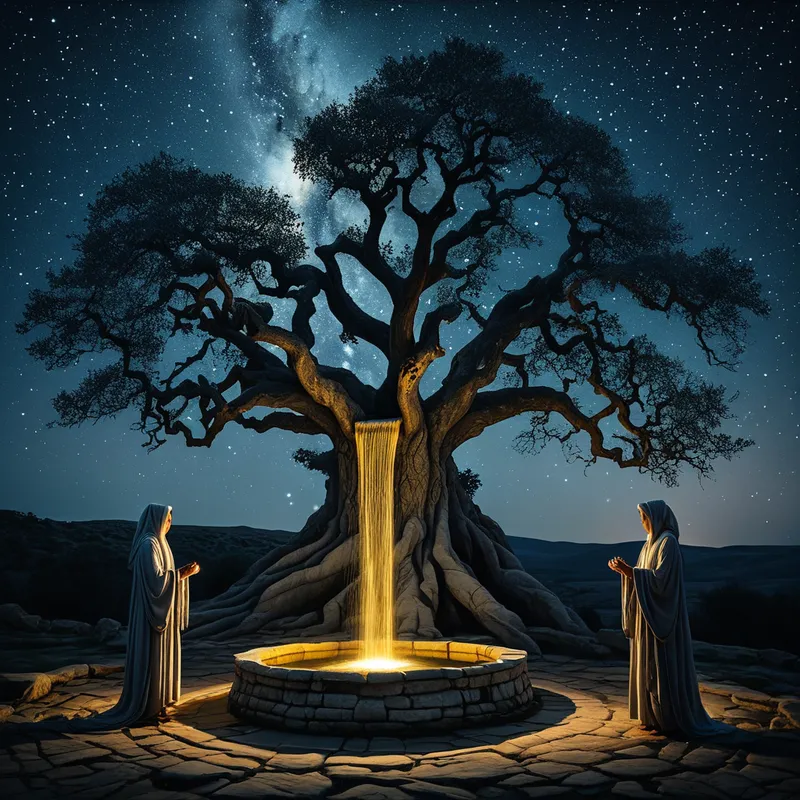
The Well of Wyrd / Urdarbrunnr Myth Meaning & Symbolism
At the root of the world tree, three sisters tend a sacred well, weaving the threads of fate for all beings from the waters of memory and time.
The Tale of The Well of Wyrd / Urdarbrunnr
Listen. Beneath the groaning roots of the Yggdrasil, where the soil is black with forgotten ages and the air hums with the whispers of what was and what may yet be, there lies a place of silent power. It is not a place for the bold or the brash, but for the knowing. Here, at the Well of Wyrd, also called Urdarbrunnr, time does not flow in a line but pools, deep and still.
Three figures are always present, their forms as ancient as the dust of stars. They are the Norns. Urd is the eldest, her face a map of every sorrow and joy that has ever been, her eyes holding the depth of the well itself. Verdandi stands with a poised intensity, her gaze fixed on the shimmering surface of the waters, watching the now as it crystallizes from the liquid past. Skuld, often veiled, holds a shearing blade, her posture one of inevitable consequence.
Each day, as the serpent Nidhogg stirs in the murk below and the eagle calls from the highest branch, they begin their work. Urd dips a weathered ewer into the well. The water she draws is not clear, but dark, swirling with mist and memory—the sap of the world tree, the tears of gods, the echoes of every spoken word. From this primal liquid, the sisters draw forth substance. With fingers that move like falling ash and rising mist, they spin. They spin threads that gleam like gold in starlight, that fray like old wool, that run cold as ice or warm as blood.
These threads are the örlög of all things: of the Aesir in their golden halls, of the Vanir in their fertile fields, of every man, woman, and beast that walks upon Midgard. They weave them into a vast, living tapestry that hangs in the air, its patterns infinitely complex, its edges forever unfinished. A single thread snaps with a sound like a dying breath, and Skuld’s blade flashes, severing what must be severed. Verdandi’s quick hands catch the new strand Urd offers, weaving it into the ever-unfolding now. The water splashes softly. The roots drink. The tree, for another moment, endures.
Even Odin, the seeker of secrets, comes here not as a king but as a supplicant. In the deepest silence, he laid down his eye as a pledge, dropping it into the dark water to gain a draught of the well’s sight. He hungers for the knowledge that pools here, for to see the weave is to touch the bones of reality itself. But the Norns do not speak to him. They only weave. Their silence is the loudest sound in all the nine worlds.
Cultural Origins & Context
The myth of the Well of Wyrd is preserved primarily in the Old Norse texts of the 13th century, the Poetic Edda and the Prose Edda, though its roots are undoubtedly far older. It is a cornerstone of the Norse cosmological vision, providing the metaphysical engine for their understanding of fate, time, and moral consequence. Unlike the Greek Moirai, who are often portrayed as impersonal and inflexible, the Norns embody a more complex relationship with destiny. They are not merely announcers of a fixed future but active weavers who draw from the waters of the past (Urðr) to shape the present and the necessary future.
This myth was not just a story for the elite; it was a functional part of the Germanic worldview, reflected in the legal concept of wyrd itself—the inescapable result of one’s actions piling upon themselves. It was told by skalds and around hearths to explain the often harsh and inexplicable turns of life in a northern world. The well situated under Yggdrasil, the axis of all worlds, signifies that fate is not an external force but is intrinsic to the structure of reality itself, nourishing and sustained by the cosmic tree. The myth served to instill a sense of sober responsibility (one’s actions become part of the well’s water) alongside a profound humility before the vast, impersonal workings of the cosmos.
Symbolic Architecture
The Well of Wyrd is a profound symbol of the unconscious, specifically the collective and personal past that deterministically shapes the present. The well is the repository of all that has happened—every memory, trauma, choice, and ancestral pattern. Its waters are dark because the roots of our being are largely hidden from conscious view.
The past is not dead history; it is living water, and we drink from it every day, becoming what we have been.
The Norns represent the psychic function that processes this raw material of experience. Urd is the weight of personal and ancestral history, the established complexes. Verdandi is the ego-consciousness, attempting to weave the given threads into a coherent present identity. Skuld is the critical, often punitive, voice of the super-ego or the inevitability of psychological cause and effect—the “debt” (the meaning of her name) that must be paid for past actions. The tapestry they weave is the phenomenal world of our lived experience, perceived through the lens of our personal wyrd. Odin’s sacrifice of his eye signifies the terrible price of true self-awareness: to see into the unconscious (the well), one must sacrifice one-sided, purely outward-looking consciousness.
The Dreamer’s Resonance
When this myth stirs in the modern psyche, it often manifests in dreams of deep, reflective water—pools, wells, or dark lakes—in subterranean or root-filled places. The dreamer may find themselves drawing water, fearful of what they might see in it, or trying to read a complex, woven pattern. There is a somatic quality of being “root-bound” or feeling the pull of old, deterministic patterns.
Psychologically, this signals a process of confronting one’s örlög—the ingrained life-patterns laid down by family, culture, and personal trauma. The dreamer is at the threshold of the unconscious, where the automatic, fate-like repetitions of their life (the weaving) are becoming visible. It is a moment of profound responsibility, where one is asked to acknowledge: “I am woven from this.” The anxiety in such dreams is the ego’s resistance to seeing how it is not entirely the master of its own house, but also the servant of deeper, older waters.
Alchemical Translation
The alchemical work modeled by this myth is the solutio—the dissolution of the hardened structures of the personality back into their primal, fluid state. The goal is not to be ruled by the waters of the well (the unconscious complexes) but to consciously drink from them, to integrate their substance.
Individuation begins not with forging a new self, but with the courageous dissolution of the old one in the waters of memory.
The modern individual’s journey mirrors Odin’s quest. First, one must journey “downward” to the roots of one’s being (entering therapy, engaging in shadow work, confronting family history). There, one encounters the threefold process: honoring the truth of what has been (Urd), observing with clarity how it actively shapes the present (Verdandi), and consciously accepting the necessary endings and changes this awareness demands (Skuld). The sacrifice is the cherished self-image—the “eye” that sees only what it wants to see. In return, one gains a draught of mead from the well—a wisdom that is not intellectual but embodied, a capacity to see the weave of one’s own life and, in that seeing, find a new degree of freedom within necessity. One does not cut the threads of fate but learns to weave with them consciously, becoming, in a small way, a co-creator with the Norns at the root of one’s own world-tree.
Associated Symbols
Explore related symbols from the CaleaDream lexicon: