The Well of Urd in Norse mytho Myth Meaning & Symbolism
At the root of the world tree lies a sacred well where three sisters weave fate, and the gods themselves seek wisdom from the waters of origin.
The Tale of The Well of Urd in Norse mytho
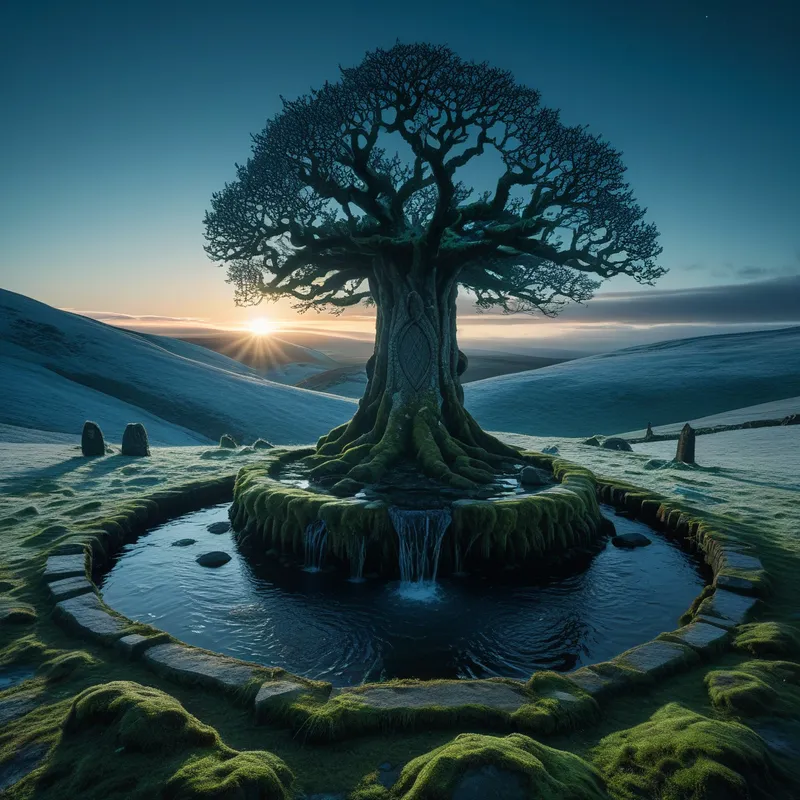
Beneath the groaning weight of the worlds, in a silence older than song, lies a place where time itself pools and thickens. Here, at the deepest root of the Yggdrasil, where its bark is gnarled by frost and its sap runs slow as glaciers, the earth opens into a sacred hollow. This is Urd’s Well.
The air is heavy with the scent of wet stone, damp soil, and the profound chill of origins. No bird sings here, only the slow drip, drip of water from the roots into the still, dark pool. Its surface is a perfect, black mirror, yet it holds no reflection of the sky—only depth, an inward-turning gaze into what has been and what must be.
To this place come three. They are the Norns, and they are not gods, though the gods heed them. Urd is the eldest, her face a landscape of memory, her eyes holding the twilight of all yesterdays. Verdandi stands beside her, vibrant and present, her gaze fixed on the shimmering, unfolding moment. Skuld, the youngest, is veiled, a shape of stern potential, holding a shears whose blade catches no light.
Each day, they draw water from the well, a liquid that is not quite water, and a sand that is not quite sand. With these, they tend to the root of the Yggdrasil, washing it, packing the sacred mud around its wounds to keep the great tree from rotting. But their greater work is done at the well’s rim. There, they weave. They spin threads drawn from the well’s essence—glistening, taut strands that are the lives of gods and men, of giants and dwarves. Urd lays down the pattern, the fixed points of the past. Verdandi works it into the vibrant, uncertain now. And Skuld waits, her hand resting on the thread, ready to cut when the pattern is complete.
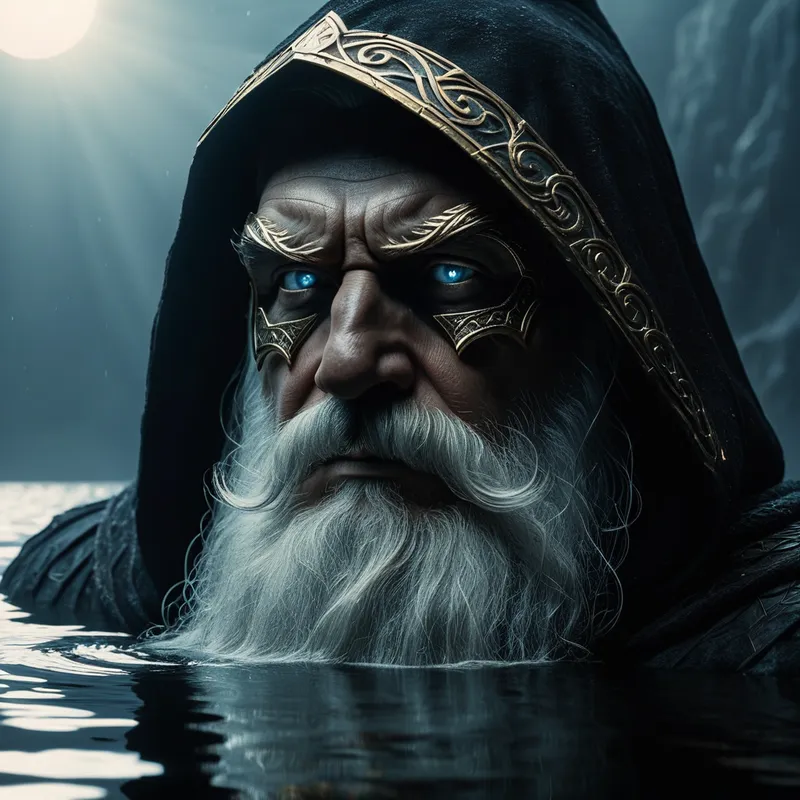
Even the All-Father, Odin, the seeker of secrets, comes here as a supplicant. He left one of his eyes in these waters, a sacrifice for a drink of wisdom. He hangs for nine nights on the world tree, a spear in his side, to win the runes. But here, at the well, the price is memory itself, the acknowledgment of all that has been laid down. The gods hold their council here, riding over the Bifrost to sit on the plains of Idavoll, their judgments informed by the whispers that rise from the dark water. For this well does not predict; it contains. It is the reservoir of all that is real, the source from which the tapestry of ørlög is drawn. And in its silent, patient depths, the doom of gods and the turning of worlds are already sleeping, waiting to be remembered.
Cultural Origins & Context
The myth of the Well of Urd is preserved primarily in the Old Norse poetic texts of the Poetic Edda, particularly in the Völuspá (The Prophecy of the Seeress) and Gylfaginning from Snorri Sturluson’s later Prose Edda. These sources are our windows into a worldview that was already ancient and fragmenting by the time it was recorded in 13th-century Iceland. The myth was not a simple folktale but a core piece of cosmological architecture, explaining the nature of time, causality, and divine authority.
The tellers of this myth were the skalds (poets) and possibly seeresses, individuals who trafficked in symbolic language. Its societal function was profound. In a culture that valued heroic action and personal honor, the concept of a fixed fate woven by external powers created a potent existential tension. The myth did not encourage passivity, however. Instead, it framed life as a drama played out within a set of parameters laid down by the past (Urd). The well represented the ultimate source of real knowledge—not speculation, but the hard, cold truth of what has already transpired and the necessary consequences that flow from it. The gods’ council at the well underscored that even divine power must align itself with this deeper, older layer of reality. It was a myth that grounded a seemingly chaotic and violent world in an immutable, if somber, order.
Symbolic Architecture
The Well of Urd is not a wishing well; it is the well of what is. Its symbolism forms a triadic structure of profound psychological depth.
First, it is the Well of Memory and the Past. The waters are the collective and personal unconscious, where every event, thought, and feeling is indelibly recorded. Urd’s domain is the foundational layer of the psyche—the traumas, joys, and patterns inherited and experienced that shape our core being. The past is not dead here; it is a living, wet root feeding the present.
To drink from Urd’s Well is to dare to remember everything, to integrate the shadow of one’s own history, for only in those dark waters can the roots of the present be truly seen.
Second, it is the Loom of Becoming. The three Norns represent the process of fate not as a singular decree, but as a continuous weaving. Verdandi** is the present moment of choice and action, where the thread from the past is actively worked. Skuld** is not merely “the future,” but necessity—the inevitable result, the debt (skuld) that comes due from the pattern woven. This transforms fate from a prison into a dynamic tapestry where our current actions are the active agents of the weave.
Third, it is the Sacrifice for True Sight. Odin’s ordeal here is the archetype of the ego’s sacrifice for deeper wisdom. He gives up his “eye”—his singular, outward-facing perspective, his daylight consciousness—to gain insight from the well’s reflective depths. This symbolizes the psychological necessity of relinquishing our limited, controlling viewpoint to gain access to the nourishing, if often painful, wisdom of the unconscious.

The Dreamer’s Resonance
When the imagery of Urd’s Well surfaces in modern dreams, it signals a profound engagement with the deep psyche. The dreamer is not merely recalling a story; they are experiencing a somatic and psychological process of confronting their own ørlög.
Dreaming of a deep, dark well in a foundational place (a basement, under a great tree, at the center of a labyrinth) often coincides with a life phase of reckoning. It is a time of asking, “How did I get here?” The still water represents the unconscious mind inviting—or demanding—introspection. The appearance of three feminine figures, or the sense of a weaving or pattern, suggests the dreamer is becoming conscious of the interplay between their past conditioning, their present choices, and the likely outcomes. This can feel fateful, even oppressive.
Somatically, this dream pattern may be accompanied by feelings of deep chill, gravity, or a pulling downward. It is the psyche’s equivalent of grounding, of connecting to the root system of one’s being. The process at work is one of anamnesis—the recovery of lost memory—not as intellectual recall, but as a full-bodied re-membering of fragmented parts of the self. The dream is a council at the roots, where the ruling complexes of the ego must sit and listen to the older, wiser, and often more severe voices from the well of personal and ancestral history.
Alchemical Translation
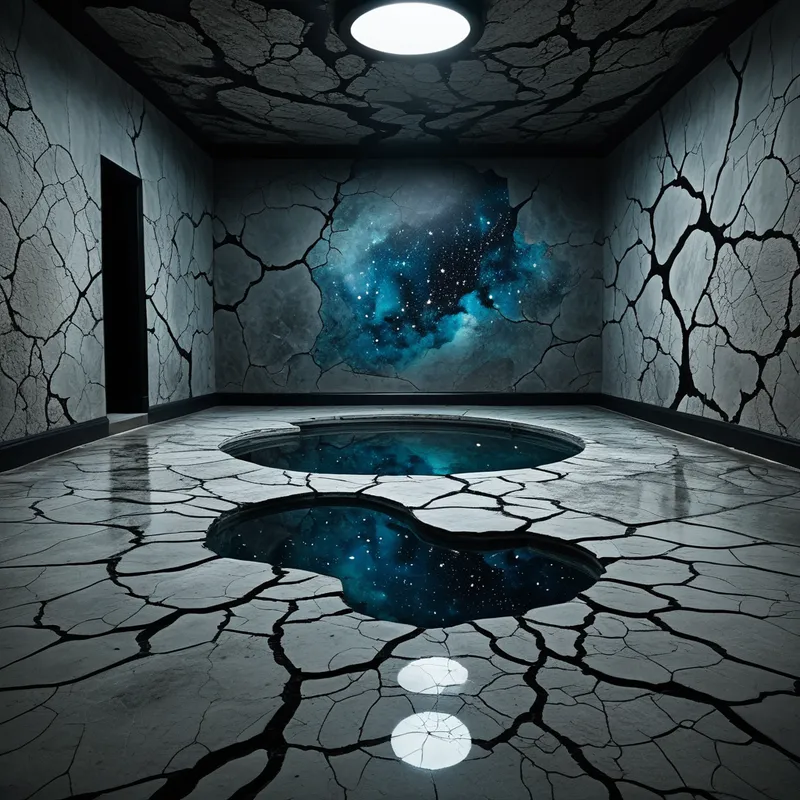
The myth of Urd’s Well provides a stark and powerful model for the alchemical process of individuation—the psychic transmutation of the base lead of the fragmented self into the gold of wholeness. This is not a quest for glory, but a descent for integrity.
The first operation is the descent to the prima materia: the journey inward to the root of one’s being, to the cold, dark well of the personal unconscious. This is the nigredo, the blackening, where one confronts the un-watered, wounded roots of one’s own world-tree. The “mud” of the well—the painful memories and complexes—is not to be discarded, but is the very substance needed to pack and heal the wounds.
The alchemical gold is not found by escaping fate, but by consciously drinking from the well that contains it, transforming blind destiny into a known, and therefore navigable, journey.
The second operation is the sacrifice of the ruling principle. Odin’s eye is the ego’s certainty. Individuation requires sacrificing the illusion of total conscious control, the single-pointed perspective that ignores the depths. One must offer this up to gain the binocular vision of consciousness in dialogue with the unconscious. This is the solutio—dissolution in the waters of the well.
Finally, the process involves sitting in council at the root. The ego does not become the Norn; it becomes the god who rides to the well for counsel. The integrated individual learns to regularly “ride to Idavoll,” to consult the deeper wisdom of the self. They understand that their life is a weaving where they hold the shuttle of Verdandi, actively working with the threads provided by Urd, with a respectful awareness of the shears of Skuld. In this model, psychic transmutation is the alignment of the conscious will with the deeper pattern of the self, achieving not control over fate, but a sacred collaboration with it.
Associated Symbols
Explore related symbols from the CaleaDream lexicon: