The Well of Urd Myth Meaning & Symbolism
At the root of the world tree lies a sacred well where the Norns weave fate, a place of profound memory, judgment, and the source of all becoming.
The Tale of The Well of Urd
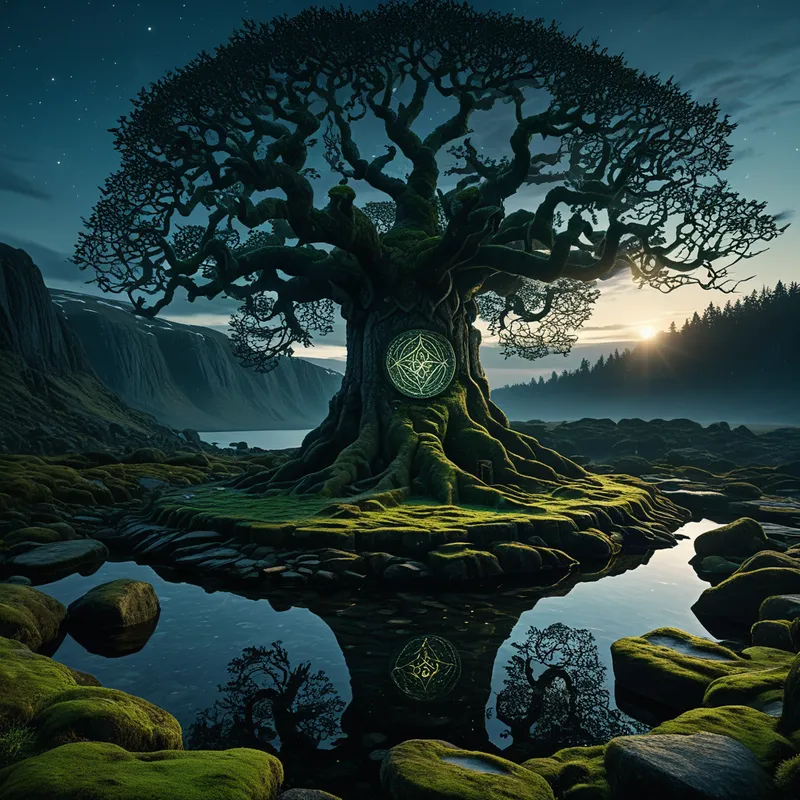
Beneath the groaning weight of the worlds, in the deep and silent dark where the roots of the great tree drink, there lies a place older than time. It is not a place for the loud or the proud. It is a place of whispers, of water on stone, of the slow, inevitable drip of destiny. Here, at the very taproot of Yggdrasil, is the Well of Urd.
Listen. Can you hear it? The soft murmur of water from a source unseen. The air is cool, damp with the breath of the earth, and smells of wet moss, ancient soil, and something else—something like the scent of old parchment and starlight. The light is a perpetual, pearlescent twilight, neither day nor night, but the hour of in-between.
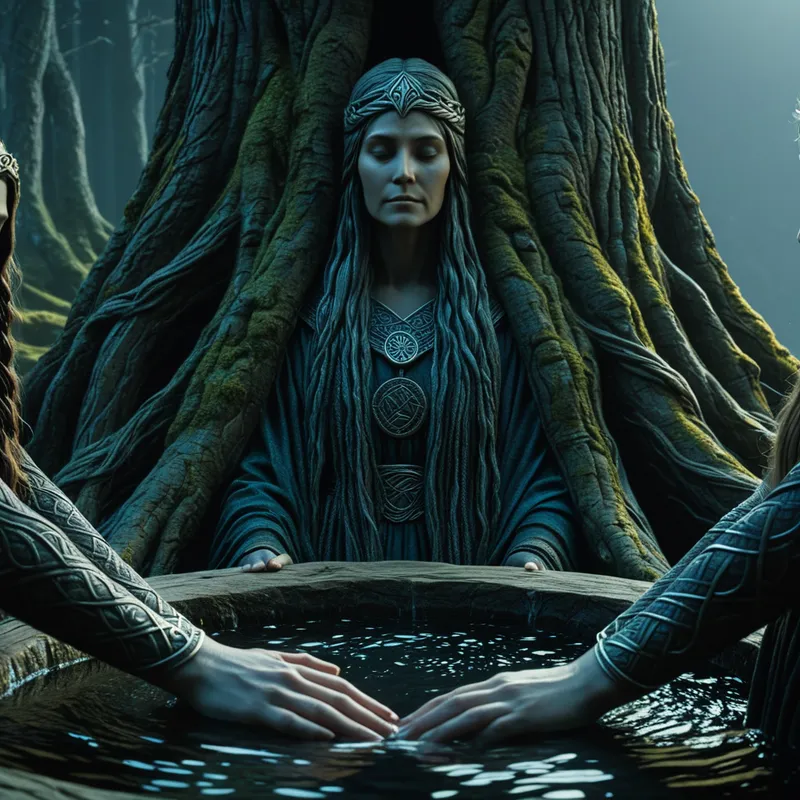
And there, by the water’s edge, are the Three. They are the Norns, and they have been here since before the first sunrise. Urd is the eldest, her face a map of all that has ever been, her eyes holding the depth of the well itself. Verdandi stands beside her, her gaze fixed on the shimmering surface of the water, watching the now as it unfolds. And Skuld, veiled and severe, holds a shears, for she knows what is owed.
Each day, without fanfare, they perform their solemn work. From the well’s sacred waters, they draw not just water, but the very substance of time and memory. They mix it with the rich, dark loam from the base of the great tree, creating a white, luminous mud. With this mud, they tenderly anoint the root of Yggdrasil, soothing the wounds inflicted by the dragon Nidhogg and his host of lesser worms. This is their first duty: to preserve the tree that holds all creation.
But their greater work is at the loom of fate. Their fingers, neither young nor old, move with a rhythm as old as the wellspring. They spin threads—some gleaming, some coarse, some strong, some heartbreakingly frail. These are the ørlög of gods and mortals alike. They weave them into a vast, ever-expanding tapestry whose pattern is too vast for any single eye to comprehend. They do not decide the threads; they find them in the waters. They read them in the reflections. They measure them against the trunk of the world.
And to this silent shore, even the mighty must come. It is said that Odin himself journeyed here, sacrificing his eye to drink from these waters, gaining not power, but sight—the terrible, weighty sight of what is, what was, and what must be. The well gave him wisdom, but it was a wisdom stained with the knowledge of an end already written in its depths. The water is clear, but it shows no simple truth. It shows the tangled roots of every action, the echo of every word, converging here, in this quiet pool, where destiny is not made, but remembered, tended, and fulfilled.
Cultural Origins & Context
The Well of Urd, along with the Norns and Yggdrasil, forms the central axis of Norse cosmological thought, primarily preserved in the Völuspá and other poems of the Poetic Edda, and later systematized by Snorri Sturluson in the 13th century. This was not priestly dogma, but a living mythology carried by skalds (poets) and told in the great halls during the long winter nights.
Its societal function was profound. In a world perceived as inherently chaotic, threatened by frost giants and ultimate dissolution at Ragnarök, the myth of the Well provided a framework of order. It presented a cosmos where fate (ørlög) was not arbitrary, but an intrinsic, woven property of existence, administered by entities who were neither fully gods nor giants, but something more primordial. It offered a model for understanding life’s hardships and triumphs not as random events, but as threads in a larger pattern. The myth encouraged a stance of sober awareness and responsibility—one’s actions became part of the well’s memory, contributing to the fate of the world-tree itself.
Symbolic Architecture
The Well of Urd is the ultimate symbol of the unconscious as the repository of all that has been. It is not merely a pool of water; it is the mundus imaginalis, the imaginal world where the past is not dead but is a living, fluid substance that nourishes the present.
The Well is the psyche’s deep memory, the waters from which the self draws the material for its own becoming.
Yggdrasil represents the structure of consciousness and the interconnectedness of all psychic realms. The Well at its root signifies that all conscious life is fed by, and dependent upon, the hidden depths of the unconscious. The Norns personify the process by which the raw material of the unconscious (the water) is formed into the coherent patterns of a life (the woven threads). Urd is the weight of personal and ancestral history, Verdandi is the moment of conscious choice and presence, and Skuld is the inevitable consequence, the future debt created by past and present action.
The daily tending of the tree with the sacred mud is a powerful image of psychic hygiene and necessity. Even the world tree, the axis of order, is perpetually wounded by the chaotic, gnawing forces of negation (Nidhogg). The work of the psyche is not to achieve a static perfection, but to continually attend to these wounds with the healing balm of remembered experience and conscious integration.
The Dreamer’s Resonance
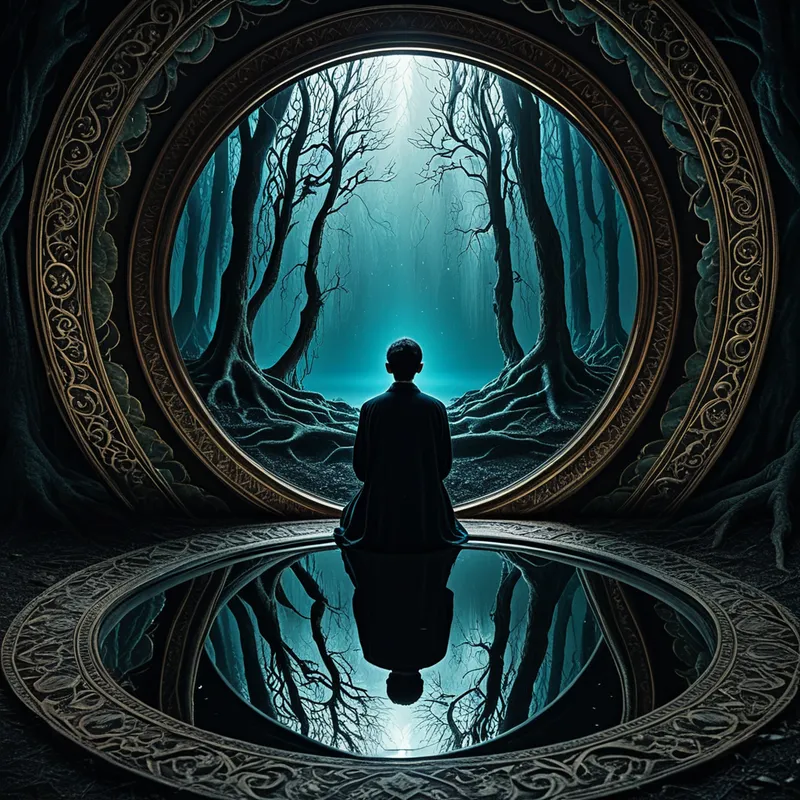
When the Well of Urd surfaces in modern dreams, it rarely appears as a literal Norse well. It manifests as a profound encounter with the depths of one’s own history. The dreamer may find themselves at a deep, dark pool in a forest, an ancient cistern in a basement, or a well in the center of a forgotten courtyard. The water is often still, dark, and compellingly reflective, yet what it reflects is not the dreamer’s face, but scenes from their past, family patterns, or unprocessed emotions.
The somatic feeling is one of gravitational pull, awe, and often deep trepidation. To dream of this well is to be summoned by the Norns of one’s own psyche. The psychological process is one of confronting one’s ørlög—the inherent pattern or “knot” of one’s life. It is a call to draw water from this depth, to look at what has been buried or ignored, and to begin the work of anointing one’s own wounded roots. The dream may present a choice: to drink from the well (seek self-knowledge, however bitter) or to turn away (remain in unconscious repetition).
Alchemical Translation
The myth models the alchemical process of solutio—dissolution in the primal waters—followed by coagulatio—the formation of a new, conscious substance from that dissolution. Odin’s sacrifice is the archetypal map: the willing surrender of a one-sided mode of perception (the physical eye) to gain insight from the deep, impersonal source.
Individuation is the process of making the journey to the well, not to change your fate, but to understand it, and in understanding, to weave your conscious will into its pattern.
For the modern individual, the “Well of Urd” is the confrontation with one’s personal and collective past—the family traumas, cultural conditioning, and forgotten joys that shape our reactions. The “white mud” is the enlightened understanding we create by mixing this raw, often painful, memory (the water) with the grounded reality of our lived experience (the earth). We use this mud not to escape our fate, but to heal the wounds in our own world-tree, our structure of being, so it may stand more resiliently against the inevitable gnawing of doubt, anxiety, and chaos (Nidhogg).
The ultimate alchemical translation is this: we are all, simultaneously, the tree, the well, and the weaver. We are the structure of our lives, fed by the deep waters of our unconscious memory, and we are the agents who, through conscious attention and choice, must tend the roots and participate in the weaving of our own becoming. The Well of Urd reminds us that destiny is not a prison sentence read aloud; it is a living pattern in which we hold the shuttle.
Associated Symbols
Explore related symbols from the CaleaDream lexicon: