The Well of Mnemosyne Myth Meaning & Symbolism
A sacred spring in the underworld whose waters grant remembrance of one's divine soul, contrasting with the river of forgetfulness, Lethe.
The Tale of The Well of Mnemosyne
Beyond the final breath, beyond the lamentations of the living, lies a land where the sun never rises. Here, the shades of the departed drift like mist through the Fields of Asphodel, their forms faint, their voices whispers. They are led by the silent ferryman to a hall of judgment, and then to a final, fateful crossroads within the very palace of [Hades](/myths/hades “Myth from Greek culture.”/) himself.
In this silent, shadowed chamber, two springs bubble from the living rock. Their waters could not be more different. From one flows the [River Lethe](/myths/river-lethe “Myth from Greek culture.”/), its currents wide and inviting, a murmuring promise of sweet oblivion. To drink is to forget—to forget the pain of life, the sting of loss, the weight of identity. It is the draught of ultimate release, the dissolution of [the self](/myths/the-self “Myth from Jungian culture.”/) into peaceful, empty night.
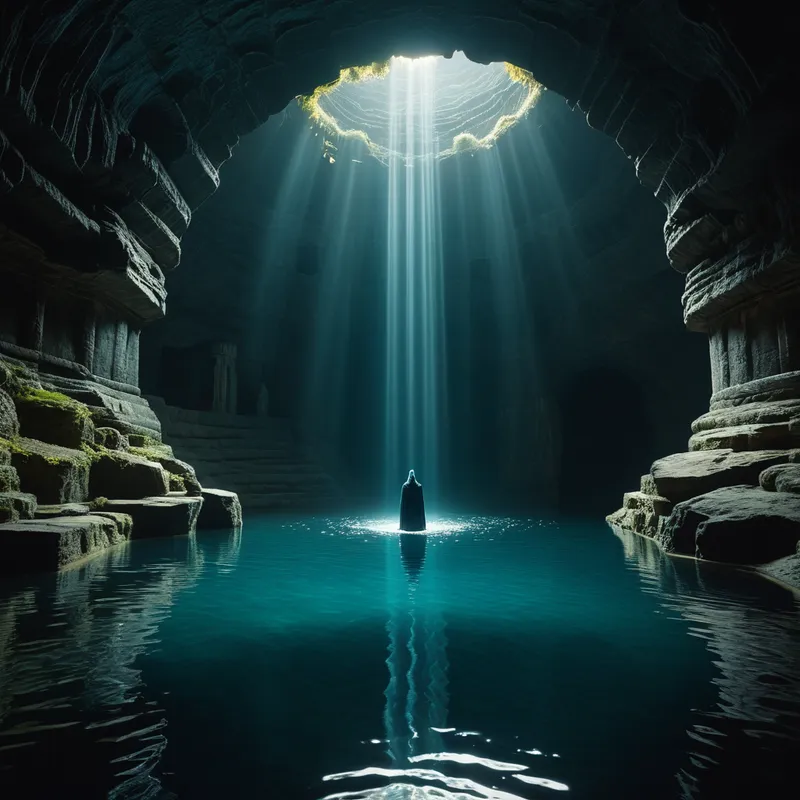
But turn your gaze. There, in a quiet alcove, shrouded in a deeper, more profound darkness, is the other. This is no rushing river, but a Well. Its waters are still, black as polished obsidian, yet they hold a light that comes from within, a glimmer like a captured star. This is the Well of [Mnemosyne](/myths/mnemosyne “Myth from Global/Universal culture.”/). To approach it is not a drift, but a conscious choice. A soul must step away from the comforting murmur of [Lethe](/myths/lethe “Myth from Greek culture.”/) and present itself to the guardians of this sacred place.
To drink from Mnemosyne’s Well is not to remember a mere life. It is to drink the cosmos. The [water](/myths/water “Myth from Chinese culture.”/) is cold, colder than ice, and it burns with truth as it passes the lips. In that draught, the soul remembers. It remembers not just its earthly name and deeds, but its primordial origin. It recalls [the music of the spheres](/myths/the-music-of-the-spheres “Myth from Greek culture.”/), the first words of creation, [the divine spark](/myths/the-divine-spark “Myth from Gnostic culture.”/) that animated its clay. It remembers that it is, and always was, a fragment of the eternal. This remembrance is not a comfort; it is a searing initiation, a re-membering of the soul’s true, immortal anatomy. The shade that drinks does not fade into the anonymous fields. It is transfigured, destined for the Elysian Fields, to live in conscious, blissful knowledge of its own divine nature, forever.
Cultural Origins & Context
This myth finds its primary home not in the grand epics of [Homer](/myths/homer “Myth from Greek culture.”/), but in the esoteric traditions of Orphism and the practices surrounding the Necromanteion. It was a doctrine for initiates, a secret map of the afterlife inscribed on thin sheets of gold foil—Orphic tablets—and placed upon the breasts of the dead. These texts served as a guide, reminding the soul of the passwords to speak and the choice to make.
The function was profoundly societal yet deeply personal. In a culture where proper funeral rites were essential for peaceful passage, this myth offered something more: agency and transcendence. It was not for every citizen, but for those who had undergone purification and initiation. It promised that the soul’s journey did not end in passive, ghostly existence, but could culminate in active deification through memory. The tellers were priests and mystics, and the myth’s societal role was to validate the power of secret knowledge (gnosis) and ritual practice in securing a glorious destiny beyond death.
Symbolic Architecture
The Well and the [River](/symbols/river “Symbol: A river often symbolizes the flow of emotions, the passage of time, and life’s journey, reflecting transitions and movement in one’s life.”/) represent the fundamental polarity of the [human](/symbols/human “Symbol: The symbol of a human represents individuality, complexity of emotions, and social relationships.”/) [psyche](/myths/psyche “Myth from Greek culture.”/): remembrance versus forgetfulness, [consciousness](/symbols/consciousness “Symbol: Consciousness represents the state of awareness and perception, encompassing thoughts, feelings, and experiences.”/) versus unconsciousness, [truth](/symbols/truth “Symbol: Truth represents authenticity, honesty, and the quest for knowledge beyond mere appearances.”/) versus illusion.
The River Lethe is the great dissolver, the embrace of the unconscious that promises peace through annihilation of the ego. The Well of Mnemosyne is the great integrator, whose bitter waters promise wholeness through the agonizing recollection of all that we are.
Mnemosyne herself is not a passive [reservoir](/symbols/reservoir “Symbol: A contained body of water representing stored resources, emotions, or potential, often signifying controlled or suppressed aspects of the self.”/) but an active, creative principle. As [mother](/symbols/mother “Symbol: The symbol of ‘Mother’ represents nurturing, protection, and the foundational aspect of one’s emotional being, often associated with comfort and unconditional love.”/) of the Muses, she shows that true [memory](/symbols/memory “Symbol: Memory symbolizes the past, lessons learned, and the narratives we construct about our identities.”/) is not mere recall, but the [source](/symbols/source “Symbol: The origin point of something, often representing beginnings, nourishment, or the fundamental cause behind phenomena.”/) of art, poetry, and wisdom. To drink from her well is to access the creative, ordering power of the psyche. The [underworld](/symbols/underworld “Symbol: A symbolic journey into the unconscious, representing exploration of hidden aspects of self, transformation, or confronting repressed material.”/) setting signifies that this [choice](/symbols/choice “Symbol: The concept of choice often embodies decision-making, freedom, and the multitude of paths available in life.”/) happens in the [depths](/symbols/depths “Symbol: Represents the subconscious, hidden emotions, or foundational aspects of the self, often linked to primal fears or profound truths.”/)—during [crisis](/symbols/crisis “Symbol: A crisis symbolizes turmoil, urgent challenges, and the need for immediate resolution or change.”/), depression, or profound introspection, what we might call the “[night](/symbols/night “Symbol: Night often symbolizes the unconscious, mystery, and the unknown, representing the realm of dreams and intuition.”/) sea [journey](/symbols/journey “Symbol: A journey in dreams typically signifies adventure, growth, or a significant life transition.”/)” of the [soul](/symbols/soul “Symbol: The soul represents the essence of a person, encompassing their spirit, identity, and connection to the universe.”/). The [choice](/symbols/choice “Symbol: The concept of choice often embodies decision-making, freedom, and the multitude of paths available in life.”/) is the critical psychic act: will we seek solace in forgetting our pains and complexities, or will we dare to drink the chilling waters of full self-[awareness](/symbols/awareness “Symbol: Conscious perception of self, surroundings, or internal states. Often signifies awakening, insight, or heightened sensitivity.”/)?
The Dreamer’s Resonance
When this myth stirs in the modern unconscious, it rarely appears as a classical tableau. Instead, one dreams of being lost in a vast, foggy landscape (the Fields of Asphodel). There is a pervasive sense of numbness, disconnection, or a life being lived on autopilot. The critical dream moment is a choice: taking a pill that makes everything blurry and calm, or a different pill that brings sharp, painful clarity. It is finding two doors; one leads to a warm, dimly lit room where everything is soft and meaningless, the other to a cold, brilliant chamber filled with mirrors reflecting every facet of the self, beautiful and terrible.
The somatic process is one of crystallization. The dreamer is moving from a fluid, dissociated state toward a more defined, conscious, but often more challenging one. Psychologically, they are at [the crossroads](/myths/the-crossroads “Myth from Celtic culture.”/) between repression and integration. The dream is the psyche’s invitation—or demand—to stop drifting and to choose the path of remembrance, to reclaim lost parts of the self, traumas, talents, and truths, even though the process feels like drinking ice.

Alchemical Translation
In the alchemy of individuation, the journey to the Well models the ultimate stage of individuation: the integration of the personal and collective unconscious into a coherent, conscious Self.
The initiate-soul is the modern individual facing the shadow. The draught from Mnemosyne is the conscious assimilation of what was previously hidden—the painful memories, the inherited traumas, the divine spark of potential we have forgotten.
The process begins with the [nigredo](/myths/nigredo “Myth from Alchemical culture.”/), the descent into [the underworld](/myths/the-underworld “Myth from Greek culture.”/) of depression or crisis. The confrontation with Lethe is the temptation to remain in unconsciousness, to let the pain dissolve [the ego](/myths/the-ego “Myth from Jungian culture.”/) entirely. Choosing the Well is the act of albedo—the purification through brutal self-honesty. Drinking is the citrinitas, where the light of understanding dawns. The resulting [transfiguration](/myths/transfiguration “Myth from Christian culture.”/) and passage to Elysium symbolize the [rubedo](/myths/rubedo “Myth from Alchemical culture.”/): the creation of the “philosopher’s stone” of the integrated personality, capable of bearing the full weight of its history and its cosmic connection.
For us, the Well is not a geographical location but a psychic attitude. It is the commitment to therapy, to journaling, to any practice that seeks not to numb but to know. It is the courage to recall, to re-member the scattered fragments of our being into a whole that remembers its own sacred origin. The myth teaches that our deepest healing and highest destiny lie not in forgetting who we were, but in daring to remember who we truly are.
Associated Symbols
Explore related symbols from the CaleaDream lexicon: