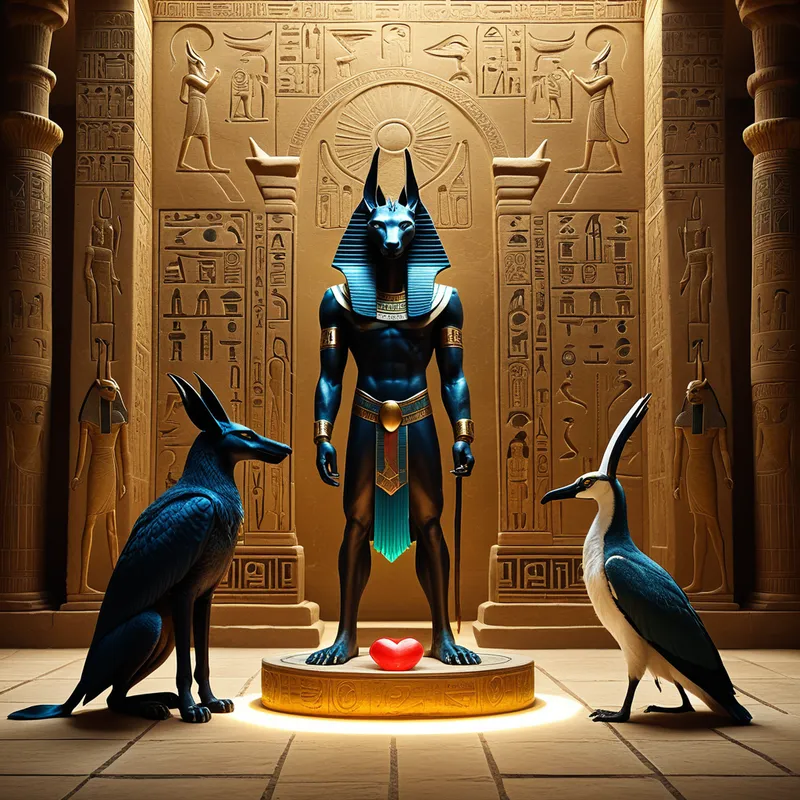
The Weighing of the Heart Ceremony Myth Meaning & Symbolism
The soul's final trial in the Egyptian afterlife, where the heart is weighed against the feather of truth to determine eternal fate.
The Tale of The Weighing of the Heart Ceremony
The final breath has been drawn. [The world](/myths/the-world “Myth from Tarot culture.”/) of sun and river, of stone and sand, falls away like a discarded garment. You are not gone. You are ka and ba, spirit and essence, traveling through the Duat. This is not a journey of miles, but of truth. Your feet find a path through reeds of shadow and stars, guided by whispers you wrote with your own life.
You arrive at a hall that was never built, yet has always existed. This is the Hall of Ma’at. The air is still and heavy, thick with the scent of incense and deep, cold earth. Before you rises a dais. Upon it, the scales of eternity wait, their golden beams gleaming in a light that has no source.
A figure approaches, serene and terrifying. It is Anubis, his ears pricked, his eyes pools of ancient night. With hands that have prepared a million bodies for this moment, he gestures. You feel a pulling, not at your ribs, but at the very core of your memory, your love, your rage, your secret shames. From your chest, he draws forth your ib—your heart. It glows with a soft, uneven light, pulsing with every kindness, every lie, every moment of courage and cowardice you ever owned. He places it gently upon the left pan of the scales.
Upon the right pan, Ma’at herself places her feather. It is not a [thing](/myths/thing “Myth from Norse culture.”/) of bird or beast, but the essence of ma’at—pure, white, and weightless as a perfect thought. The scales tremble.
The hall holds its breath. To the side, a creature watches, part lion, part hippopotamus, part crocodile—Ammit, the Devourer. Her jaws are slack, her hunger absolute and patient. Nearby, the ibis-headed [Thoth](/myths/thoth “Myth from Global/Universal culture.”/)</ab title=“The god of writing, magic, and wisdom, who records the results of the weighing.”> stands ready, a reed pen and palette in his hands, the scribe of the gods, the recorder of what is.
The beam dips. Your heart is heavy. A memory of a stolen loaf, a cruel word left unatoned, a promise broken—these are stones in your chest. The feather rises, impossibly light. Ammit stirs. But then, from behind you, your ba begins to speak. It is your voice, but clearer. It recites not excuses, but the 42 Declarations of Innocence. “I have not caused pain. I have not caused tears. I have not stolen. I have not lied. I have not made anyone hungry…” With each truth spoken, a stone within the heart dissolves. The glow evens. The scales quiver, seeking equilibrium.
The beam steadies. Perfectly level. Your heart, in all its flawed, human glory, balances the feather of cosmic truth. Thoth’s pen scratches the verdict onto a scroll of eternity: “True of Voice.” A great warmth fills the hall. Ammit sinks back into the shadows, her hunger denied. Anubis nods, a silent acknowledgment. You are led forward, to be presented to [Osiris](/myths/osiris “Myth from Global/Universal culture.”/), enthroned in green and white, lord of the peaceful dead. [The field of reeds](/myths/the-field-of-reeds “Myth from Egyptian culture.”/) awaits. You have passed through the fire of your own life and emerged, not unscathed, but justified.
Cultural Origins & Context
This myth was not merely a story for the ancient Egyptians; it was the central operating system of their ethical and spiritual universe. Its primary textual source is the Book of the Dead (known to them as “The Book of Coming Forth by Day”), a collection of spells, prayers, and illustrations placed in tombs from the New Kingdom onward. However, its conceptual roots stretch back to the [Pyramid Texts](/myths/pyramid-texts “Myth from Egyptian culture.”/) of the Old Kingdom, showing a millennia-long evolution in the understanding of the afterlife.
The myth was enacted through ritual and material culture. The elaborate process of mummification preserved the physical ib for this very ceremony. A [heart scarab](/myths/heart-scarab “Myth from Egyptian culture.”/), inscribed with Chapter 30B of [the Book of the Dead](/myths/the-book-of-the-dead “Myth from Egyptian culture.”/), was often placed over the heart, a magical safeguard pleading for its silence. The myth was told by priests and scribes, but its audience was every individual, from [pharaoh](/myths/pharaoh “Myth from Egyptian culture.”/) to farmer. Its societal function was profound: it democratized morality. Eternal fate was not solely a birthright but a consequence of one’s actions (ma’at). It provided a cosmic framework for [justice](/myths/justice “Myth from Tarot culture.”/), encouraging social harmony and personal accountability in a world where the state and the divine were inextricably linked.
Symbolic Architecture
The [ceremony](/symbols/ceremony “Symbol: Ceremonies in dreams often symbolize transitions, rituals of passage, or significant life events.”/) is a masterful map of the [psyche](/myths/psyche “Myth from Greek culture.”/)‘s confrontation with its own totality. Each element is an archetypal [actor](/symbols/actor “Symbol: An actor represents roles, transformation, and the performance of identity in dreams.”/) in the [drama](/symbols/drama “Symbol: Drama signifies narratives, emotional expression, and the exploration of human experiences.”/) of self-judgment.
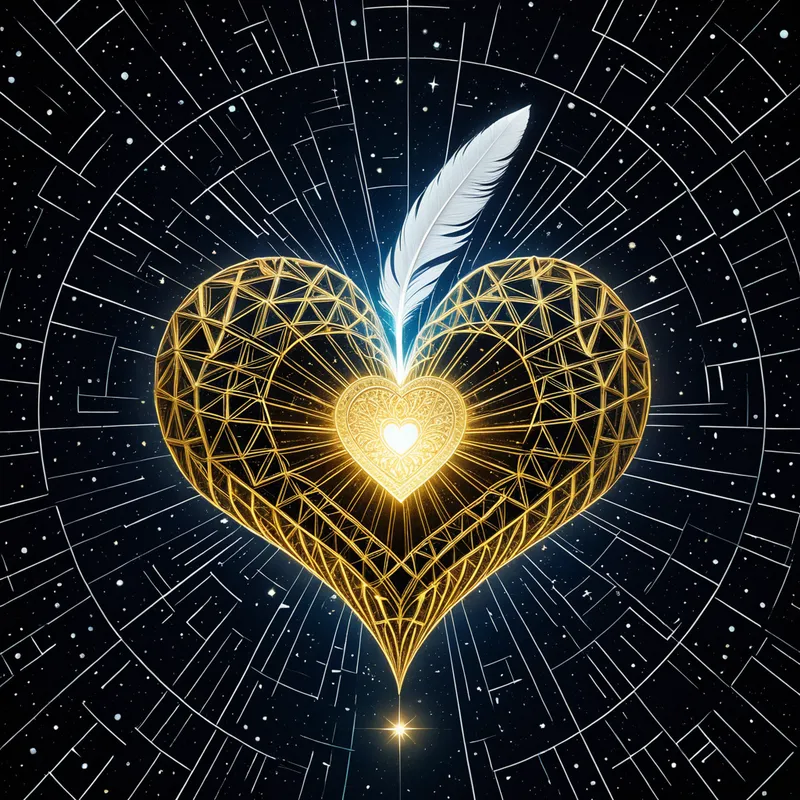
The [Heart](/symbols/heart “Symbol: The heart symbolizes love, emotion, and the core of one’s existence, representing deep connections with others and self.”/) (ib) is not the romantic [organ](/symbols/organ “Symbol: An organ symbolizes vital aspects of life and health, often representing one’s emotional or physical state.”/), but the seat of [consciousness](/symbols/consciousness “Symbol: Consciousness represents the state of awareness and perception, encompassing thoughts, feelings, and experiences.”/), [memory](/symbols/memory “Symbol: Memory symbolizes the past, lessons learned, and the narratives we construct about our identities.”/), and conscience—the accumulated record of a [life](/symbols/life “Symbol: The symbol of ‘Life’ represents a journey of growth, interconnectedness, and existential meaning, encompassing both the joys and challenges that define human experience.”/). It is the “self” presented for audit.
The [Feather](/symbols/feather “Symbol: A feather represents spiritual elevation, lightness, and the freedom of the spirit. It often symbolizes messages from the divine and connection to ancient wisdom.”/) of Ma’at represents the objective, impersonal standard of [truth](/symbols/truth “Symbol: Truth represents authenticity, honesty, and the quest for knowledge beyond mere appearances.”/) and ethical order. It is not a harsh law, but the fundamental principle of [harmony](/symbols/harmony “Symbol: A state of balance, agreement, and pleasing combination of elements, often associated with musical consonance and visual or social unity.”/) against which all actions are measured.
The scale does not measure good versus evil, but the weight of a lived life against the feather-light standard of essential integrity.
Anubis, as the [conductor](/symbols/conductor “Symbol: A conductor represents guidance, leadership, and the orchestration of life’s various elements toward harmony.”/), symbolizes the necessary, neutral guide through the transition—the part of us that must objectively face our own [ledger](/symbols/ledger “Symbol: A symbolic record of accounts, debts, and balances, representing life’s moral, emotional, and transactional reckonings.”/). Thoth is the witnessing consciousness, the part that records and makes meaning of the process. Ammit is the ultimate [shadow](/symbols/shadow “Symbol: The ‘shadow’ embodies the unconscious, repressed aspects of the self and often represents fears or hidden emotions.”/)—the psychic [dissolution](/symbols/dissolution “Symbol: The process of breaking down, dispersing, or losing form, often representing transformation, release, or the end of a state of being.”/), the fear of annihilation that awaits if [the self](/myths/the-self “Myth from Jungian culture.”/) is found to be fundamentally at odds with [reality](/symbols/reality “Symbol: Reality signifies the state of existence and perception, often reflecting one’s understanding of truth and life experiences.”/). The “True of Voice” [verdict](/symbols/verdict “Symbol: A formal judgment or decision, often legal or moral, representing closure, accountability, and societal evaluation.”/) is the [achievement](/symbols/achievement “Symbol: Symbolizes success, mastery, or reaching a goal, often reflecting personal validation, social recognition, or overcoming challenges.”/) of inner congruence, where one’s self-concept and one’s actual life are in alignment.
The Dreamer’s Resonance
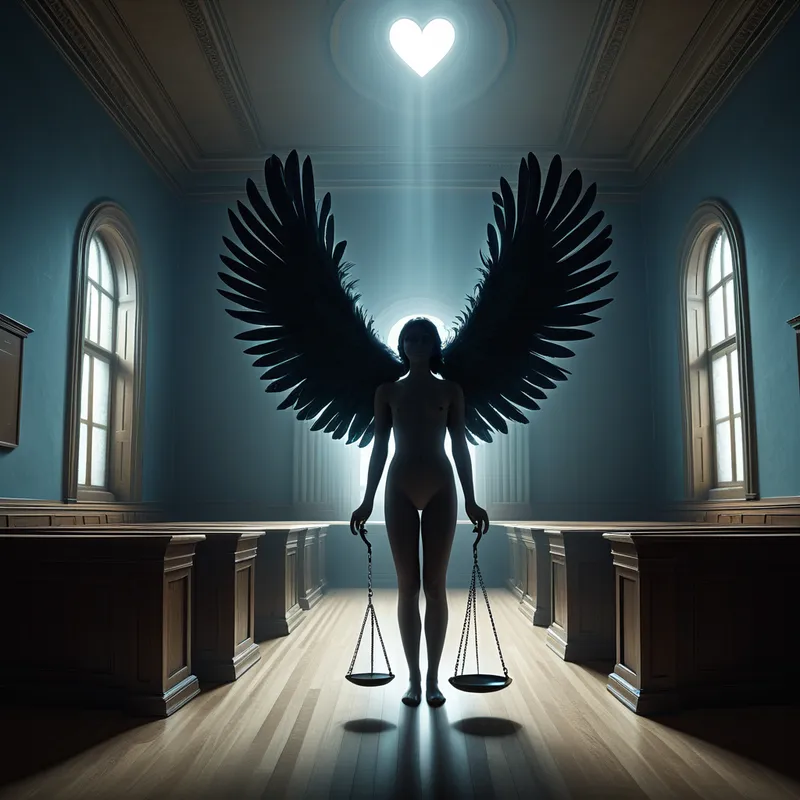
When this myth surfaces in modern dreams, the individual is undergoing a profound somatic and psychological process of self-assessment. The dreamer may find themselves in a sterile office being audited, standing trial in an empty courtroom, or simply holding two objects of vastly different weights, feeling the strain in their body.
This is the psyche’s ritual of existential accounting. The “heart” being weighed is the dreamer’s core identity, their accumulated choices, guilt, and unintegrated traumas. The “feather” is their innate, often neglected, sense of what is right and true for them. The anxiety in the dream—the fear of the devouring monster (failure, exposure, annihilation)—is the somatic echo of [the ego](/myths/the-ego “Myth from Jungian culture.”/)‘s resistance to this deep review. Such dreams often precede or accompany major life transitions: career changes, the end of relationships, spiritual awakenings, or the integration of a shadow aspect. The body feels the “weight” of inauthenticity, and the dream is the soul’s tribunal, pressing for a verdict that will allow movement forward or require a painful but necessary dissolution of a false self.
Alchemical Translation
For the modern individual, [the Weighing of the Heart](/myths/the-weighing-of-the-heart “Myth from Egyptian culture.”/) is not a post-mortem event but the ongoing alchemy of individuation. It models the process of psychic transmutation from a state of inner conflict to one of wholeness.
The first alchemical stage is Mortificatio—the “death” represented by the journey to [the Duat](/myths/the-duat “Myth from Egyptian culture.”/). This is the necessary dissolution of the [persona](/myths/persona “Myth from Greek culture.”/), the comfortable lies we tell ourselves, often triggered by crisis or deep introspection. We enter our own inner Hall of Two Truths.
The weighing itself is [Separatio](/myths/separatio “Myth from Alchemical culture.”/) and Coniunctio. We must separate ([Separatio](/myths/separatio “Myth from Alchemical culture.”/)) our actions and their motives from our self-justifications. We hold our heart (the complex, emotional self) apart to examine it against the feather (the transcendent function, the Self’s guiding principle).
The goal is not a heart as light as a feather, but a heart balanced by it—a conscious life weighed and found congruent with the soul’s own truth.
The recitation of the Declarations is not a denial of wrongdoing, but the conscious integration of [the shadow](/myths/the-shadow “Myth from Jungian culture.”/). To say “I have not caused pain” is to acknowledge the times you did, and to consciously choose a different alignment. Thoth’s recording is the act of making this process conscious—journaling, therapy, honest reflection—which transforms blind impulse into witnessed narrative.
Achieving balance is the [Rubedo](/myths/rubedo “Myth from Alchemical culture.”/), the reddening, the final stage of the alchemical [Magnum Opus](/myths/magnum-opus “Myth from Alchemical culture.”/). It is the birth of the “Justified One,” the individual who has faced their own Ammit and, by integrating their shadow, rendered it powerless. They are not perfect, but they are true of voice. Their outer life is in harmony with their inner truth. They have met their own Osiris—the symbolic, deeper Self—and gained access to the “field of reeds,” a state of inner peace and fertile potential where one’s authentic life can finally grow.
Associated Symbols
Explore related symbols from the CaleaDream lexicon: