The Weighing of the Heart Myth Meaning & Symbolism
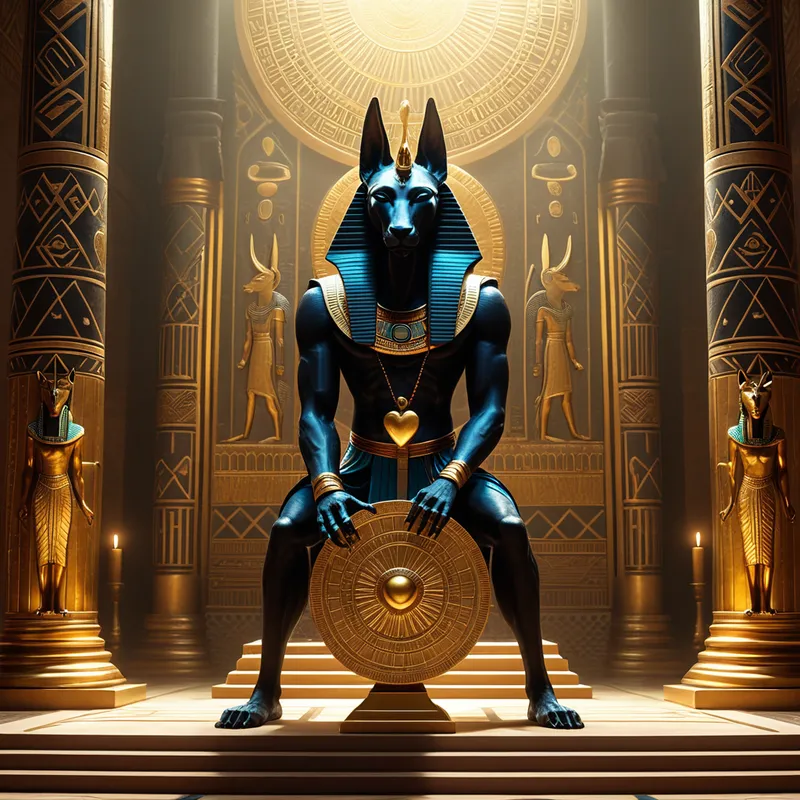
An ancient soul stands before the scales of Ma'at, its heart weighed against a feather to determine its eternal fate in the Hall of Two Truths.
The Tale of The Weighing of the Heart
The final breath has been drawn. The sun-baked world of the living recedes like a forgotten dream. Now, you are in the Duat, the silent, starless realm of the dead. A path of deepest shadow leads you forward, pulled by a current older than the Nile. You arrive not at a gate, but at the threshold of an immense hall, its ceiling lost in darkness, its floor of blackest basalt. This is the Hall of Two Truths.
A profound silence hangs here, thick as temple incense. Before you, presiding over a scale of exquisite gold and obsidian, stands Anubis. His eyes are pools of ancient knowing, his movements deliberate and sacred. He does not speak, but his intention is clear. With hands that have prepared countless bodies for eternity, he gestures. From the center of your being, a luminous, throbbing orb—your Ib—is drawn forth. It is not the muscle of flesh, but the essence of all you have been: every kindness, every secret envy, every moment of courage and cowardice. It pulses with the weight of a lifetime.
Anubis places your heart upon the left pan of the scale. Upon the right, he sets a single, perfect feather. This is the Shut of Ma’at. It is lighter than a thought, purer than dawn light. The scale trembles. The entire pantheon is witness. The monstrous Ammit crouches nearby—crocodile-jawed, lion-bodied, hippopotamus-hipped—her hunger a palpable void.
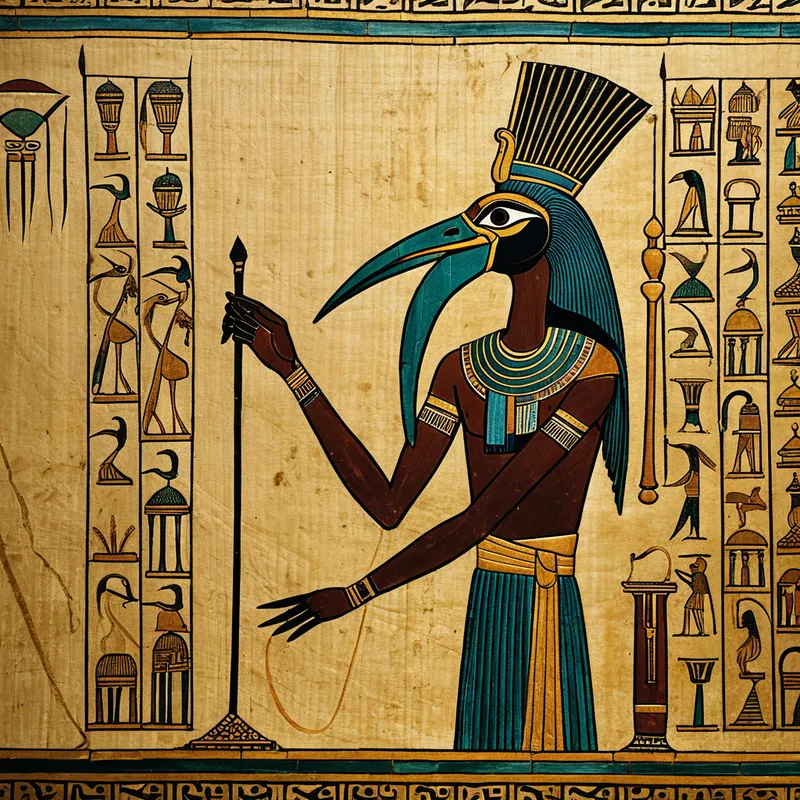
Now, Thoth, the scribe of the gods, steps forward. His ibis head is bent, his stylus ready. He will record the verdict. You are commanded to speak. Not to plead your case, but to recite the Negative Confessions. “I have not caused pain. I have not caused tears. I have not stolen. I have not told lies. I have not made anyone hungry…” Each statement is a test of the heart’s truth, resonating in the silent hall. With each “I have not,” the scale shifts minutely.
The balance hangs, a breath between existence and oblivion. The feather and the heart hover, mirroring each other. If they balance—if your heart is as light as the feather of truth—Thoth nods, and a path opens to the Field of Reeds, to eternal peace beside Osiris, the green lord of the dead. But if your heart is heavy with the weight of falsehood and corruption, it sinks. The scale dips. Anubis steps back. And Ammit, with a finality that ends all stories, opens her maw.
Cultural Origins & Context
This myth, known as the “Psychostasia” or Weighing of the Heart, is not a single story but the central, unifying ritual of the Egyptian afterlife journey. Its most complete depiction is found in the Book of the Dead (or, more accurately, the Book of Coming Forth by Day), a personalized guide placed in tombs from around 1550 BCE onward. However, its conceptual roots stretch back to the Old Kingdom Pyramid Texts.
This was not a public myth told around fires, but a sacred technology inscribed on papyrus and tomb walls, a script for the soul’s most critical performance. It was a democratization of immortality; initially reserved for pharaohs, the ritual became accessible to any who could afford the spells and proper burial rites. The function was profoundly societal: it codified Ma’at as the ultimate ethical standard. The myth taught that cosmic order and personal integrity were inseparable, and that the ultimate judge was not a capricious god, but an impersonal, perfect balance. It provided a terrifyingly beautiful answer to the human fear of death and the longing for moral significance, framing eternity as a reward for a life lived in harmony with truth.
Symbolic Architecture
The myth is a masterpiece of symbolic architecture, mapping the landscape of the soul’s accountability. The Hall of Two Truths represents the liminal space of ultimate revelation, where the masks of the persona fall away. The two truths are the truth of the life lived and the truth of cosmic law; they must become one.
The heart is not judged for its passions, but for its alignment. A heavy heart is not one that loved deeply, but one that lied to itself.
Anubis, the conductor, symbolizes the necessary, neutral guide who presides over the transition from one state of being to another. He is the psychopomp who ensures the ritual is performed correctly. The Feather of Ma’at is the ultimate symbol of the incorporeal ideal—truth has no mass, no corruption, it simply is. To be weighed against it is to be measured against absolute reality.
Ammit is not a devil or a punisher, but the embodiment of the consequence of failing the test. She represents the second death, the complete annihilation of the individual consciousness that occurs when the soul proves too corrupt to continue. Thoth represents the objective record, the unalterable fact of what was. His recording makes the process judicial and eternal.
The Dreamer’s Resonance
When this myth stirs in the modern dreamer, it rarely appears with its full Egyptian iconography. Instead, we dream of being weighed. We stand before a tribunal of shadowy figures (bosses, parents, faceless authorities). We are asked to present an account of ourselves, a report card, or a ledger. Often, we are trying to hide a “heavy” object—a dark stone, a lump of lead, a guilty secret—that threatens to tip the scales.
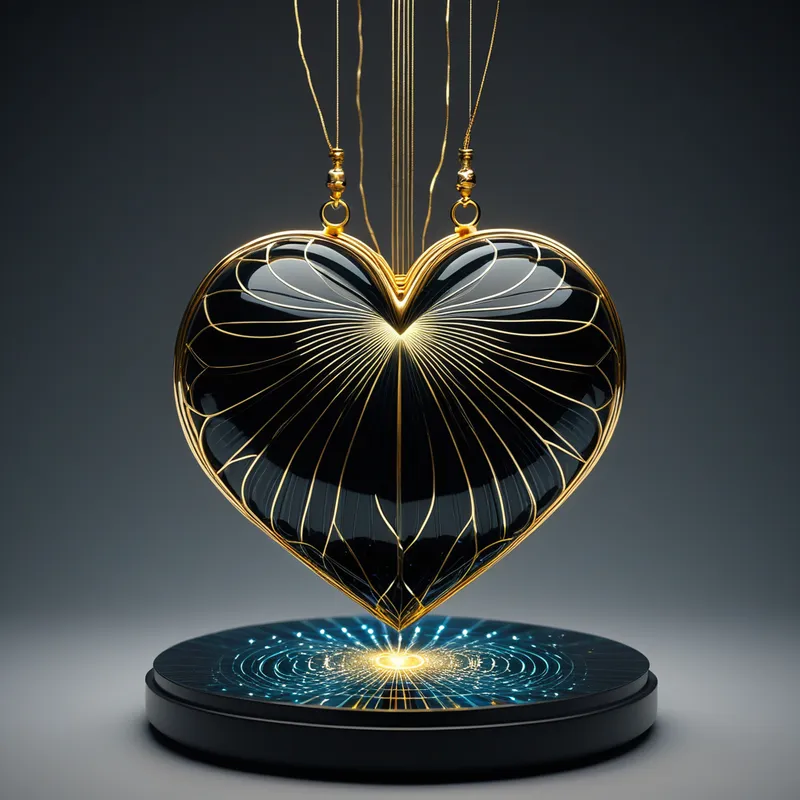
Somatically, this can feel like a pressure in the chest, a literal “heavy heart.” Psychologically, this dream pattern signals a profound process of self-assessment. The ego is being called before the deeper Self. The “Negative Confessions” translate into an internal audit: Have I been living in alignment with my own values? Have I betrayed my truth for convenience or approval? What unacknowledged guilt or self-deception am I carrying? The dream is an initiatory crisis, forcing a confrontation between the persona’s story and the soul’s actual condition. The terror of Ammit is the terror of psychic disintegration—of realizing one’s life has been built on a foundation that cannot sustain the soul.

Alchemical Translation
In the alchemy of individuation, the Weighing of the Heart is the mortificatio and separatio stage—the breaking down and sorting of the psyche’s contents. The goal is not to become heartless, but to transform the “heavy,” leaden heart of unconscious complexes and unintegrated shadow material into a “light,” golden heart of conscious integrity.
The alchemical furnace is the Hall of Two Truths. The fire is the unbearable light of self-honesty.
The modern individual undergoes this ritual not in death, but in moments of profound life crisis: the end of a relationship, a career failure, a diagnosis, or simply the midlife realization that one’s path feels false. We must voluntarily extract our own “heart”—our core identity and actions—and place it on the scale of our deepest values. We must recite our own negative confessions, not to an external god, but to the inner Ma’at. I have not been authentic. I have neglected my creativity. I have spoken against my own knowing.
The triumph is the balance. It is the moment when self-acceptance (the heart) meets self-truth (the feather). This balance grants passage to a new state of being—the Field of Reeds within. It is a state of inner congruence where one is no longer at war with oneself. The devouring monster of self-annihilation is neutralized not by perfection, but by the courageous, ongoing work of bringing the full weight of who we are into the light, and choosing, piece by piece, to let go of what does not belong to our truth. The heart that is weighed is the heart that is made whole.
Associated Symbols
Explore related symbols from the CaleaDream lexicon: