The Web of Wyrd Myth Meaning & Symbolism
The cosmic tapestry woven by the Norns at the Well of Urd, binding all fates—past, present, and future—into a single, unfathomable pattern.
The Tale of The Web of Wyrd
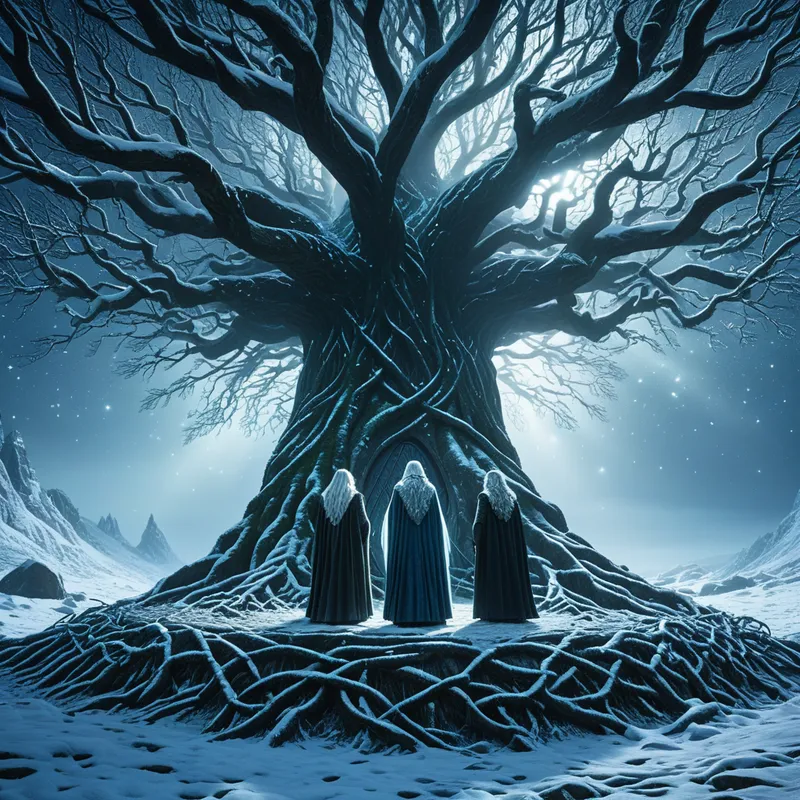
Beneath the groaning roots of the Yggdrasil, where time drinks from its own source, there is a well. This is no simple pool, but the Well of Urd, a liquid memory so deep it holds the echo of the first breath and the shadow of the last sigh. The air here is thick with the scent of wet earth, ancient bark, and the cold, clean smell of destiny. It is here they dwell, the three who know the shape of things: Urd, Verdandi, and Skuld.
Urd, her face a map of all that has passed, reaches into the dark waters. Her fingers do not dip, but pluck, drawing forth not water, but a thread—glimmering, supple, heavy with the weight of what was. She passes it to Verdandi, whose eyes burn with the fierce, focused light of the present moment. Verdandi’s hands do not rest; they spin, they weave, they integrate this thread of the past into a living, breathing now. The thread hums with potential, vibrating with every choice being made in the worlds above, from the flight of a sparrow to the oath of a king.
But the pattern is not complete. It passes to Skuld, who stands veiled, a sword often resting at her side. She is not merely the future, but the debt, the necessity, the consequence that must be. Her touch is final. She does not always cut the thread—sometimes she merely turns it, directing its course, tightening a knot begun centuries before. With her shears, she holds the power of severance, of ending, which makes all beginnings possible. Their work is silent but for the whisper of thread and the deep, resonant drip of water into the well.
They weave for Odin, who gave an eye to drink from this well and hung for nine nights on the World Tree to grasp the secrets of the runes. They weave for Thor, whose might shakes the loom. They weave for the lowest mortal, whose life-thread is but a brief, bright strand in the grand design. Every laugh, every tear, every act of courage and cowardice is a tremor in the web. The gods themselves ride to the roots to behold it, to seek counsel, to read the patterns of coming doom and glory. They see the glittering threads of the Aesir, the deep, earthy cords of the Vanir, the dark, gnawing fibers of the Jotnar, and the countless shimmering lives of humanity, all interlaced, pulling and tightening against one another. The web is vast, it is beautiful, and it is terrible in its completeness. It is the Wyrd.
Cultural Origins & Context
The concept of the Web of Wyrd, or Wyrd itself, is not a single myth from a specific poem like the tale of Tyr and the Fenris Wolf. It is a pervasive, underlying principle woven through the tapestry of Old Norse and wider Germanic worldview. It appears in fragments: in the image of the Norns at the well in the Poetic Edda, in kennings for fate, and in the etymological root of the word wyrd itself, which is ancestral to the modern English “weird,” meaning that which comes to pass.
This was not a philosophy confined to temples or priests. It was a lived reality, passed down in the great halls by skalds, around hearths by elders, and reinforced by the harsh realities of a life intimately tied to seasons, storms, and survival. The function of this belief was profound. It provided a framework for understanding fortune and misfortune not as random acts, but as part of a coherent, if inscrutable, pattern. It fostered a specific kind of courage: the courage to act with integrity and purpose (ørlög, your primal layer of fate) even when the overarching outcome (wyrd) might be grim, knowing your actions still mattered within the weave. It was a cosmology that balanced absolute destiny with the dignity of personal deed.
Symbolic Architecture
At its core, the Web of Wyrd symbolizes the interconnected, dynamic, and patterned nature of existence. It is the antithesis of chaos and of meaningless linearity. The web is not a predetermined script but a living matrix where every element exerts tension and influence on the whole.
The past is not a dead weight, but the thread from which the present is spun. The future is not an empty space, but the shape demanded by the pattern of the now.
The Norns represent the tripartite structure of time—Past, Present, and Future—but psychologically, they map onto the psyche itself. Urd is the personal and collective unconscious, the deep well of memory, trauma, and inherited patterns. Verdandi is the conscious ego, actively weaving the raw material of the unconscious into the lived experience of the present moment. Skuld is the super-ego or the psychic imperative, the internal judge and the voice of consequence that shapes decisions and carries the “debt” of unresolved complexes. The web, therefore, is the total psyche—the Self in its complete, interconnected form.
The Well of Urd is the source, the mysterious font of being and memory from which all phenomena arise. Yggdrasil is the axis of this system, the structural principle of consciousness that holds and connects all the disparate realms of experience.
The Dreamer’s Resonance
When the Web of Wyrd appears in modern dreams, it rarely manifests as three women at a tree. Instead, the dreamer encounters its pattern. They may dream of intricate nets, neural networks, city grids that pulse with light, or find themselves in a library where every book is connected by glowing threads. They may experience a profound somatic sensation of being “tugged” by an invisible string, or feel their life as a tapestry where touching one thread makes a distant part vibrate.
This dream motif signals a psychological process of integration and pattern-recognition. The unconscious is communicating that disparate life events—a childhood memory, a recent conflict, a forgotten ambition—are not isolated. They are part of a larger, meaningful configuration of the Self. The dream often arises during periods of life review, existential questioning, or when facing a major decision. It is the psyche’s way of asserting that there is a coherent narrative beneath the surface chaos, and that the dreamer is both a product of this web and an active weaver within it. The feeling can be awe-inspiring or claustrophobic, reflecting one’s relationship to the concept of destiny versus agency.
Alchemical Translation
The alchemical work modeled by the Web of Wyrd is the opus of individuation—the process of becoming the unique, integrated individual one is meant to be, by consciously relating to the totality of one’s psyche. The modern seeker is not a passive victim of the web but an apprentice weaver.
The first stage is drinking from the well: confronting the Urd aspect. This is shadow work, delving into the personal and ancestral past, retrieving memories and acknowledging patterns (the threads) that have been passively inherited. The second is the work of Verdandi: the conscious, present-moment effort to take those raw threads—our instincts, our wounds, our gifts—and actively, responsibly weave them into our daily actions, relationships, and choices. This is where agency lives.
The shears of Skuld are not merely punishment, but the necessary act of discrimination. To weave a new pattern, old threads must sometimes be cut—habits, identities, relationships that no longer serve the integrity of the whole self.
The final, transcendent stage is perceiving the whole web. This is the achievement of the Sage archetype: moving from being a single, anxious thread to understanding oneself as a crucial nexus within a magnificent, boundless design. One realizes that their individual journey (ørlög) is their unique contribution to the universal pattern (wyrd). The goal is not to escape fate, but to align with it so completely that the act of weaving becomes synonymous with being. In this alignment, the tension between destiny and free will dissolves. You are not pulling the threads; you are the point where the threads cross, and your awareness is what makes the pattern conscious.
Associated Symbols
Explore related symbols from the CaleaDream lexicon: