The Weaver Girl and the Cowherd
A celestial romance between a weaver girl and a cowherd, separated by the Milky Way, whose annual reunion on a magpie bridge symbolizes enduring love across cosmic divides.
The Tale of The Weaver Girl and the Cowherd
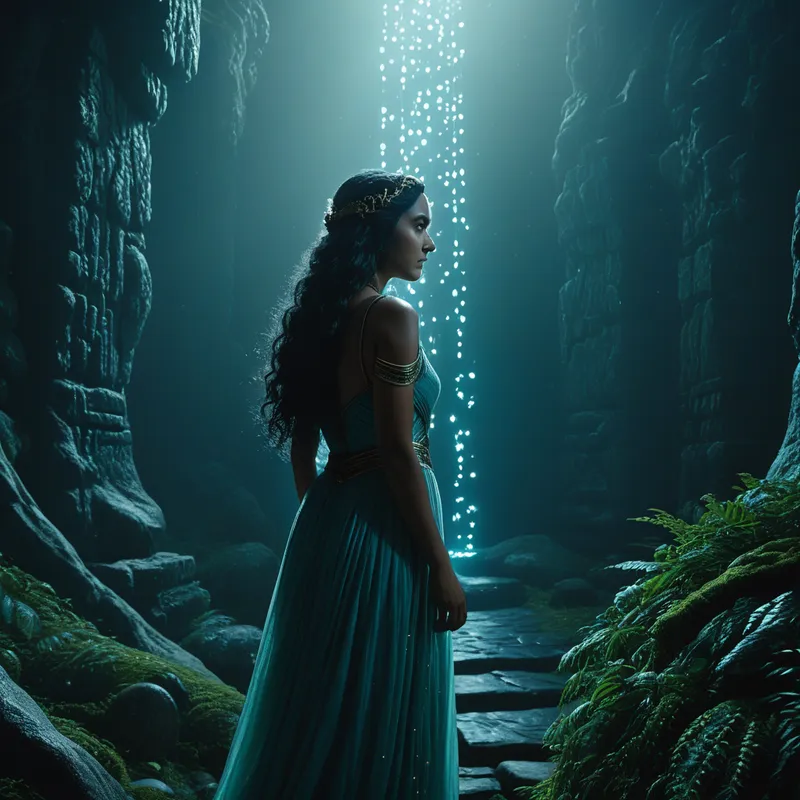
In the celestial realms, where [the Jade Emperor](/myths/the-jade-emperor “Myth from Taoist culture.”/) held court, lived a granddaughter of profound skill and divine grace. She was Zhinü, the Weaver Girl, whose shuttle flew across the loom of the heavens, crafting the robes of the gods and the very clouds of sunset with threads of silver and light. Her existence was one of solitary perfection, a rhythm measured only by the beat of her loom, until the day her gaze fell upon the mortal world.
Below, on the verdant banks of an earthly river, lived a young orphan named Niulang, the Cowherd. With nothing but a single aging ox for company, he lived a life of simple honesty and gentle labor. His world was one of soil and stream, of tending and patience. The ox, a creature of surprising wisdom, one day spoke to him. It told him of the celestial maidens who bathed in a secluded mountain pool, and that if Niulang were to take the robe of one, she would be bound to [the earth](/myths/the-earth “Myth from Hindu culture.”/). Guided by a longing he could not name, Niulang went. There, amidst the dappled light and clear [water](/myths/water “Myth from Chinese culture.”/), he saw Zhinü. In an act that was both theft and destiny, he took her feathered robe, the garment of her flight.
Stranded, the Weaver Girl met the Cowherd’s eyes. Instead of anger, a recognition passed between them—a recognition of a missing half. She stayed. In the thatched hut by [the river](/myths/the-river “Myth from Buddhist culture.”/), the celestial and the earthly wove a life together. She taught him the beauty of the patterns in [the sky](/myths/the-sky “Myth from Persian culture.”/); he showed her the solid joy of the rooted earth. Their love bore fruit in two children, and for a time, the boundary between heaven and earth dissolved in the warmth of their hearth.
But the cosmic order, the Dao, tolerates no such permanent blurring. The [Jade Emperor](/myths/jade-emperor “Myth from Chinese culture.”/), learning of his granddaughter’s desertion and union with a mortal, was incensed. The Weaver’s loom stood silent; the clouds grew ragged. With a decree that echoed like thunder, he commanded her return. As Zhinü was seized by celestial guards, Niulang, in desperation, shouldered their children in baskets and gave chase, the faithful ox having given its hide to make flying shoes.
Yet the Emperor, with a stroke of his hand, drew a raging, starry river across the firmament—[the Milky Way](/myths/the-milky-way “Myth from Greek culture.”/)—an impassable barrier of cold light. There, on opposite banks, the lovers were fixed: the Weaver in her silvery solitude, the Cowherd with his earthly burdens, forever in sight, forever apart. Their grief, however, was so pure and profound that it moved the magpies of [the world](/myths/the-world “Myth from Tarot culture.”/). Each year, on the seventh day of the seventh lunar month, every magpie on earth would fly up to the heavens, and with their own bodies, form a living bridge across the stellar torrent. For one night, under the soft glow of the summer stars, Zhinü and Niulang cross this feathered span and reunite. Their tears, it is said, fall as gentle rain upon the earth below.
Cultural Origins & Context
The myth of [the Weaver and the Cowherd](/myths/the-weaver-and-the-cowherd “Myth from Korean culture.”/) is ancient, with roots stretching back to the Zhou Dynasty. It is a [cornerstone](/myths/cornerstone “Myth from Biblical culture.”/) of Chinese folk tradition, later absorbed and refined within the Taoist cosmological framework. The story is intrinsically tied to the stars: the stars Vega (the Weaver Girl, Zhinü) and Altair (the Cowherd, Niulang), separated by the luminous band of the Milky Way. The annual reunion corresponds to the Qixi Festival, often called Chinese Valentine’s Day, which occurs when the celestial configuration makes the “river” most visible.
Within Taoism, the tale is not merely a romance but a narrative about the fundamental principles of [yin and yang](/myths/yin-and-yang “Myth from Chinese culture.”/). Zhinü represents the yin principle: celestial, artistic, introspective, and associated with the west and autumn. Niulang embodies yang: earthly, active, nurturing (as a herdsman), and associated with the east. Their union is a perfect, if temporary, harmonization of these complementary opposites, a living manifestation of the Dao’s flow. Their forced separation illustrates the cosmic law that such perfect balance is dynamic, not static—a fleeting moment of union within an eternal cycle of coming together and moving apart.
Symbolic Architecture
The myth’s power lies in its stark, elegant symbols that map a profound internal [landscape](/symbols/landscape “Symbol: Landscapes in dreams are powerful symbols representing the dreamer’s emotional state, personal journey, and the broader context of life situations.”/) onto the [cosmos](/symbols/cosmos “Symbol: The entire universe as an ordered, harmonious system, often representing the totality of existence, spiritual connection, and the unknown.”/).
The Milky Way is not merely a barrier but the very embodiment of fenbie (分彆), separation. It is the river of destiny, the immutable law or principle that defines boundaries—between spirit and matter, aspiration and reality, the ideal and the attainable. It is fate made visible as geography.
The Magpie Bridge is the miracle born from collective compassion. It signifies that while cosmic law may decree separation, the heart—of all living creatures—can forge a temporary passage. It represents the intermediary, the hun (魂) or soul-bridge, that makes connection possible across seemingly impossible divides.
The Annual Reunion encapsulates the Taoist view of time as cyclical, not linear. Love and fulfillment are not endpoints but recurring festivals of the soul. The joy is made more poignant, more sacred, by its transience. It teaches that the value of connection is often crystallized by the experience of its absence.
The Dreamer’s Resonance
Why does this story, of all love stories, echo so deeply? Psychologically, it gives form to the universal human experience of yearning—for a beloved, for a lost part of [the self](/myths/the-self “Myth from Jungian culture.”/), for a home we feel we have been exiled from. The Weaver and the Cowherd live within us as those aspects of our own nature that feel eternally separated: our spiritual aspirations (the Weaver) from our earthly, embodied existence (the Cowherd); our creative genius from our daily labor; the idealized beloved from the reality of relationship.
Their eternal gaze across the starry river mirrors our own inner divisions. The myth validates the pain of that separation while offering a profound consolation: the separation itself is part of a sacred, cosmic order. Our longing is not a personal failing but a participation in a celestial drama. The promise of the bridge—the annual, hard-won reunion—speaks to the soul’s conviction that no separation is final, that communion is always possible, if only for a sacred, fleeting night.

Alchemical Translation
In the inner work of the [psyche](/myths/psyche “Myth from Greek culture.”/), the myth charts a path of neidan, or internal alchemy. The initial union—the “theft” of the robe and the earthly marriage—represents an unconscious, instinctive conjoining of opposites. It is blissful but naive, unaware of the greater cosmic laws.
The forced separation by the Jade Emperor is not a punishment, but a necessary crucible. It is the stage of solve (to dissolve), where the naive union is broken apart by the demands of consciousness, duty, and the reality principle (the Emperor as superego or cosmic law).
The eternal守望 (shouwang, watching over) from opposite banks is the stage of conscious suffering and differentiation. Here, the Weaver and Cowherd are no longer fused but become distinct, purified principles. They hold their connection not through possession, but through unwavering witness.
The building of the Magpie Bridge is the active, creative work of the soul (liao). It is the ego’s surrender to a force greater than itself (the compassion of all magpies) to facilitate, not force, the reunion. The annual crossing then becomes the achieved coniunctio—the sacred marriage of conscious opposites, now temporary, cyclical, and infinitely more sacred for its earned, fleeting nature.
Associated Symbols
Explore related symbols from the CaleaDream lexicon:
- Fate (Urðr / Wyrd) — The Milky Way as the woven thread of cosmic necessity, the inescapable pattern that both separates and defines the lovers’ destinies.
- Separation — The fundamental state of existence illustrated by the starry river, representing the painful but necessary space between self and other, aspiration and reality.
- Bridge — The magpies’ miraculous, temporary span across [the abyss](/myths/the-abyss “Myth from Kabbalistic culture.”/), symbolizing the soul’s capacity to create connection where none seems possible.
- Weave — The act of the Weaver Girl, representing the creative patterning of destiny, art, and the fabric of reality itself on her celestial loom.
- Star — The lovers as fixed, guiding lights in the night sky, eternal points of [reference](/myths/reference “Myth from Global/Universal culture.”/) in the darkness of separation.
- River — The flowing, uncrossable boundary of the Milky Way, embodying the passage of time, emotional currents, and the divisions carved by fate.
- Love — [The force](/myths/the-force “Myth from Science Fiction culture.”/) that persists across the cosmic divide, motivating the chase, the watchful waiting, and the annual reunion against all celestial decree.
- Sacrifice — The offering of the ox’s hide, the magpies’ annual flight, and the lovers’ acceptance of a fleeting union rather than none at all.
- Dreamweaver’s Loom — The celestial instrument of creation, on which the tapestry of clouds, robes, and perhaps even fate itself is threaded.
- Circle of Fate — The annual, cyclical return of the Qixi reunion, representing the repetitive, orbiting nature of destined meetings and partings.
- Taoist Alchemy — The inner process mirrored in the myth: from unconscious union, through painful separation, to a conscious, cyclical [coniunctio](/myths/coniunctio “Myth from Alchemical culture.”/) of opposites.