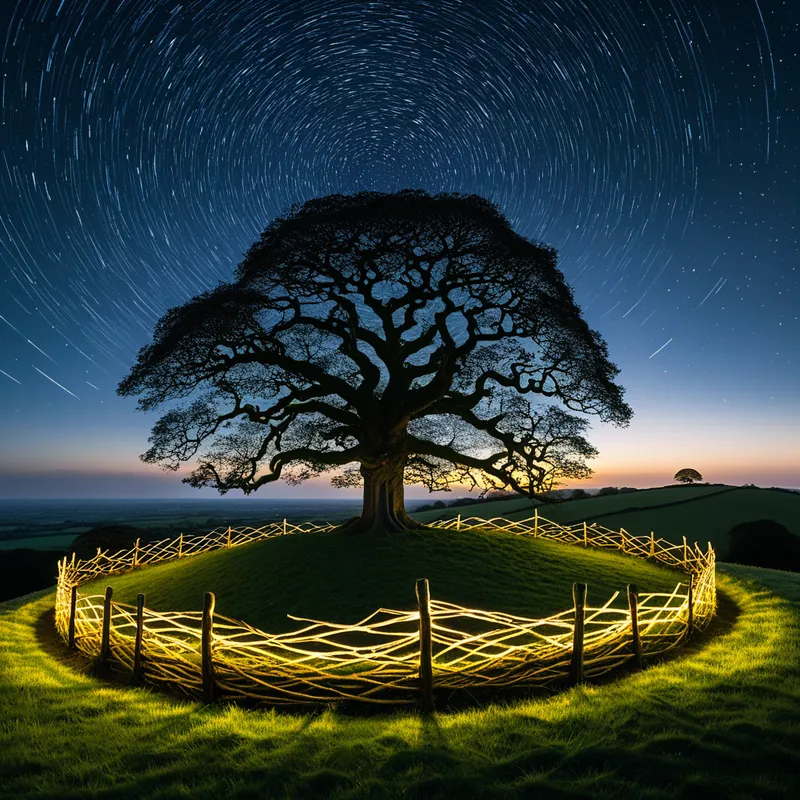
The Wattle Fence of Tara Myth Meaning & Symbolism
A myth where the sacred center of Tara is defined not by stone, but by a living wattle fence, symbolizing the permeable boundary between the human and divine.
The Tale of The Wattle Fence of Tara
Hear now, and let your mind travel to the green heart of Ériu. Not to a mountain of stone, nor a fortress of iron, but to a gentle hill where the sky kisses the land. This is Tara. In the time of mists, when the druid’s word was law and the king’s truth was his strength, Tara was not a citadel as others know it. Its boundary, its soul-wall, was woven from the living land itself.
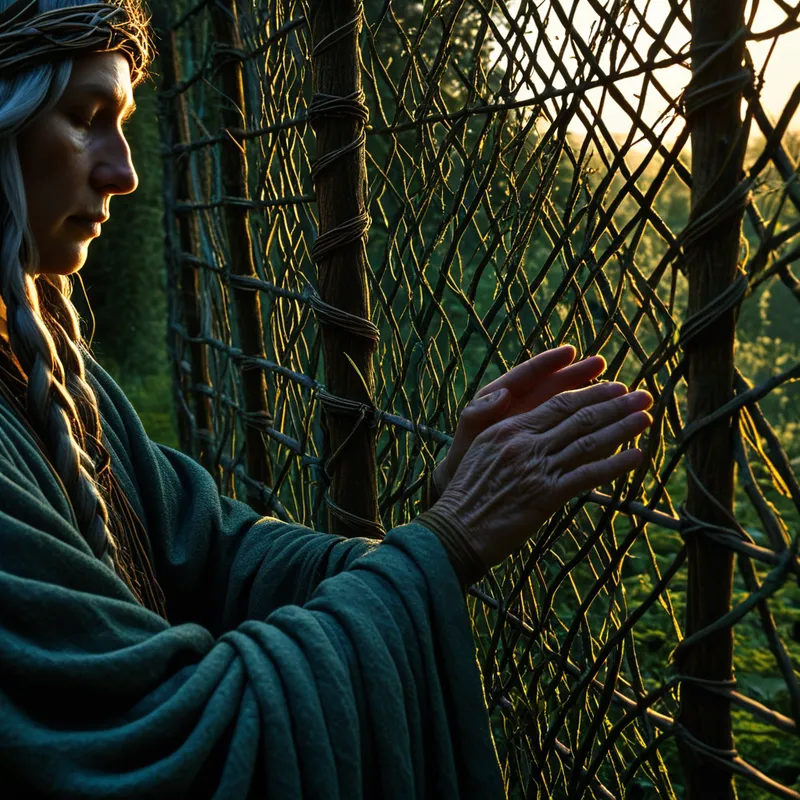
Each year, as the sun wheeled to its height at Bealtaine, a sacred rite unfolded. The king, his brow heavy with the weight of the tribe’s fate, would stand upon the Lia Fáil. The druids, cloaked in white, their eyes seeing the unseen threads of the world, would gather. From the sacred groves came the supple rods of hazel and willow, cut with prayers and purified by smoke. Not with mortar and trowel, but with intention and song, they began to weave.
The air hummed with the scent of damp earth and green sap. Fingers, old and young, worked in rhythm, intertwining the withies into a fence that encircled the royal enclosure. This was no mere barrier to keep cattle out. This was a declaration, a living sigil drawn upon the earth. As each section was raised, chants rose with it—invocations to the land goddess, to the spirits of the hazel, to the sovereignty of Ériu herself. The fence was pliable, it breathed with the wind, yet it held a power more potent than any rampart. It defined nemeton, the sacred center where the human world touched the realm of the gods.
The myth tells that when the fence stood complete, a palpable silence would descend. The ordinary world outside receded. Within the woven circle, the king was no longer merely a man; he was the embodiment of a covenant. The land’s fertility, the tribe’s prosperity, and the cosmic order itself were held in balance by the integrity of this living boundary. Should the king rule with falsehood or injustice, the lore warns, the fence would not break—it would simply cease to be true. Its magic would wither, its symbolic power draining away like water into sand, leaving the center vulnerable and the kingship hollow. The fence’s strength was a mirror of the king’s own truth.
Cultural Origins & Context
The image of the Wattle Fence of Tara emerges from the rich tapestry of early Irish tradition, preserved in texts like the Lebor Gabála Érenn and the Ulster Cycle. It is less a single, dramatized story and more a pervasive symbolic motif embedded in the concept of sacred kingship and the nemeton. This was not entertainment, but foundational cosmology.
The myth was likely part of the oral teachings of the druid and fili classes, recited during the inauguration rituals of a king or at seasonal festivals like Bealtaine. Its function was societal and psychic: it visually and ritually encoded the contract between the ruler, the people, and the land. The fence physically manifested an abstract principle—that true sovereignty and social order are not imposed by force, but are woven from reciprocal relationship, justice (fír), and truth (fírinne). It taught that the center of power must be consciously defined and ritually maintained, or it dissolves into chaos.
Symbolic Architecture
At its core, the Wattle Fence is an archetypal symbol of the limen—the threshold. It does not seek to be an impervious wall of separation, but a permeable, living membrane of distinction.
The sacred center is not defended by walls of stone, but by the integrity of its own definition. A boundary woven, not built, reminds us that what protects us must also allow the world to breathe through it.
The materials are profoundly significant. Hazel is the tree of wisdom and poetic inspiration in Celtic lore; willow is associated with intuition, dreams, and the lunar realms. The fence, therefore, is woven from consciousness and the subconscious. It represents a container fashioned from both knowing and feeling. Its circular form mirrors the Celtic reverence for the cyclical and the centered. The king within represents the conscious ego, but an ego in right relationship—his authority is valid only as long as he honors the “fence,” the sacred laws and truths that connect him to the larger Self of the land and tribe.
Psychologically, the fence symbolizes the necessary structure of the psyche—the ego boundary. A healthy ego is not a rigid, isolating fortress, but a resilient, defining presence that allows for exchange with the inner and outer worlds. It holds the center of identity secure so that the work of the soul can proceed within.
The Dreamer’s Resonance
When this myth stirs in the modern unconscious, it often manifests in dreams of weaving, building permeable barriers, or finding oneself within a circular, lightly defined space. One might dream of mending a garden fence with living branches, or of being tasked with defining the boundary of a sacred grove.
Such dreams frequently arise during life transitions where one’s sense of identity or personal sovereignty is being reconfigured—a new career, the end of a relationship, a spiritual awakening. The somatic feeling is not one of claustrophobic confinement, but of conscious containment. There may be anxiety about the “fence’s” strength, or a profound peace found within its circle.
The dream is pointing to a psychological process of redefining the center. The dream-ego is engaged in the work of determining what is “self” and what is “other,” what values and truths form the pliable yet essential structure of one’s identity. The fear that the fence is “not strong enough” mirrors ancient anxieties about the king’s truth; it asks the dreamer, “Upon what integrity does your own sovereignty rest?”
Alchemical Translation
The myth of the Wattle Fence models a crucial stage in the alchemical process of individuation: the construction of the vas or vessel. In psychological terms, this is the creation of a conscious, resilient ego-structure capable of containing the transformative fires of the unconscious.
Individuation does not begin by storming the heavens, but by weaving a humble circle on the earth of the self. The vessel must be fashioned before the gold can be made.
The first step is collatio—the gathering of materials. The dreamer must identify their own “hazel and willow”: their core wisdom, their intuitive gifts, their personal truths. These are the raw, living elements of the psyche. The weaving itself is the work of consciousness—deliberately connecting these elements into a coherent identity, a defined sense of “I.” This is not about building an impenetrable persona, but about creating a sacred enclosure where the deeper work of encountering the Self (the symbolic “king” in right rule) can occur.
The myth’s warning—that the fence loses power under falsehood—translates directly to the modern journey. A personality built on deception, borrowed values, or unexamined complexes is a vessel that cannot hold the pressure of transformation; it cracks, leading to fragmentation or inflation. The true “alchemical gold” of the integrated Self can only be forged within a container woven from authentic personal truth. Thus, the ongoing maintenance of the “fence” becomes the lifelong practice of self-examination, integrity, and honoring the sacred contract between the individual consciousness and the vast, fecund unconscious—the modern expression of the covenant with the land.
Associated Symbols
Explore related symbols from the CaleaDream lexicon: