The Wallet of Fortuna Myth Meaning & Symbolism
A mortal receives a magical wallet from the goddess of fortune, learning that true wealth lies not in endless gold, but in the wisdom of its use.
The Tale of The Wallet of Fortuna
Listen, and hear a tale spun on the wheel of [the world](/myths/the-world “Myth from Tarot culture.”/) itself. In the days when gods walked just beyond the edge of sight, and the breath of destiny was a cold wind on the neck, there lived a man named Tychon. His life was a tapestry of worn threads: a small farm that yielded little, a heart that hoped for much, and pockets that held only dust and longing.
One evening, as a bruised purple twilight settled over the land, Tychon sat by a crossroads, his spirit as heavy as the stones at his feet. He did not pray to the high gods of law or thunder, for they seemed deaf to the small miseries of men. Instead, he whispered a plea into the gathering dark, a plea not for virtue or victory, but for simple, undeniable luck. He called upon [Fortuna](/myths/fortuna “Myth from Roman culture.”/), she who is blindfolded and holds [the cornucopia](/myths/the-cornucopia “Myth from Global/Universal culture.”/), she whose great wheel lifts kings to the heavens and grinds emperors into [the earth](/myths/the-earth “Myth from Hindu culture.”/).
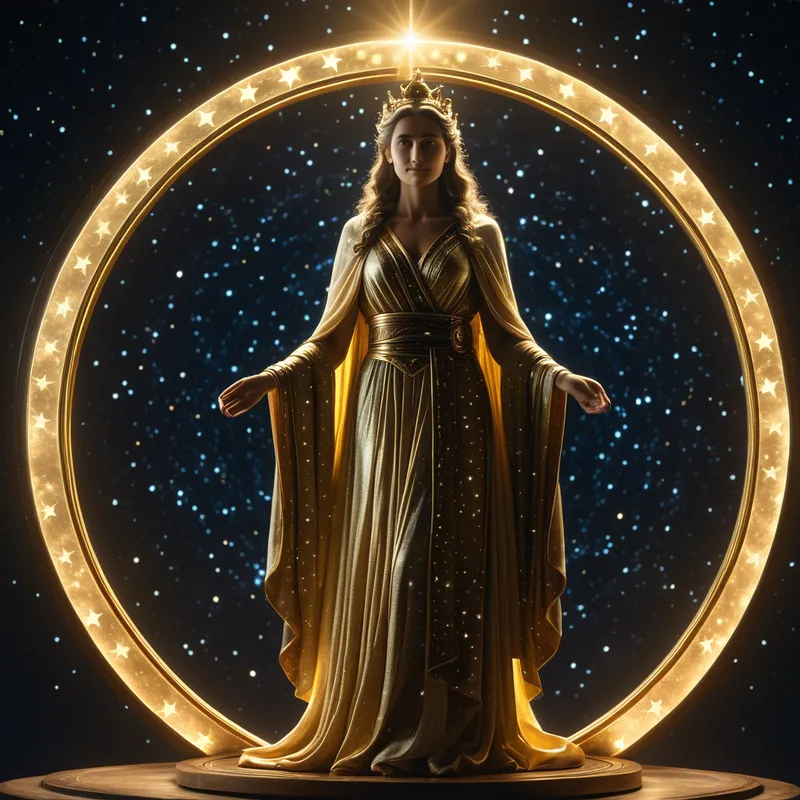
The air grew still. The scent of ozone and distant roses filled his nostrils. Before him, the very space seemed to ripple like pond [water](/myths/water “Myth from Chinese culture.”/), and from it stepped a figure of terrifying and beautiful ambiguity. She was both young and ancient, clad in a gown that shifted from sunrise gold to twilight indigo. In one hand she held a ship’s rudder, in the other, a simple, unadorned leather wallet. Her eyes, when she turned them upon him, were not blindfolded, but were deep pools reflecting every possibility that ever was or could be.
“You called for a turn of the wheel, little mortal,” her voice was the sound of dice rolling in a marble cup. “You shall have it. This is my wallet. It contains a single gold coin. Spend it, and by morning, another shall take its place. It is endless, but it is not infinite. Remember this.”
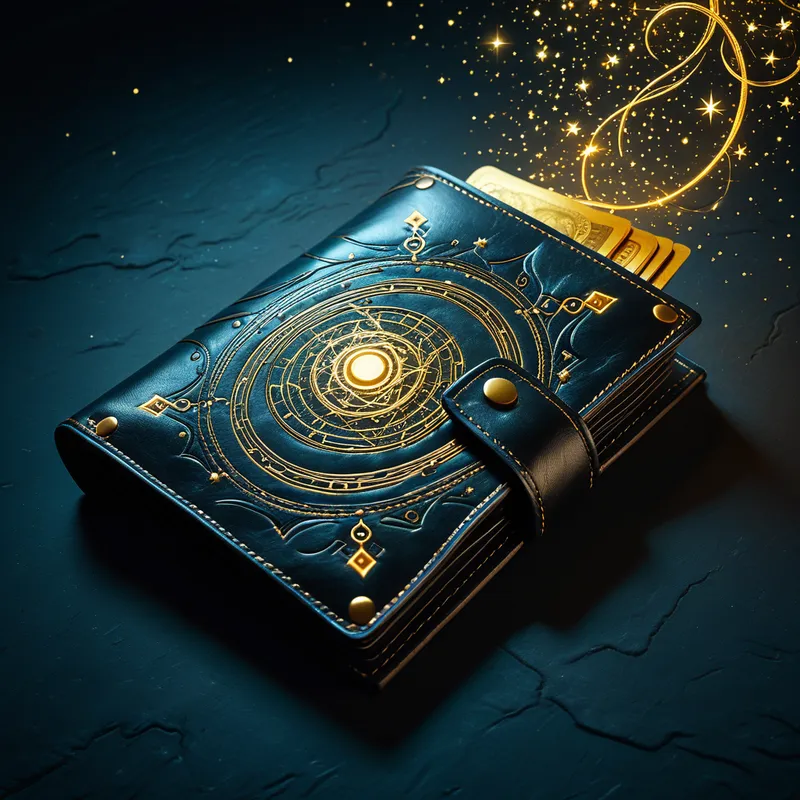
She placed the soft leather in his trembling hands. It was warm, and held the weight of a single, solid disc. Then, with a whisper of fabric and a sigh of the turning earth, she was gone.
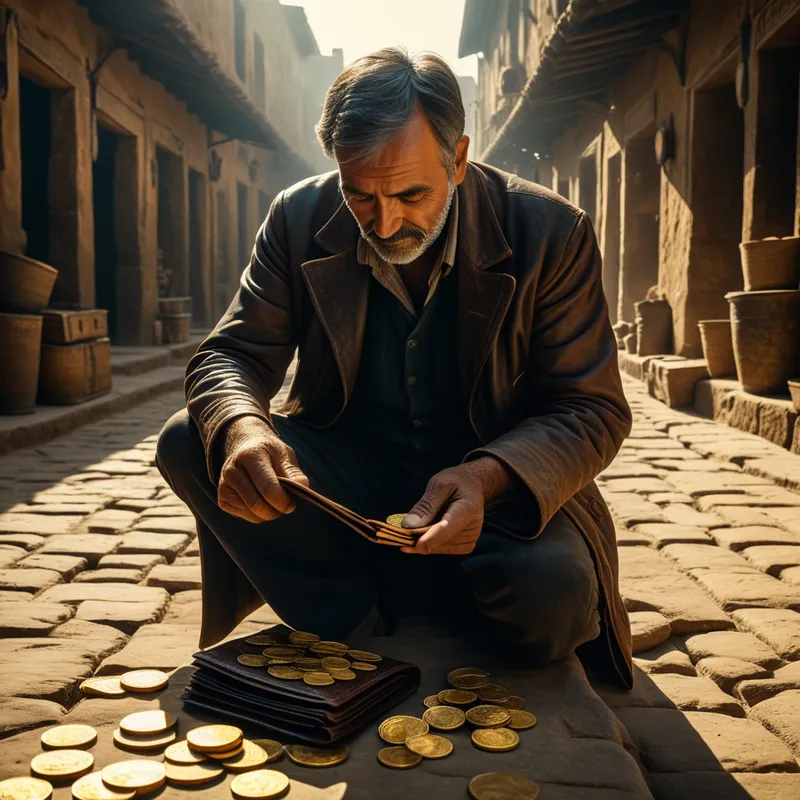
Tychon ran home, his heart a wild drum. In the candlelight, he opened the wallet. There it was—a coin of purest gold, stamped with the image of Fortuna’s wheel. He spent it the next day on a feast, on fine cloth, on clearing a petty debt. That night, he lay awake, and as [the moon](/myths/the-moon “Myth from Tarot culture.”/) reached its zenith, he heard a soft clink. In the wallet, another coin gleamed.
So began his ascent. The farm became an estate. His simple tunic became silks. Friends multiplied like spring blossoms. The coin was spent on grander and grander things: a marble fountain, a private orchestra, a vaulted library filled with scrolls he never read. The clink at midnight was the sound of his heartbeat, the guarantee of his world. He forgot the feel of dust in his pockets. He forgot the weight of true need. He remembered only the spending, the glorious, effortless outflow.
Years wheeled by. One night, at a lavish banquet of his own making, a poet—a man with hungry eyes and a sharp tongue—toasted him. “To Tychon,” he cried, “who has conquered fate itself! Whose wealth is as endless as the stars! What can you not buy? What destiny is beyond your purchase?”
In that moment, drunk on wine and hubris, Tychon made a decision. He would buy the one [thing](/myths/thing “Myth from Norse culture.”/) he felt eluded him: certainty. He would buy the future. He stood and declared to the stunned hall, “With this fortune, I shall build a tower that pierces the clouds! Its foundation will be laid upon a thousand gold coins, and its spire will scratch at the door of the gods themselves! I will look down upon the very [wheel of fortune](/myths/wheel-of-fortune “Myth from Tarot culture.”/)!”
He emptied his vault, hiring every mason and engineer in the land. The first thousand coins were paid from the wallet’s nightly bounty. But the project was a ravenous beast. The wallet’s single daily coin was a drop in a vast ocean of expense. Impatient, arrogant, Tychon began to borrow against the promise of tomorrow’s coin, and the next, and the next. He mortgaged his future to feed the present. The midnight clink became not a promise, but a taunting reminder of his limitation.
[The tower](/myths/the-tower “Myth from Tarot culture.”/) rose, a skeletal monument to his aspiration. Then, one rain-lashed night, as he stood in his half-built pinnacle, the creditors came. They were not men, but shades of consequence, their faces hard as ledger-stone. They demanded payment in full. Desperate, Tychon fumbled for the wallet. He pulled out the day’s coin. “See! More comes tomorrow! And the next day! It is endless!”
The lead creditor took the coin, held it to the light of a lightning flash, and let it fall. It did not clink on the stone. It vanished with a hiss, like a drop of water on a hot griddle. “Endless,” the shade echoed, “but not infinite. You have spent against coins not yet minted. You have spent the principle of your luck. The account is closed.”
The wallet in Tychon’s hand grew cold, then light. He opened it. It was empty. Not a single coin remained, and no sound would ever come at midnight again. The shades dissolved into the storm. Tychon was left alone in the howling dark, in his towering folly, with nothing but the empty leather and the crushing memory of the goddess’s words: It is endless, but it is not infinite.
Cultural Origins & Context
The tale of The Crumena Fortunae is a myth that belongs to no single culture, yet appears in the folklore and philosophical parables of many. Its most recognizable form is rooted in the syncretic Greco-Roman world, where the cult of Fortuna/Fate was widespread. However, its essence—a divine boon of conditional abundance—echoes in stories from [King Midas](/myths/king-midas “Myth from Greek culture.”/) to the countless “magic purse” folktales found across Europe and Asia.
It was not a temple myth, recited by high priests, but a market-square story, a fireside cautionary tale told by travelers and elders. Its societal function was multifaceted: for the poor, it was a fantasy of respite; for the merchant, a parable about cash flow and debt; for the philosopher, an allegory about the nature of sophrosyne and the perils of confusing the infinite with the limitless. It taught that the gifts of chance ([Tyche](/myths/tyche “Myth from Greek culture.”/)) come with invisible strings attached to the loom of necessity (Ananke).
Symbolic Architecture
The myth’s power lies in its deceptively simple symbolic [architecture](/symbols/architecture “Symbol: Architecture in dreams often signifies structure, stability, and the framing of personal identity or life’s journey.”/). The [Wallet](/symbols/wallet “Symbol: A wallet in dreams symbolizes personal values, security, and the management of resources.”/) itself is the core [symbol](/symbols/symbol “Symbol: A symbol can represent an idea, concept, or belief, serving as a powerful tool for communication and understanding.”/). It is not a cornucopia, spilling forth bounty indiscriminately. It is a container, a limit. It represents potential [capital](/symbols/capital “Symbol: A capital city represents the center of power, governance, and national identity, often symbolizing authority, structure, and collective aspirations.”/)—be it financial, creative, emotional, or temporal—that regenerates but does not expand. It is the daily allotment of [energy](/symbols/energy “Symbol: Energy symbolizes vitality, motivation, and the drive that fuels actions and ambitions.”/), luck, or [opportunity](/symbols/opportunity “Symbol: The symbol ‘opportunity’ signifies potential for advancement, growth, and new beginnings in various life aspects.”/) given to a [life](/symbols/life “Symbol: The symbol of ‘Life’ represents a journey of growth, interconnectedness, and existential meaning, encompassing both the joys and challenges that define human experience.”/).
The wallet is the soul’s daily bread; to mortgage it is to starve the future self.
Fortuna represents not mere luck, but the amoral, cyclical [nature](/symbols/nature “Symbol: Nature symbolizes growth, connectivity, and the primal forces of existence.”/) of circumstance itself. Her gift is not one of love or merit, but of pure [chance](/symbols/chance “Symbol: A representation of opportunities and unpredictability in life, illustrating how fate can influence one’s journey.”/), a test disguised as a blessing. The single coin is the [unit](/symbols/unit “Symbol: Represents wholeness or completeness within the dream narrative.”/) of the present [moment](/symbols/moment “Symbol: The symbol of a ‘moment’ embodies the significance of transient experiences that encapsulate emotional depth or pivotal transformations in life.”/), the “now” that is ours to spend. Tychon’s fatal [error](/symbols/error “Symbol: A dream symbol representing internal conflict, perceived failure, or a mismatch between expectations and reality.”/) is a psychological one: he mistakes the reliable recurrence of the coin (endlessness) for a boundless [reservoir](/symbols/reservoir “Symbol: A contained body of water representing stored resources, emotions, or potential, often signifying controlled or suppressed aspects of the self.”/) ([infinity](/symbols/infinity “Symbol: A mathematical and philosophical symbol representing endlessness, eternity, and limitless potential.”/)). He confuses a renewable resource with a permanent possession. His [tower](/symbols/tower “Symbol: The tower symbolizes protection, aspirations, and isolation, representing both stability and the longing for higher achievement.”/) is the symbol of hubris, [the ego](/myths/the-ego “Myth from Jungian culture.”/)’s [monument](/symbols/monument “Symbol: A structure built to commemorate a person, event, or idea, often representing legacy, memory, and cultural identity.”/) to its own supposed exemption from natural law.
The Dreamer’s Resonance
When this myth pattern stirs in the modern unconscious, it often manifests in dreams of magical objects that fail, of endless corridors that lead nowhere, or of finding money that turns to leaves or dust. The somatic sensation is one of initial exhilaration followed by a deep, sinking anxiety—the “other shoe” that never drops but whose impending fall is felt in the bones.
To dream of the Wallet is to dream at [the crossroads](/myths/the-crossroads “Myth from Celtic culture.”/) of anxiety and abundance. The dreamer is likely navigating a real-life situation where a source of sustenance—a job, a relationship, a creative wellspring—feels both reliably present and perilously fragile. They may be “spending against the future”: burning out at work, exploiting a partner’s goodwill, or drawing on emotional capital faster than it can be replenished. The dream is the [psyche](/myths/psyche “Myth from Greek culture.”/)’s audit, a stark presentation of the ledger showing that the principle is being eroded. The empty wallet is the image of impending depletion, the moment when the renewable resource stops renewing because the system of reciprocity has been violated.

Alchemical Translation
The alchemical journey modeled here is the transmutation of Chance into Choice, and of Abundance into Value. The initial stage is the [nigredo](/myths/nigredo “Myth from Alchemical culture.”/): Tychon’s poverty and despair, the raw lead of human need. The gift of the wallet is the albedo, the washing pure, the dazzling but deceptive silver moon of sudden fortune. The building of the tower is the misguided citrinitas, the yellowing where the ego attempts to turn everything to its own gold, a false inflation.
The collapse is the crucial [rubedo](/myths/rubedo “Myth from Alchemical culture.”/), the reddening, the painful but necessary combustion. It is not a failure, but the burning away of the illusion of limitlessness.
The true gold forged in this myth is not the coin, but the wisdom earned by its loss. The empty wallet becomes the philosopher’s stone.
For the modern individual, the process of individuation requires confronting our own “wallets.” What is the daily coin we receive? Is it time? Attention? Love? Creative spark? The alchemical work is first to identify the coin—to become conscious of our true capital. Second, to spend it wisely—to invest it in actions that nourish the soul’s estate, not just the ego’s tower. And finally, to accept the limit—to understand that endless renewal requires respect for the cycle. The [triumph](/myths/triumph “Myth from Roman culture.”/) is not in having an infinite supply, but in achieving a sovereign relationship with the single, perfect coin of the present moment. We become, not owners of fortune, but skillful stewards of our own fate.
Associated Symbols
Explore related symbols from the CaleaDream lexicon: