The Wailing Wall Myth Meaning & Symbolism
The story of a sacred remnant, where the prayers of a people are woven into stone, bridging the chasm between divine promise and earthly exile.
The Tale of The Wailing Wall
Listen. Can you hear it? A sound older than empires, softer than the desert wind, yet heavier than the foundation stones of the earth. It is the sound of a wall weeping.
It was not always so. Once, it stood not as a solitary relic, but as the mighty western flank of a mountain crowned in gold and cedar—the Temple of Solomon. Here, the Tetragrammaton dwelt in a cloud of glory between the wings of golden cherubim. The air thrummed with the scent of incense and the chant of Levites. The stones themselves, quarried by silent giants, seemed to hum with the presence of the Holy. Pilgrims from all tribes would ascend, their hearts a single drumbeat of joy, to touch the hem of heaven.
But kingdoms are mortal. Pride is a slow poison. Prophets with eyes of fire cried warnings that scattered like dust on the plaza. The cloud of glory thinned, then vanished. The drums of Babylon were heard in the hills.
Then came the fire. It ate the gold, devoured the cedar, and cracked the foundation stones with a sound like the world breaking. The army of Nebuchadnezzar pulled down what the flames spared, leaving only a field of smoldering rubble and a people shackled, their songs strangled in their throats, marched into the weeping exile of Babylon.
Decades passed. A remnant returned, hearts scarred but stubborn with hope. They built a Second Temple, smaller, a memory of the first. But the true western wall of the Temple Mount, those colossal, perfectly fitted blocks from the age of Herod, remained. It became the closest point one could approach the Debir, the place where heaven had touched earth. It was just a wall. And it was everything.
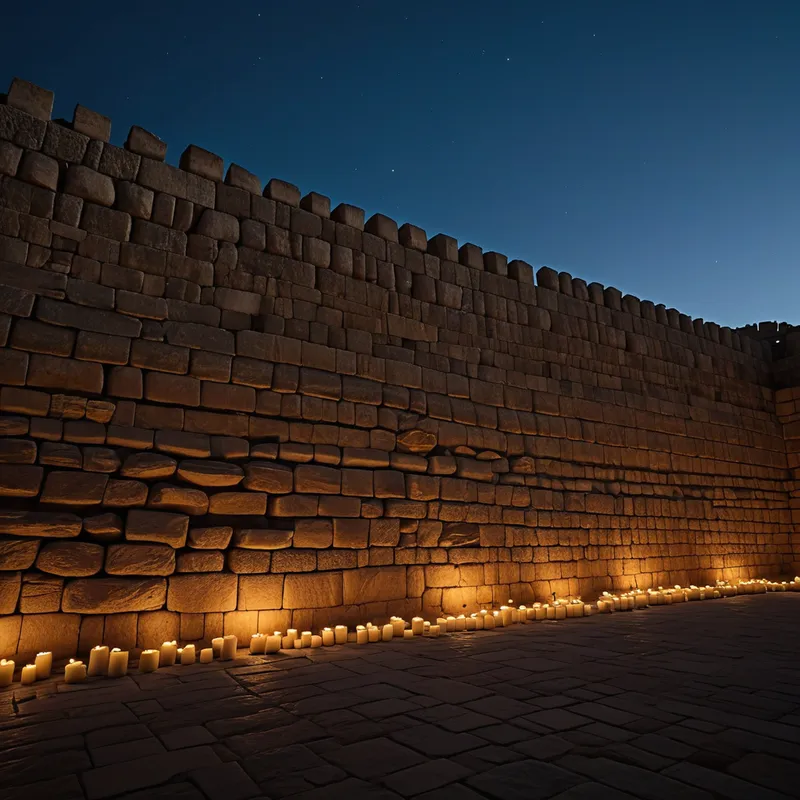
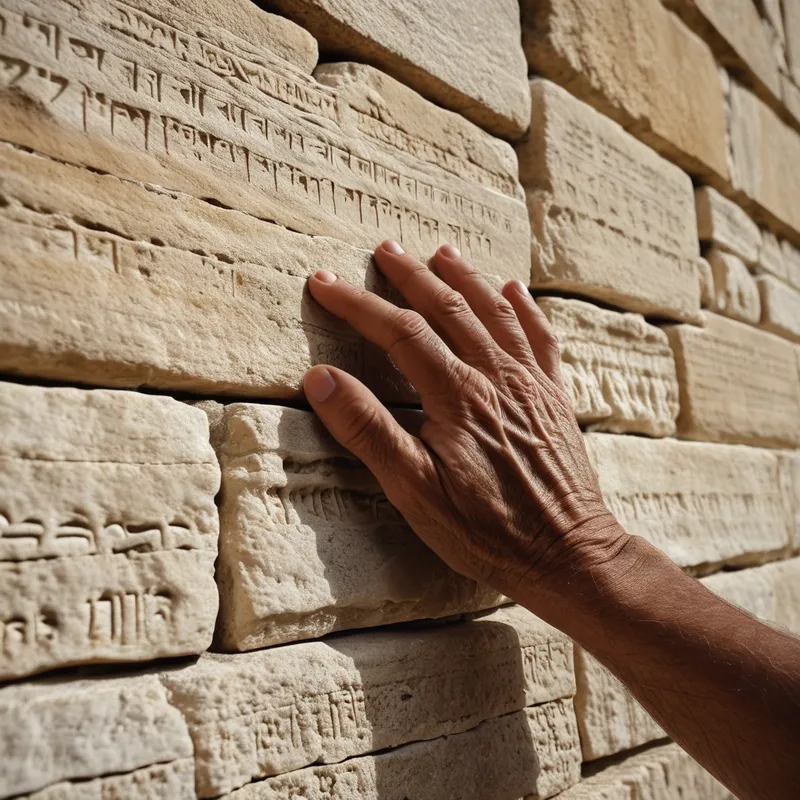
Generations of mothers came, pressing their palms against the sun-warmed limestone, whispering the names of children into the crevices. Fathers came, rocking in prayer, their foreheads cool against the stone, pouring out fears for harvests and futures. The devout and the desperate, the joyous and the broken—all came. They tucked their written prayers, their secret hopes and crushing griefs, into the cracks between the stones. Their tears salted the mortar. Their sighs became the wind that sighed through the plaza. The wall absorbed them all—every sob of the exile, every groan of the persecuted, every whispered dream of return. It became a living parchment, inscribed not with ink but with human longing. It did not speak. It listened. And in its silent, steadfast receiving, it began to wail with the accumulated sorrow of a thousand years. It became the Wailing Wall, the Kotel HaMa’aravi, the one shoulder of the holy mountain that refused to fall, forever bearing the weight of a people’s soul.
Cultural Origins & Context
The entity we call the Wailing Wall is not a figure from a single, codified mythological narrative like the exploits of Heracles. Its myth is historical, collective, and accretive. It originates in the tangible, catastrophic historical events of 586 BCE and 70 CE—the destructions of the First and Second Temples in Jerusalem. These were not mere military defeats; they were theological and cosmological ruptures. The Temple was the axis mundi, the guarantee of the Brit. Its loss threw the relationship between the divine and the people into a profound crisis.
The myth of the Wall grew in the fertile soil of Rabbinic Judaism following the Second Temple’s destruction. With the central locus of sacrifice and priestly mediation gone, prayer, study, and communal lament became the primary modes of connecting with the divine. The surviving western retaining wall of the Temple Mount, a staggering feat of Herodian engineering, became the focal point for this new piety. It was a relic, a spolia of holiness. The myth was passed down not by bards but by pilgrims, by the continuous, embodied practice of visitation and lament. Its societal function was multifaceted: it was a site of collective memory, a geographical anchor for a dispersed people, a physical symbol of both destruction and endurance, and a permeable boundary where the most private grief could be deposited into the collective, sacred body of history.
Symbolic Architecture
The Wailing Wall is perhaps the ultimate symbol of the pars pro toto—the part that stands for the whole. It is a fragment that remembers the cathedral. A single, enduring note that holds the echo of an entire symphony. Psychologically, it represents the psyche’s own foundational structures that remain after a cataclysm—a trauma, a great loss, the shattering of a cherished ideal or identity.
The wall is the enduring Self that remains when the temple of the persona has fallen.
The stones are the hardened, factual realities of our history—the unchangeable events, the losses etched in time. The cracks between them are the liminal spaces where the living, fluid psyche—our prayers, tears, and hopes—interacts with that immutable past. To insert a prayer into the wall is a profound alchemical act: transforming personal, often inarticulate emotion into a physical offering, integrating it into a structure of shared meaning. The wall does not answer; it receives. In doing so, it validates the lament. It says the grief is real, it is witnessed, and it belongs to a story larger than the individual.
The act of facing the wall is an act of facing what is most solid and unyielding in one’s own life—the facts of mortality, failure, and irrevocable change. Yet, by leaning into it, one does not crumble. One is supported. The wall symbolizes the paradox of finding strength in acknowledging utter vulnerability, of discovering a foundation in the very place of fracture.

The Dreamer’s Resonance
When the Wailing Wall appears in a modern dream, it rarely manifests as a tourist site. It appears as the Wall. It may be a vast, endless barrier in a landscape of inner desolation, or a small, poignant section of stone in one’s childhood home. The dreamer is typically drawn to it, compelled to approach and touch it.
Somatically, the dream often carries a profound sense of weight—in the chest, in the hands, in the posture of leaning. There is a palpable texture: the cool, rough, ancient surface of the stone. Psychologically, this dream marks a process of confronting a foundational grief or a historical wound—personal, familial, or ancestral. It signifies a moment where the psyche is ready to stop fleeing a painful truth and instead turn toward it, to “lay it against the stone.”
The act of weeping at the wall in a dream is not a sign of weakness, but of a critical somatic release. It is the unconscious insisting that a held sorrow must finally be expressed and offered up, moved from the silent, pressurized chambers of the heart into the shared, symbolic space of the soul. The dream may also feature the writing or placing of a note, indicating a need to articulate and externalize a deeply buried hope or fear. The Wall in a dream is the psyche’s own container, assuring the dreamer that their lament has a place, that their grief will not annihilate them, but can be integrated into the enduring structure of who they are.

Alchemical Translation
The individuation process, the journey toward psychic wholeness, requires a confrontation with one’s own ruins—the shattered ideals, the broken relationships, the parts of the self exiled in shame or trauma. The myth of the Wailing Wall provides a powerful model for this alchemical mortificatio and solutio—the breaking down and the dissolving.
First, one must acknowledge the destruction of the personal “Temple”—the conscious identity, the guiding belief system, or the life structure that once felt divinely ordained. This is the necessary, painful stage of disillusionment. The alchemical work begins not in rebuilding immediately, but in going to the remaining wall. This is the core of the Self that survives the catastrophe: one’s integrity, one’s core values, one’s simple, enduring capacity to feel.
The alchemy occurs in the crevice, the liminal space where the fluid soul meets the solid fact.
The process involves the continual, ritual offering of the raw, unrefined materia prima of emotion—the grief, the anger, the longing—into the cracks of that enduring self-structure. This is the prayer note. One does not shout at the sky; one whispers into the stone. This act transmutes chaotic, isolating pain into a sacred substance of connection—connection to one’s own depth, to human history, to the archetypal reality of suffering and endurance.
The goal is not to resurrect the old Temple in its previous form. That is nostalgia, a psychic regression. The goal is what the Wall itself became: a new, more humble, and more profound mode of connection. The divine presence (Shekhinah), according to the Midrash, went into exile with the people and now dwells in the sighs of the oppressed and the words of prayer. The alchemical translation teaches that wholeness is found not in recovering a lost perfection, but in learning to lean into the enduring, supportive reality of what remains, and in making that very site of fracture the place where the soul’s most authentic voice is heard, collected, and ultimately, redeemed.
Associated Symbols
Explore related symbols from the CaleaDream lexicon: