The Wagon Myth Meaning & Symbolism
A myth of a celestial wagon, its divine cargo, and the mortal driver tasked with an impossible journey across the crumbling bridge of the world.
The Tale of The Wagon
Listen. [The world](/myths/the-world “Myth from Tarot culture.”/) is not as solid as you believe. Between the firmament of the gods and the clay of mortals, there is a bridge. And on that bridge, there is a wagon.
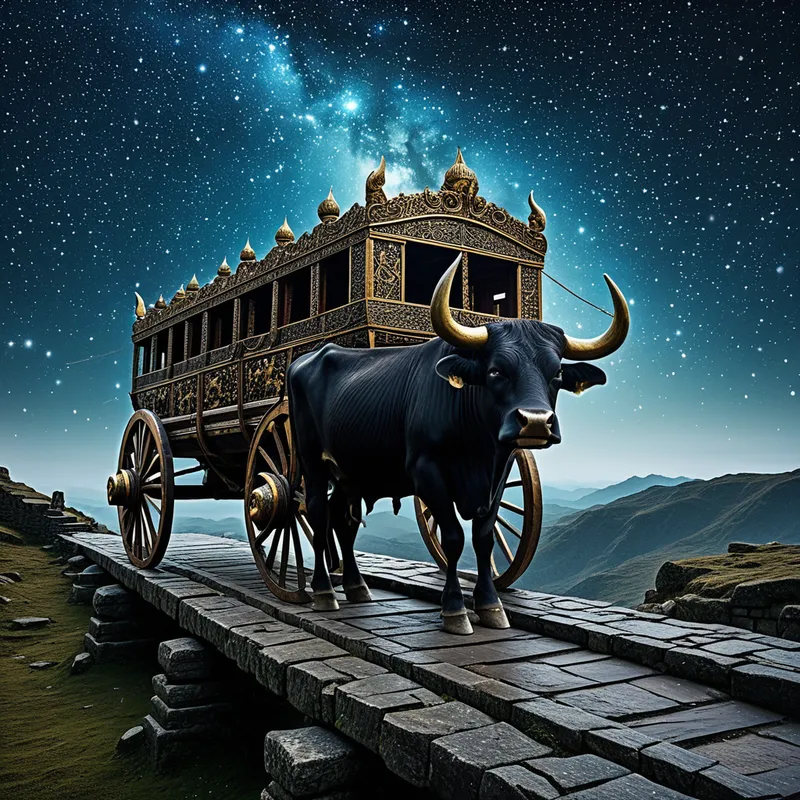
It was in the First Age, when [the sky](/myths/the-sky “Myth from Persian culture.”/) still dripped with the raw stuff of creation, that the High Ones forged a vessel. Not a ship for seas, but a wagon for the land of being. Its timbers were hewn from the World Ash, its bands forged in the heart of a fallen star, its wheels carved from the stone of the first mountain. They called it Kherdos. And into its covered bed, they placed a burden more precious than all realms: a single, pulsing ember of the First Fire—the unmanifest potential of all that is, was, and could be.
The bridge it must cross, Gephyra, spans [the abyss](/myths/the-abyss “Myth from Kabbalistic culture.”/) between the unmoving eternity of the divine and the flowing, dying time of [the earth](/myths/the-earth “Myth from Hindu culture.”/). It is a road of becoming. But the bridge is old, and with each turning of the great wheel of ages, its stones crumble a little more into [the void](/myths/the-void “Myth from Buddhist culture.”/) below.
The High Ones could not pull the wagon themselves, for their touch would solidify the path into permanence, ending the story before it began. A mortal driver was needed—one with a heart that knew both the weight of clay and the whisper of the sky. They chose a herder, a tender of beasts and keeper of thresholds, named Anaxos.
His task was simple and impossible: guide the wagon and its sacred cargo across the crumbling bridge to the far shore, where a new age could be kindled from the ember. The oxen, seven beasts with coats like the night sky and eyes like calm pools, were yoked. They knew [the way](/myths/the-way “Myth from Taoist culture.”/) in their bones, but they required a hand on the reins—a conscious will to choose the path moment by moment, to balance the immense weight, to feel the stones give way.
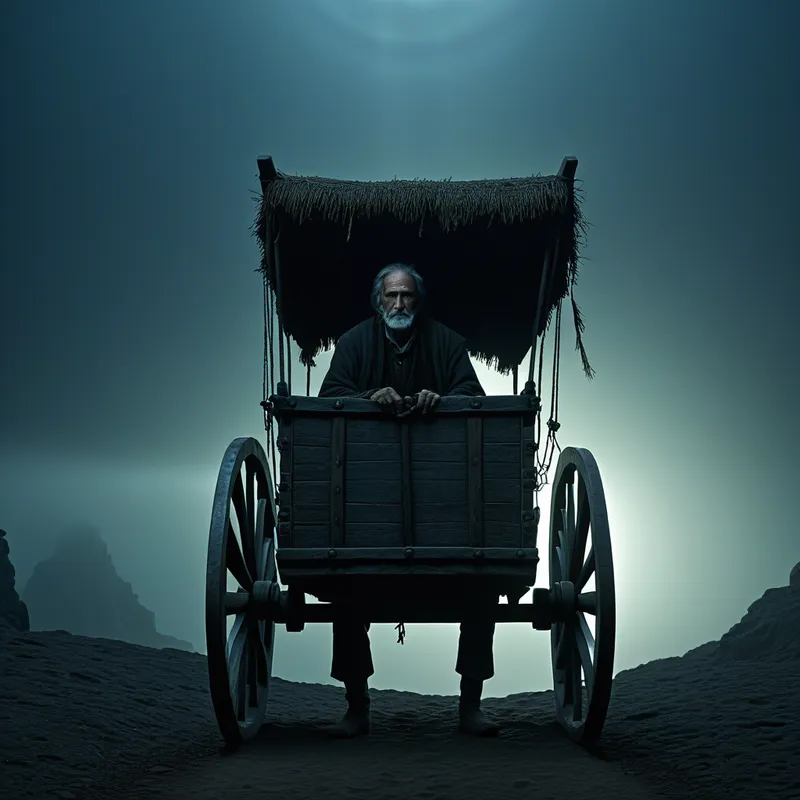
So Anaxos climbed onto the driver’s bench. He felt the living wood groan beneath him. He heard the soft, radiant hum from within the covered cart, a sound that vibrated in his teeth and made his shadow dance. With a click of his tongue and a gentle pull, the journey began.
The air on the bridge was thin and sang with forgotten voices. Stars wheeled close enough to touch. At first, the way was broad, the stones firm. But as they journeyed, the bridge narrowed. Winds, born from the fears of the world below, howled and pushed at the wagon’s high sides. Cracks appeared in the path, revealing the bottomless dark beneath.
Anaxos’s arms ached. His focus was the only [thing](/myths/thing “Myth from Norse culture.”/) keeping the left wheels from the edge. He spoke to the oxen, steadying them, his voice a thread of mortal courage against the cosmic gale. He could not look back. He could not stop. The ember’s hum was now a heartbeat in his chest—his own heart syncing to its sacred rhythm. He was no longer just driving the wagon; he was of the wagon. His care, his attention, his weary, loving persistence became part of the vehicle itself.
Then, the crisis: a central stone, worn to sand, gave way. The right rear wheel lurched, splintering, dipping into nothingness. The wagon tilted. The oxen lowed in terror. The world held its breath. In that moment, Anaxos did not pray to the High Ones. He did not think of glory. He thought only of the cargo—the gentle, potent light in the dark. With a groan that came from the very timbers of his soul, he leaned. He threw his weight against the tilt, reins cutting into his palms, his will a solid thing. And the wagon, as if feeling his sacrifice, found a purchase. The wheel, though cracked, held.
They moved on, slower now, wounded but unwavering. The far shore, a land of soft, dawn-like light, grew before them. The bridge’s end was near. As the first ox set hoof on the solid, uncharted earth of the new age, the ember within the wagon flared. A warm, golden light filled the cart, seeping through the canvas, illuminating Anaxos’s tear-streaked face with the gentle radiance of a promise kept. He had not carried the gods. He had carried their possibility. And in doing so, he had forged his own soul into a bridge.
Cultural Origins & Context
The myth of The Wagon is a polygenetic narrative, appearing in fragments and echoes from the steppe cultures of Eurasia to the caravan lore of the Sahara, and in the metaphysical traditions of temple builders. It was never the property of a single priesthood but was a story of the road—told by carters, migrant herders, and itinerant smiths. It was recited at dusk beside communal fires, its rhythm matching the creak of wheels, its purpose to sanctify the daily, grueling reality of transport and trade.
In these cultures, the wagon was not mere technology; it was the nucleus of the home, the moving hearth. The myth served a profound societal function: it transformed the burden of livelihood into a sacred pilgrimage. The merchant carrying salt, the family fleeing drought, the herder moving his flock—all could see themselves as Anaxos, conducting not just goods or beasts, but the very continuity of life across the perilous “bridge” of the season or the conflict. It was a story that conferred dignity on exhaustion and framed resilience as a cosmic duty.
Symbolic Architecture
The [Wagon](/symbols/wagon “Symbol: A wagon in dreams often symbolizes the journey of life, progress towards goals, and the burdens we carry along the way.”/) is the vas, the [vessel](/symbols/vessel “Symbol: A container or structure that holds, transports, or protects something essential, representing the self, emotions, or life journey.”/) of [the Self](/myths/the-self “Myth from Jungian culture.”/). Its cargo, the First [Ember](/symbols/ember “Symbol: A small, glowing piece of burning coal or wood, representing potential, memory, and fragile life. It signifies transformation and latent power.”/), is the irreducible core of potential—[the divine spark](/myths/the-divine-spark “Myth from Gnostic culture.”/), the Self in its nascent, unactualized state.
The journey is not toward the divine, but with it. The god-fragment does not drive; it must be driven, cared for, and protected by the conscious ego.
The crumbling bridge, Gephyra, is the [path](/symbols/path “Symbol: The ‘path’ symbolizes a journey, choices, and the direction one’s life is taking, often representing individual growth and exploration.”/) of individuation itself—the lifelong process of becoming who we are. It is inherently unstable, built over the [abyss](/symbols/abyss “Symbol: A profound void representing the unconscious, the unknown, or a spiritual threshold between existence and non-existence.”/) of the unconscious (the void). Its decay represents the inevitable crises, doubts, and neuroses that threaten to dissolve our sense of [direction](/symbols/direction “Symbol: Direction in dreams often relates to life choices, guidance, and the path one is following, emphasizing the importance of navigation in personal journeys.”/) and [purpose](/symbols/purpose “Symbol: Purpose signifies direction, meaning, and intention in life, often reflecting personal ambitions and core values.”/). Anaxos, the [caregiver](/symbols/caregiver “Symbol: A spiritual or mythical figure representing nurturing, protection, and unconditional support, often embodying divine or archetypal parental energy.”/) [archetype](/symbols/archetype “Symbol: A universal, primordial pattern or prototype in the collective unconscious that shapes human experience, behavior, and creative expression.”/), is not a [warrior](/symbols/warrior “Symbol: A spiritual archetype representing inner strength, discipline, and the struggle for higher purpose or self-mastery.”/)-[hero](/symbols/hero “Symbol: A hero embodies strength, courage, and the ability to overcome significant challenges.”/) who slays monsters, but the sustaining function of [consciousness](/symbols/consciousness “Symbol: Consciousness represents the state of awareness and perception, encompassing thoughts, feelings, and experiences.”/). His heroism is one of endurance, attentiveness, and [responsibility](/symbols/responsibility “Symbol: Responsibility in dreams often signifies the weight of duties and the expectations placed upon the dreamer.”/) for the precious, fragile content of his own [soul](/symbols/soul “Symbol: The soul represents the essence of a person, encompassing their spirit, identity, and connection to the universe.”/).
The breaking wheel is the critical [moment](/symbols/moment “Symbol: The symbol of a ‘moment’ embodies the significance of transient experiences that encapsulate emotional depth or pivotal transformations in life.”/) of psychological [breakdown](/symbols/breakdown “Symbol: A sudden failure or collapse of a system, structure, or mental state, often signaling a need for fundamental change or repair.”/)—when a long-held [structure](/symbols/structure “Symbol: Structure in dreams often symbolizes stability, organization, and the framework of one’s life, reflecting how one perceives their environment and personal life.”/) of the [personality](/symbols/personality “Symbol: Personality in dreams often symbolizes the traits and characteristics of the dreamer, reflecting how they perceive themselves and how they believe they are perceived by others.”/) (a belief, a [relationship](/symbols/relationship “Symbol: A representation of connections we have with others in our lives, often reflecting our emotional state.”/), a [career](/symbols/career “Symbol: The dream symbol of ‘career’ often represents one’s ambitions, goals, and personal identity in a professional context.”/)) fails. The myth asserts that this is not the end of the [journey](/symbols/journey “Symbol: A journey in dreams typically signifies adventure, growth, or a significant life transition.”/), but its most vital point. The salvation comes not from outside intervention, but from the [driver](/symbols/driver “Symbol: The ‘Driver’ symbolizes control, direction, and the pursuit of goals in both personal and external aspects of life.”/)’s immediate, somatic [response](/symbols/response “Symbol: Response in dreams symbolizes how one reacts to situations, often reflecting the subconscious mind’s processing of events.”/): the lean. This is the total commitment of the [psyche](/myths/psyche “Myth from Greek culture.”/) to its own preservation and purpose.
The Dreamer’s Resonance
When this myth stirs in the modern unconscious, it often manifests as dreams of driving a heavy vehicle (a bus, a truck, a laden car) across a treacherous, narrow, or collapsing road. The dreamer feels an immense responsibility for unseen passengers or a crucial cargo. There is a somatic feeling of strain in the shoulders and hands, of gripping too tightly.
This dream pattern signals that the psyche is engaged in a core process of carrying something vital—a new talent, a healing trauma, a creative project, a relational commitment—through a period of instability. The anxiety in the dream is not pathological but procedural; it is [the ego](/myths/the-ego “Myth from Jungian culture.”/)’s acute awareness of its sacred duty. The dream asks: What is the “First Ember” you are carrying? What in your life feels like that sacred, non-negotiable burden? And where is your bridge crumbling? The dream is a map of the current pressure points in the soul’s journey toward wholeness.

Alchemical Translation
The alchemical operation mirrored in this myth is not the dramatic solve (dissolution) or coagula (coagulation), but the sustained, patient labor of circulatio—the careful, constant tending of the fire in [the vessel](/myths/the-vessel “Myth from Alchemical culture.”/). The psyche is the vas, the wagon. The ego is Anaxos, the driver.
Individuation is less a glorious conquest and more a faithful cartage. We do not find the Self; we learn to carry it faithfully through the weathering storms of our own biography.
The transmutation occurs in the relationship between driver and cargo. Initially, the burden feels external, heavy, imposed by the “gods” (fate, family, culture). Through the act of conscientious care—through holding the reins through storm and fracture—the ego gradually identifies with its charge. The “I” that drives and the “It” that is carried begin to resonate as one. The cracked wheel is essential; it is the flaw through which the light of the ember can be seen by the driver, the moment of breakdown that reveals the sacredness of the cargo. By the journey’s end, Anaxos is illuminated from within. The driver has become a beacon, not because he grasped the light, but because he proved a trustworthy vessel for its passage. The new shore he reaches is not a geographical location, but a new state of being—a personality that has integrated its divine fragment through the humble, heroic act of daily, devoted care.
Associated Symbols
Explore related symbols from the CaleaDream lexicon: