
The Völva Myth Meaning & Symbolism
A seeress, summoned by Odin, chants a cosmic prophecy of the world's doom and rebirth from a throne of forgotten gods.
The Tale of The Völva
Hear now a tale not of glory, but of sight. A story sung in the throat of the world, in the space between the crow’s call and the silence that follows.
The world was younger, yet already old with memory. Odin, the All-Father, whose single eye had paid the price for a drink from Mímir’s Well, felt a deeper thirst. A gnawing in the hollow of his wisdom. He sought not what was, but what would be. The final shape of things. The doom of gods.
His ravens, Huginn and Muninn, flew on silent wings across the nine worlds and returned with whispers of a power older than Asgard itself. They spoke of a Völva, a seeress so ancient she remembered the birth of the giants. She did not dwell among men or gods, but in a hall of shadows at the edge of knowing. To summon her was to stir the depths of fate itself.
Odin journeyed, crossing the rainbow bridge Bifröst and descending into the mortal realm, Midgard. He came to a burial mound, a barrow raised for a forgotten queen. There, with the power of the runes he had won upon the Yggdrasil, he chanted spells of waking. He called to the dust and the memory within it. The earth trembled. The stones groaned.
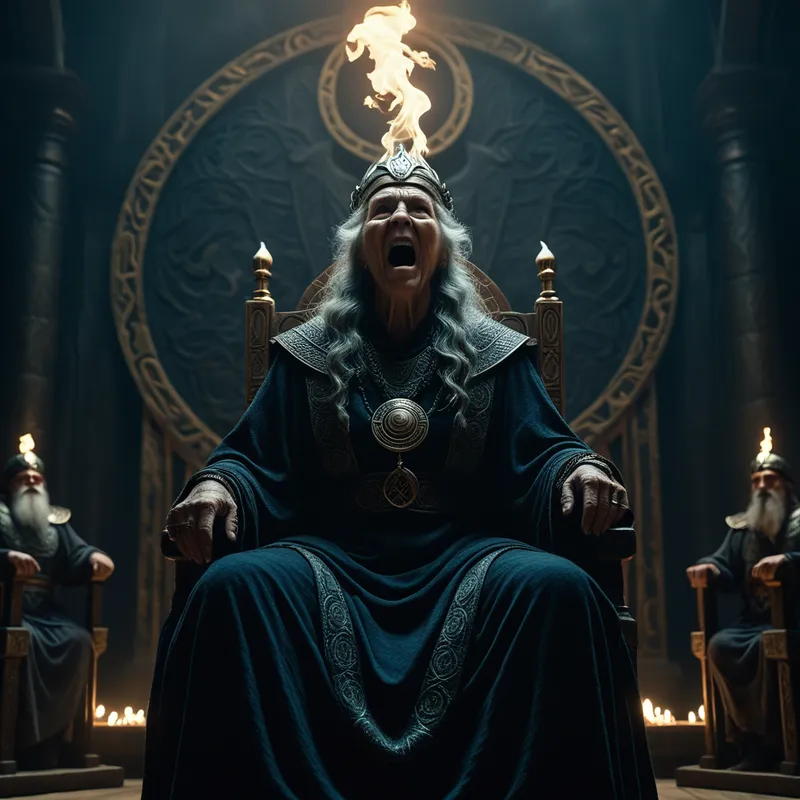
From the dark mouth of the barrow, a form emerged. Not a corpse, but a presence. The Völva. Her flesh was the color of old parchment, her eyes milky pools that reflected not light, but time. She was clad in a cloak of crow feathers, and in her hand was a staff, knotted with the rings of uncounted years. She did not speak to Odin, but past him, her voice a dry rustle of leaves, the creak of ancient ice.
“I know where you sat, Odin,” she intoned, her first words an accusation of his disguise. She saw him whole. Then, she began to sing.
Her song was the universe unraveling. She sang of the world’s dawn, from the gaping void of Ginnungagap. She sang of the first gods, the murder of the being Ymir, the shaping of the earth from his flesh. She sang of the golden age and its slow tarnishing. And then, her voice dropped to a terrible whisper.
She sang of the end. Ragnarök. The trembling of the great tree, the freeing of the wolf Fenrir, the serpent Jörmungandr rising from the sea. She sang of the final battle on the field of Vígríðr, of Odin falling to the wolf’s maw, of Thor dying from the serpent’s venom. She sang of the sun turning black, the stars vanishing, and the earth sinking beneath the boiling waves.
But in the ashes of her song, a final note emerged. Not a note of triumph, but of continuation. A green shoot from drowned soil. A new earth, rising fresh and fertile from the water. A new sun, daughter of the old. And the silent, watchful figures of surviving gods, and two human survivors, Líf and Lífþrasir, hiding in the wood of the world tree.
Her song ceased. The air, which had thrummed with prophecy, went still and cold. The Völva looked upon Odin, who had sought this knowledge, and now bore its unbearable weight. Without another word, she receded into her mound, returning to the long sleep of the earth. Odin stood alone in the gathering dark, his question answered, his future sealed. He had looked into the well of fate and seen his own death reflected. And beyond it, a beginning.
Cultural Origins & Context
The primary source for the Völva’s prophecy is the Old Norse poem Völuspá (“The Prophecy of the Seeress”), the opening and cornerstone of the Poetic Edda. This poem is a masterpiece of eschatological literature, believed to have been composed in Iceland in the 10th century, a time of intense social and religious transition on the cusp of Christianity.
The figure of the Völva was not merely a mythological construct but a recognized social and spiritual role in Norse society. These were women who practiced seiðr, a form of magic involving prophecy, soul journeying, and influencing fate. They operated in a liminal space, respected for their power but often viewed with unease, as their craft could blur the lines of accepted gender roles and societal order. The myth in Völuspá elevates this figure to a cosmic scale. It presents her as the ultimate authority, a primordial memory bank who holds the narrative of the cosmos from alpha to omega. The poem was likely performed, perhaps in ritual contexts, to affirm the cosmic order, explain its inevitable cycles of destruction and renewal, and provide a framework for understanding humanity’s place within a fate-driven universe.
Symbolic Architecture
The Völva is the archetype of the Deep Memory. She is not the future-teller of trivial events, but the voice of the pattern itself. She represents the unconscious psyche in its most collective and impersonal form—the repository of all that has been, which contains the blueprint for all that will be.
To consult the Völva is to dare a dialogue with the objective psyche, where personal desire meets impersonal law.
Her throne upon a burial mound is profoundly symbolic. She speaks from the place of the dead, the ancestors, and the past. All true prophecy, in a psychological sense, is a reading of the patterns laid down by history—personal and collective. Her blindness to the present world signifies her sight is turned inward, to the inner landscape where time is nonlinear. The staff she holds is her völr, a symbol of her authority and her connection to the axis of the world, the Yggdrasil itself.
Odin’s quest is the ego’s desperate, heroic attempt to comprehend the Self. He seeks the ultimate knowledge, even if it is the knowledge of his own demise. The prophecy he receives is not a warning he can avert, but a truth he must integrate. Ragnarök symbolizes the necessary death of an old psychic order—outworn gods (dominant conscious attitudes), petrified structures, and unsustainable ways of being. The green new world that follows is the potential for renewal that only such a total dissolution can make space for.

The Dreamer’s Resonance
When this myth stirs in modern dreams, it often manifests not as a Norse seeress, but through its core sensations and symbols. One might dream of:
- An Ancient, Knowing Figure: A grandmother, a librarian in an infinite archive, a silent guide in a wasteland. This figure exudes an aura of immense, non-judgmental knowledge.
- Being Shown a Pattern: Seeing the intricate, fatal weave of a tapestry; reading a book that narrates one’s own life up to its end; watching a film of inevitable global catastrophe.
- The Mound or Tomb: Entering a cave, a basement, a sealed room, or an archaeological dig. This is the descent into the personal and collective unconscious.
- The Unheeded Prophecy: Shouting a vital warning that no one hears, or hearing a truth about oneself that is initially rejected with terror.
The psychological process is one of confrontation with impersonal fate. The dreamer is encountering aspects of their life pattern—inherited familial traumas, deep personality structures, or the consequences of long-held choices—that feel fated and inescapable. The somatic experience is often a mix of awe and dread, a chilling recognition that carries the weight of truth. The work here is not to change the prophecy, but to find the courage to listen to it fully, to integrate its painful truths, and thus to find the agency that exists within acceptance of the pattern.
Alchemical Translation
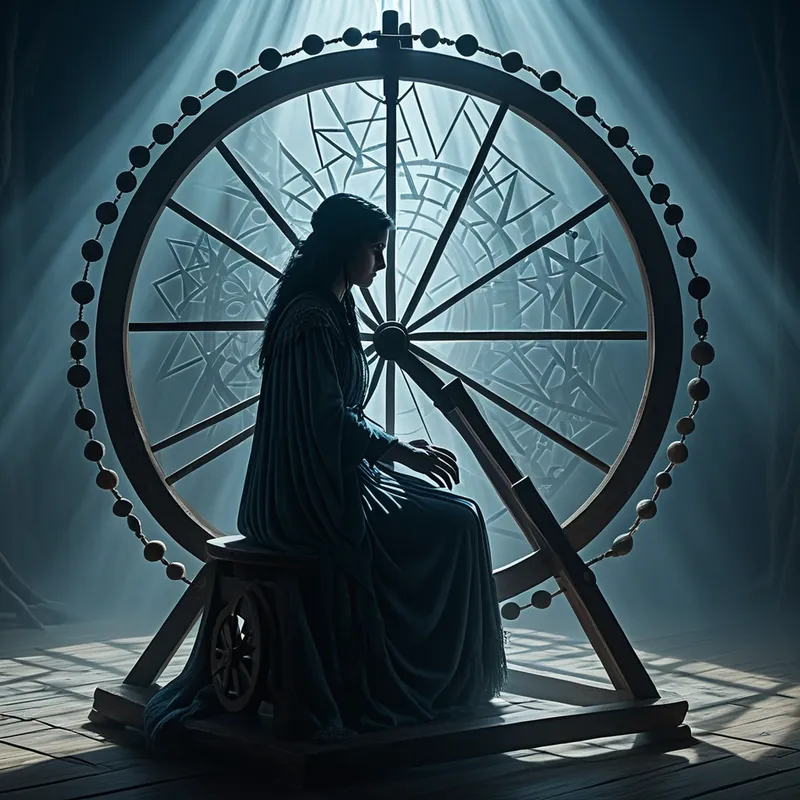
The alchemical journey modeled by the Völva myth is the Nigredo—the blackening, the confrontation with the shadow and the prima materia of the soul. Odin’s journey to the burial mound is the conscious mind’s voluntary descent into the darkest, most rejected parts of the self. The Völva herself is the spirit of the prima materia; she is the chaotic, ancient, and terrifying truth that must be encountered before any transformation can begin.
The prophecy of doom is the necessary dissolution of the old persona. The ego must know its limits, must see its own destined end, to make room for the authority of the Self.
The modern individual’s “Ragnarök” is the collapse of a life structure: the end of a career, the death of a relationship, a profound failure, or a mental health crisis that shatters one’s former identity. It feels like total annihilation. The Völva’s song teaches that this is not a mistake, but a stage in the cycle. The alchemical work is to sit in the darkness of that dissolution (mortificatio) without rushing to rebuild the old form.
The hope—the green land after the flood—is not promised by the Völva; it is simply reported as part of the pattern. It arises organically, but only if the floodwaters have done their work of cleansing. Psychic renewal requires the total surrender of the old god—the outdated ideal, the inflated self-image, the rigid belief. The individuation process demands we listen to the seeress within, hear our own difficult prophecy, and through that brutal honesty, allow a more authentic, resilient, and grounded consciousness to emerge from the waters. We do not escape fate; we fulfill it by understanding it, and in that understanding, find a new kind of freedom.
Associated Symbols
Explore related symbols from the CaleaDream lexicon: