The Vision Quest Myth Meaning & Symbolism
A sacred rite of passage where an individual seeks spiritual guidance through solitude, fasting, and communion with the unseen world.
The Tale of The Vision Quest
Listen. The world is not only what you see with eyes open under the sun. There is another world, a world of spirit, that breathes beneath the skin of the earth and sings in the spaces between the stars. To know your place, to know your name, you must go there. You must leave the warmth of the fire and the sound of the drum.
So the seeker goes. They are guided by an elder, one who has walked this path before and knows the language of the wind. They are purified in the sweat lodge, the steam carrying prayers to the four directions. Their body is cleansed, their mind emptied of the chatter of the village. Then, they are taken to a place of power—a high butte, a deep canyon, a lonely island in a lake. Here, they will make their circle. With only a blanket for warmth, perhaps a sacred pipe, they sit. They fast. They thirst.
The sun beats down. The cold night bites. Hunger becomes a hollow drum in the belly. Thirst is a fire in the throat. This is the first stripping away. The comforts of the body fall away like old leaves. In the silence, the mind turns inward, a frantic animal in a cage. Memories, fears, pride—they all rise up like smoke. The seeker lets them go. They stare into the vastness of the sky until the self begins to dissolve.
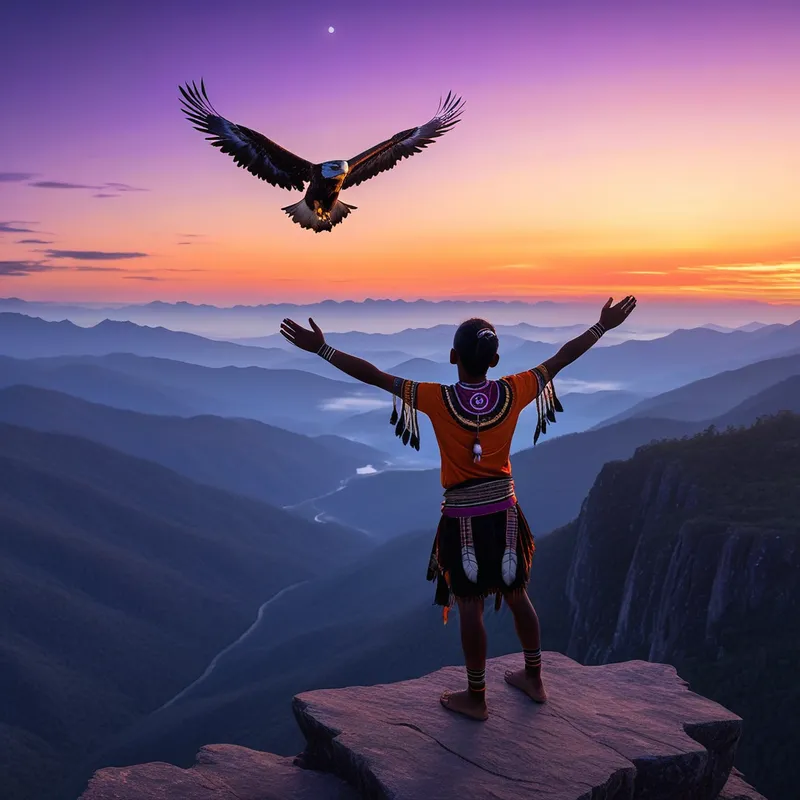
Then, in the liminal hours between midnight and dawn, when the veil is thinnest, it comes. It may come as a dream, vivid and undeniable. It may come as a visitation. A totem animal approaches—a wolf with eyes of amber, a bear that stands like a mountain, an eagle that speaks in the voice of thunder. It may be an ancestor, a face formed from starlight. It may be a song, a melody that arrives whole and complete, a gift from the Wakan Tanka.
The vision is not gentle. It is a truth. It shows the seeker their path, their purpose, their medicine. It may show a coming trial, a duty to the people, a hidden talent. It is a covenant. The animal spirit may promise its power, its protection, in exchange for respect and remembrance. The seeker weeps, or laughs, or trembles in awe. They are no longer who they were. They have been given a new name, a new sight.
When the sun finally breaks the horizon on the fourth day, the elder returns. The seeker, weak but radiant, stumbles from the circle. They are fed a little water, a little food. In a voice cracked but clear, they tell the story of their vigil. Every detail is sacred. The elder listens, nods, helps to interpret the symbols. The vision is woven into the fabric of the person’s life, a compass for all their days to come. They return to the people, not as a child, but as one who has spoken with the unseen world and returned with a gift.
Cultural Origins & Context
The Vision Quest, known by many names among the diverse Nations—Hanbleceya among the Lakota, simply “the fast” for others—is a foundational rite of passage found across many Indigenous cultures of North America. It was not a singular, monolithic practice but a profound spiritual technology adapted to the specific ecological and cosmological understandings of each people. Traditionally, it was undertaken by young people at the brink of adulthood, though it could be sought at other critical junctures in life by warriors, healers, or those in deep grief.
The knowledge was transmitted orally, from elder to youth, in a sacred and careful manner. It was not a public spectacle but a deeply personal, yet communally supported, endeavor. The entire community understood its importance; the seeker’s journey was for the benefit of the whole. The vision received would often determine one’s role—as a hunter guided by the buffalo spirit, a healer touched by the plant spirits, or a leader who dreamed for the people. The myth of the quest is the lived experience of generations, a story told not to entertain, but to map the territory of the human soul in relationship to the animate universe.
Symbolic Architecture
At its heart, the Vision Quest is a master symbol of the journey to the center of the self. The physical isolation mirrors psychological interiority. The fasting and exposure are not punishments, but alchemical fires that burn away the ego’s attachments—the persona we present to the tribe.
The wilderness without becomes the wilderness within. Only in the terrifying and beautiful emptiness can the authentic self, the soul’s true name, be heard.
The medicine circle is a mandala, a bounded universe where the microcosm of the individual meets the macrocosm of spirit. The totem animal that appears is an embodiment of an archetypal force, an instinctual power from the collective unconscious that the individual must integrate. The wolf might bring lessons of loyalty and hunting (pursuing one’s purpose), the bear of introspection and healing, the eagle of perspective and spiritual vision.
The ordeal itself symbolizes the necessary death of the old, dependent identity. The vision is the birth of the new, responsible self, now connected to a transpersonal source of meaning. It is the ultimate dialogue between the human and the numinous.
The Dreamer’s Resonance
When this mythic pattern stirs in the modern dreamer, it signals a profound psychic initiation. Dreams of being alone in vast, sublime landscapes—endless deserts, towering mountains, deep forests—often carry this energy. You may dream of being lost, of searching for a specific but unknown place, or of waiting for a sign.
Somatically, this can coincide with feelings of disorientation, anxiety, or a deep, restless longing in waking life—the soul’s hunger and thirst for meaning. The dream-ego is the seeker, and the dream setting is the medicine circle. The appearance of a potent, numinous animal figure is a direct communication from the instinctual psyche. To dream of receiving a gift, a song, or a new name is the unconscious conferring a new level of identity. These dreams often occur during life transitions: career changes, the end of relationships, spiritual awakenings, or any crisis that demands we ask, “Who am I, truly, beyond my roles?”
Alchemical Translation
For the modern individual, the Vision Quest models the core of individuation. Our “village” is the collective norms, expectations, and digital noise of contemporary life. The first, crucial step is the voluntary withdrawal—creating psychological and often literal solitude through meditation, retreat, or simply turning inward.
The fast is the refusal to consume the world’s ready-made meanings. The vigil is the courageous act of staring into your own void until it begins to speak.
The “visions” that come are not supernatural hallucinations, but the emerging contents of the deep unconscious: repressed talents, forgotten wounds, archetypal energies, and the nascent blueprint of the Self. Integrating the totem means consciously embracing those instinctual qualities—perhaps the resilience of the bear or the keen vision of the hawk—into our daily consciousness.
The return is not to a physical tribe, but to our community and life with a renewed sense of purpose and authenticity. We bring back our “medicine”—our unique capacity to heal, create, or lead, now grounded in a dialogue with something greater than the personal ego. The myth teaches that wholeness is not found in comfort, but in the sacred, solitary encounter with the unknown depths of one’s own being, and in the humble, empowered return with a gift for the world.
Associated Symbols
Explore related symbols from the CaleaDream lexicon: