The Virgin Mary Myth Meaning & Symbolism
A young woman's divine encounter births a god, embodying the sacred union of human and spirit, and the ultimate mystery of incarnation.
The Tale of The Virgin Mary
In the quiet, sun-baked hills of a land under the heel of empire, there lived a girl named [Miriam](/myths/miriam “Myth from Biblical culture.”/). She was betrothed to a man of David’s line, a carpenter named Yosef, and her life was a tapestry of simple threads: [water](/myths/water “Myth from Chinese culture.”/) drawn from the well, bread kneaded for the oven, prayers whispered at dusk. [The world](/myths/the-world “Myth from Tarot culture.”/) was heavy, waiting for a breath it could not name.
Then came the visitation.
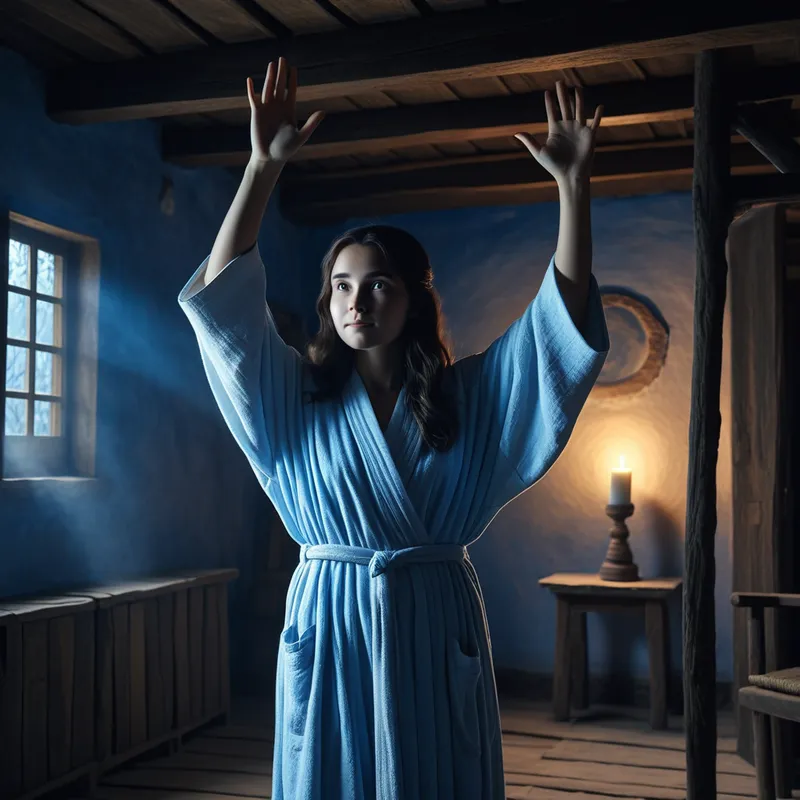
It was not with thunder, but with a silence so profound it became a sound. The light in her small room did not brighten from the window, but from the space between the air itself. And there stood a figure, not of earth, whose presence was like clarity given form. “Hail, Kecharitomene,” the messenger spoke, and the words were not heard by the ear but felt in the marrow. “The Lord is with you.”
Terror, pure and cold, gripped her. What manner of greeting was this? But the messenger continued, his voice a river smoothing stone. “Do not be afraid, Miriam. You have found favor with God. Behold, you will conceive in your womb and bear a son, and you shall call his name Yeshua.”
Her mind raced through the impossible arithmetic of flesh. “How can this be,” she breathed, “since I know not a man?” The answer came, and it unmoored the world from its hinges. “[The Holy Spirit](/myths/the-holy-spirit “Myth from Christian culture.”/) will come upon you, and the power of the [Ruach](/myths/ruach “Myth from Hebrew culture.”/) HaKodesh will overshadow you; therefore [the child](/myths/the-child “Myth from Alchemy culture.”/) to be born will be called holy—the Son of God.”
Here was the fulcrum of all ages. The promise to her ancestors, the yearning of [the prophets](/myths/the-prophets “Myth from Biblical culture.”/), the silent groan of creation—it all flowed into this single, still point: a young woman in a dusty village. The cosmos held its breath. Would [the vessel](/myths/the-vessel “Myth from Alchemical culture.”/) shatter? Would it refuse?
Miriam looked into [the abyss](/myths/the-abyss “Myth from Kabbalistic culture.”/) of the divine will. She did not understand, but she perceived. And from the depths of her being, a word formed, a word that would echo through eternity, weaving the infinite into the finite. “Behold,” she said, her voice steady as [the earth](/myths/the-earth “Myth from Hindu culture.”/)’s core, “I am the servant of the Lord. Let it be to me according to your word.”
And the light consented. The messenger departed, and she was alone again, yet utterly transformed. The secret grew within her, a quiet, burgeoning star. When her condition could no longer be hidden, there was pain—the suspicion in Yosef’s eyes, the whispers of the town. But a dream steadied the carpenter’s heart, and he stayed by her side.
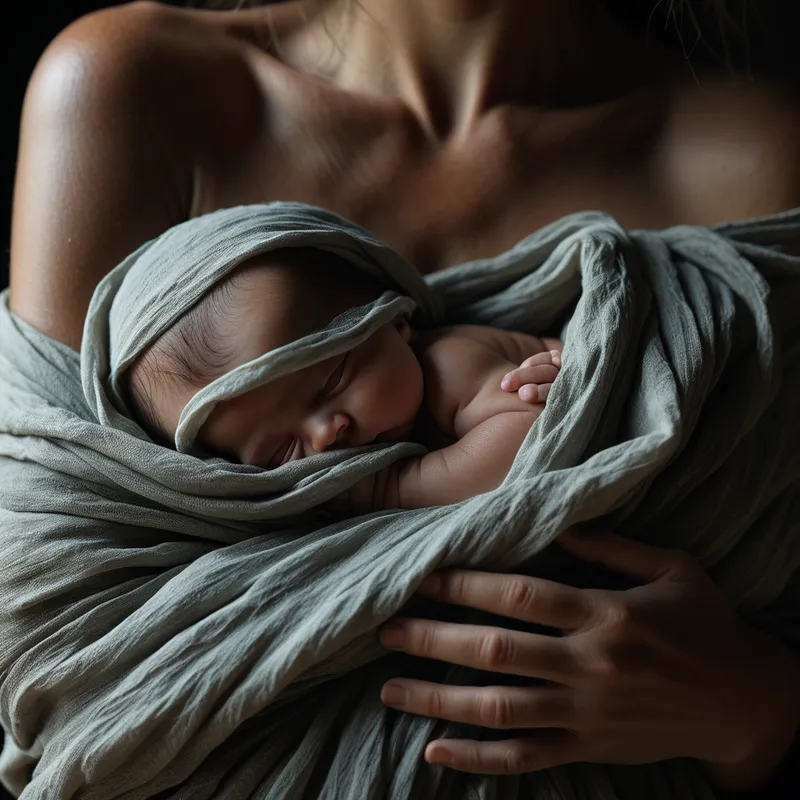
The decree of a distant emperor forced them onto the road, to the city of David. There, in the press of strangers, her hour came. No room was found in the inn. The only sanctuary was a space among animals, the air thick with the scent of hay and earth. There, under a sky indifferent to kings and shepherds alike, she brought forth her firstborn son. She wrapped him in swaddling cloths and laid him in a feeding trough, a [manger](/myths/manger “Myth from Biblical culture.”/).
Heaven could not contain its joy. A chorus broke upon bewildered shepherds, proclaiming glory and peace. They came and found the child, and the mother, and they saw [the word](/myths/the-word “Myth from Biblical culture.”/) made flesh, sleeping in straw. And Miriam, the girl who had said “yes,” kept all these things, pondering them in her heart—a heart that would one day be pierced by a sword, as she stood witness to the culmination of the mystery she had consented to carry.
Cultural Origins & Context
The myth of the [Virgin Mary](/myths/virgin-mary “Myth from Christian culture.”/) emerges from the fertile ground of Second Temple Judaism, a culture steeped in prophetic expectation and messianic hope. The primary sources are the Gospels of Matthew and Luke, written in the latter half of the first century. These were not dry historical reports but theological narratives, told within early Christian communities to explain the paradoxical origin of [Jesus Christ](/myths/jesus-christ “Myth from Christian culture.”/).
The story functioned on multiple levels. For a Jewish audience, it evoked powerful scriptural echoes: the Spirit of God hovering over the primordial waters at creation, the barren matriarchs like [Sarah](/myths/sarah “Myth from Biblical/Apocryphal culture.”/) and Hannah who bore children through divine intervention. It presented [Jesus](/myths/jesus “Myth from Christian culture.”/)’s conception as a new, definitive act of God within history. For a Greco-Roman world familiar with stories of heroes born from unions between gods and mortals, it offered a radical counter-narrative: here, there was no physical seduction or violence, but a sacred, spiritual conception that honored rather than violated the human participant.
The myth was passed down liturgically, in hymns and readings, and artistically, in icons and mosaics that made the ineffable tangible. Its societal function was foundational. It established the hypostatic union—the dual nature of Christ—at its very origin. It also presented an ideal of faithful obedience (fiat) and humble partnership with the divine plan, making Mary [the archetypal disciple](/myths/the-archetypal-disciple “Myth from Global/Universal culture.”/) and, later, the primary intercessor and mother of the Church.
Symbolic Architecture
At its core, the [Virgin Mary](/symbols/virgin-mary “Symbol: A central figure in Christianity representing divine purity, maternal compassion, and miraculous intervention. Often symbolizes spiritual guidance and unconditional love.”/) myth is a profound [symbol](/symbols/symbol “Symbol: A symbol can represent an idea, concept, or belief, serving as a powerful tool for communication and understanding.”/) of the [vessel](/symbols/vessel “Symbol: A container or structure that holds, transports, or protects something essential, representing the self, emotions, or life journey.”/). She represents the perfectly prepared, receptive [human](/symbols/human “Symbol: The symbol of a human represents individuality, complexity of emotions, and social relationships.”/) [consciousness](/symbols/consciousness “Symbol: Consciousness represents the state of awareness and perception, encompassing thoughts, feelings, and experiences.”/) capable of receiving and incarnating the divine without corruption or [distortion](/symbols/distortion “Symbol: The alteration of form, sound, or perception from its original state, often creating unsettling or creative effects.”/) by the personal ego.
The virgin birth is not a gynecological statement, but a psychological one: it describes a conception untouched by the ordinary, desirous will of the individual, a genesis initiated entirely by the spirit.
Her virginity symbolizes a state of [psychic wholeness](/symbols/psychic-wholeness “Symbol: A state of complete integration between conscious and unconscious aspects of the psyche, representing spiritual unity and self-realization.”/) and integrity, a self not fragmented by external projections or possessive instincts. She is the [prima materia](/myths/prima-materia “Myth from Alchemical culture.”/) of the [soul](/symbols/soul “Symbol: The soul represents the essence of a person, encompassing their spirit, identity, and connection to the universe.”/)’s transformation. The angelic annunciation represents the sudden, overwhelming irruption of [the Self](/myths/the-self “Myth from Jungian culture.”/) (the total, archetypal [psyche](/myths/psyche “Myth from Greek culture.”/)) into the sphere of the conscious ego. The ensuing inner [dialogue](/symbols/dialogue “Symbol: Conversation or exchange between characters, representing communication, relationships, and narrative flow in games and leisure activities.”/)—“How can this be?”—is [the ego](/myths/the-ego “Myth from Jungian culture.”/)’s necessary confrontation with the impossible [logic](/symbols/logic “Symbol: The principle of reasoning and rational thought, often representing order, structure, and intellectual clarity in dreams.”/) of the unconscious.
Her [response](/symbols/response “Symbol: Response in dreams symbolizes how one reacts to situations, often reflecting the subconscious mind’s processing of events.”/), “Let it be,” is the supreme act of psychological surrender. It is the ego consenting to be reorganized around a central, numinous fact greater than itself. This is not passivity, but the most active state of being: becoming a [conduit](/symbols/conduit “Symbol: A passage or channel that transfers energy, information, or substance from one place to another, often hidden or structural.”/). The nativity that follows is the symbolic [birth](/symbols/birth “Symbol: Birth symbolizes new beginnings, transformation, and the potential for growth and development.”/) of a new, guiding center within the [personality](/symbols/personality “Symbol: Personality in dreams often symbolizes the traits and characteristics of the dreamer, reflecting how they perceive themselves and how they believe they are perceived by others.”/)—the individuated Self, which is both intimately personal (“her son”) and universally transcendent (“the Son of God”).
The Dreamer’s Resonance
When this mythic pattern stirs in the modern dreamer, it often signals a profound invitation from the deep psyche. To dream of a mysterious, sacred pregnancy—especially one that feels immaculate or divinely ordained—points to the gestation of a new potential within. The dreamer may be on the cusp of a creative or spiritual awakening that feels both deeply personal and strangely “given,” not solely of their own making.
The somatic experience can be one of both awe and anxiety: a sense of carrying a precious, fragile secret, coupled with the fear of how this new life will change one’s existing world (the “[Joseph](/myths/joseph “Myth from Biblical culture.”/)” and “societal judgment” aspects). Dreams of annunciation—a visit from a luminous figure, a voice, or an overwhelming sense of purpose—often accompany major life transitions or calls to a new vocation. The psychological process is one of active receptivity. The ego is not being erased but being asked to make space, to become a hospitable womb for something it does not yet fully understand. Resistance to this process can manifest as dreams of barrenness, locked rooms, or fleeing from messengers.

Alchemical Translation
The alchemical journey mirrored in the Virgin Mary myth is the incarnation of the spirit. For the modern individual seeking individuation, the myth models the complete process of psychic transmutation.
First, the [nigredo](/myths/nigredo “Myth from Alchemical culture.”/): the humble, “earthly” state of the ordinary life in Nazareth—the raw material. Then, the albedo: the purification and whitening represented by her virginity, a state of inner clarity and detachment from compulsive identity. [The annunciation](/myths/the-annunciation “Myth from Biblical/Islamic culture.”/) is the infusion of the anima mundi, the silver tincture. Her fiat is the crucial moment of conjunction, where human will aligns with transpersonal purpose.
The manger is the alchemical vessel: the humble, despised, and earthly container where the supreme union of opposites—divine and human, eternal and temporal—takes tangible form.
The nine months of pregnancy are the slow, secret work of citrinitas, the yellowing or illumination, as the new consciousness develops unseen. The birth in Bethlehem (which means “House of Bread”) is the [rubedo](/myths/rubedo “Myth from Alchemical culture.”/), the reddening: the embodied manifestation, the “philosopher’s stone” born into the poverty of our common human condition. The shepherds and magi represent the integrated functions of the psyche—the instinctual and the intellectual—coming to pay homage to this new ruling principle.
For us, the alchemical translation is clear. The work is not to become divine, but to become a vessel so whole, so consenting, that the divine can find a dwelling place within our own humanity. The goal is to give birth to the “holy child” of our own authentic Self, the integrated being that is uniquely ours yet connected to the eternal. It is the ultimate human task: to say “yes” to the mystery seeking to be born through us, and to ponder its meaning in the heart, through all the joy and the piercing sorrow that such a birth entails.
Associated Symbols
Explore related symbols from the CaleaDream lexicon: