
The Velvet Cover of Grimms' Tales Myth Meaning & Symbolism
A myth of a living book's velvet cover, which holds the untold, forgotten stories of the soul, waiting for a worthy dreamer to listen and remember.
The Tale of The Velvet Cover of Grimms' Tales
Listen, and let the hearth-fire grow low. In the deep woods of the world, where the roots of old oaks drink from the well of memory, there stands a clearing that is not on any map. It is found only when the moon is a sliver and the wind carries the scent of parchment and rain. In its center, upon an altar of moss-grown stone, rests the Book.
It is no ordinary tome. Its spine is the color of heart’s blood and twilight, a velvet so deep it seems to drink the light. This is The Velvet Cover of Grimms' Tales. It is said the book has no pages one can turn, for its stories are not written in ink. They are held within the weave of the velvet itself—every thread a fate, every shimmer a sigh, every subtle shift in hue a laughter or a tear that was never fully voiced.
For generations untold, the wise and the curious sought it. Scholars came with their logic, but the Cover remained still, a mere relic. Kings came with demands, but it offered only silence. The book waited. It waited for the one who approached not as a conqueror or a collector, but as a listener in the dark.
Such a one was a dreamer named Elara, whose own story felt thin and half-remembered. Guided by a lullaby hummed by the wind, she found the clearing. The air was thick with the perfume of damp earth and old roses. The velvet Cover, in the silver moonlight, seemed to breathe. A soft, resonant hum vibrated in her bones, a wordless song of lost beginnings and interrupted endings.
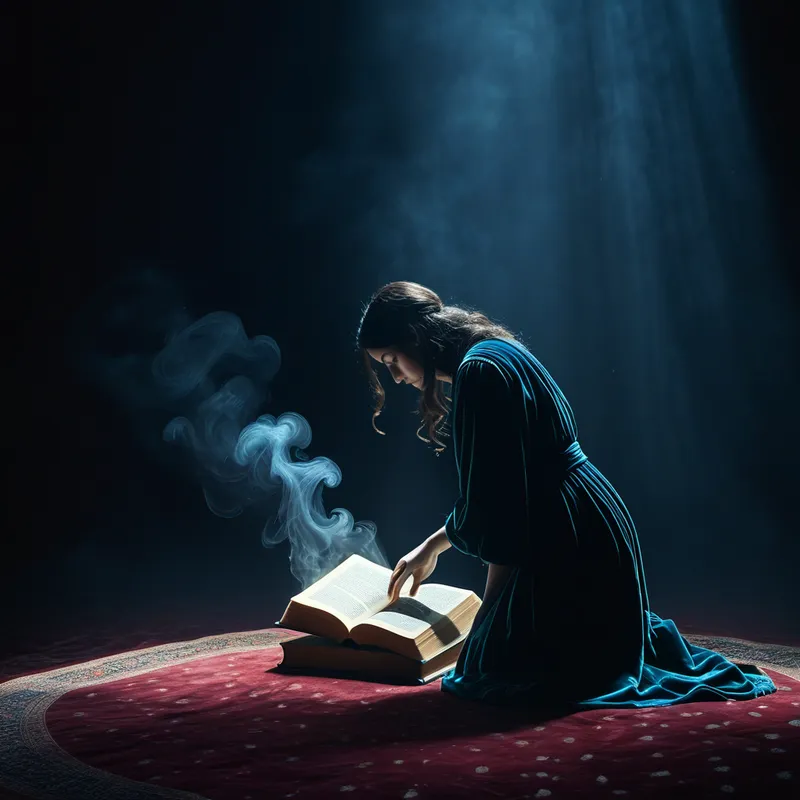
Without thinking to ask, Elara knelt. She did not reach to open, for she sensed there was no clasp. Instead, she placed her palm flat upon the velvet. It was warm. A shock, gentle but profound, traveled up her arm. Then, the whispers began. Not in her ears, but in the chamber of her mind—fragments of lullabies in languages she’d never learned, the echo of a child’s promise, the bitter taste of a betrayal swallowed whole, the bright, sharp joy of a courage she forgot she possessed.
The velvet beneath her hand began to glow. Threads of crimson and gold light lifted from the fabric like smoke, weaving in the air above the book. They formed images: a wolf not as a monster, but as a lonely guardian; a spindle not as a curse, but as a doorway to a necessary sleep; a stepmother’s harshness, threaded with her own unhealed wound. These were the tales behind the tales, the shadows cast by the published words, the truths deemed too complex, too painful, or too raw for the simple page.
Elara wept. Her tears fell upon the Cover and were absorbed, becoming new, faint silvery threads in its eternal weave. In that moment, she did not learn a story; she remembered. She remembered the parts of her own soul she had sent away into the dark woods of forgetting. The Velvet Cover had not given her a foreign myth; it had acted as a mirror, a living loom that re-wove her fragments into a tapestry that included the dark, the lost, and the redeemed. As dawn tinged the sky, the light threads settled back into the fabric. The book was once more still. But Elara was changed. She carried the hum within her, and her own life, she knew, was now a tale worthy of the velvet.
Cultural Origins & Context
This myth does not spring from the published volumes of the Brothers Grimm, but from the oral, folk-cultural substrate that birthed them—the “Fairy Tale” culture as a living, psychological ecosystem. It is a meta-myth, a story about stories, born in the spaces between the hearth-fire and the forest’s edge. It was told not to children at bedtime, but to apprentices of midwives, woodcutters, and wise women—those who dealt in transitions, in cutting away the old, and in listening to the unseen.
Its function was initiatory and therapeutic. In a pre-psychological age, the culture understood that not all experiences become neat narratives. Trauma, shame, inexplicable joy, and profound ambiguity often remain “un-storied,” trapped in a somatic, wordless state. The myth of the Velvet Cover served as a cultural container for this phenomenon. It taught that the collective wisdom—the Grimms' Tales here representing the canon of known human experience—has a living, breathing periphery, a shadow archive. The ritual of “seeking the Cover” was a metaphor for the courageous inner journey to confront and reclaim one’s disowned narratives.
Symbolic Architecture
The myth is a profound map of the psyche’s relationship with its own contents. The Grimms' Tales represent the ego’s collected story of itself—the edited, moralized, coherent identity we present to the world and to ourselves.
The Velvet Cover is the threshold between the story we tell and the experience we lived.
It symbolizes the personal unconscious, specifically the sensory and emotional texture of memories that never solidified into linear narrative. Velvet is tactile, soft, absorbing; it represents affect, the felt sense. Its crimson color speaks of blood, passion, wounding, and the vital life force—the raw material of existence before it is sanitized into a tale.
Elara, the dreamer, represents the conscious ego weary of its own thinness, experiencing what Jung called a psychic hunger. Her kneeling is an act of humility, surrendering the ego’s need to control and interpret. Placing her hand on the Cover is an act of profound sensing, of making contact with the unconscious not through analysis, but through embodied receptivity. The light-threads that rise are the archetypal patterns and complexes, now made visible, seeking integration. Her tears, absorbed to become new threads, signify the alchemical completion: the conscious self contributes its refined awareness (the salt of tears) to the unconscious matrix, enriching the eternal, evolving tapestry of the Self.

The Dreamer's Resonance
When this myth stirs in the modern dreamer, it often manifests as dreams of discovering hidden rooms, forgotten libraries, or sealed journals. One might dream of a book with a cover that changes texture, of trying to read text that shifts and melts, or of hearing a chorus of faint, urgent voices from behind a wall.
Somatically, this points to a process of somatic recall. The psyche is signaling that certain lived experiences—perhaps childhood impressions, relational wounds, or moments of unarticulated ecstasy—are pressing for recognition. They exist not as clear memories but as bodily sensations: a tightness in the chest, a specific scent association, a recurring ache, or a wave of emotion without a clear story. The dream is an invitation to do as Elara did: to approach these sensations not with the analytical mind, but with a listening, compassionate presence. It is the beginning of turning “symptoms” back into stories, of transforming psychic pain from a static, buried thing into a dynamic, integrable part of one’s narrative.

Alchemical Translation
The myth models the Jungian process of individuation, specifically the stage of confronting and integrating the personal shadow. Our published “tale” is our persona. The Velvet Cover is the shadow, not as evil, but as the totality of the repressed, undeveloped, and unlived life.
The alchemical operation here is solutio (dissolution) followed by coagulatio (coagulation). The dreamer’s fixed, conscious identity (Elara’s thin story) is dissolved (solutio) through contact with the moist, affective, confusing realm of the unconscious (the whispering velvet). This is often experienced as a period of disorientation, emotional flooding, or the unsettling of long-held beliefs about oneself.
The goal is not to read the book, but to become legible to oneself.
From this dissolved state, a new, more substantial consciousness coagulates. This is the weaving of the light-threads into a personal understanding and the absorption of the dreamer’s tears back into the Cover. The ego does not conquer the unconscious; it enters into a reciprocal relationship with it. The individual becomes the living bridge between the canonical tale and the velvet archive. They no longer just live a life; they author it from a place of profound depth, holding both the crisp moral and the ambiguous, textured truth. They achieve what the myth ultimately promises: not possession of the mystery, but a lasting, humming resonance with the whole, unfinished story of the soul.
Associated Symbols
Explore related symbols from the CaleaDream lexicon: