The Veil of the Temple in Jeru Myth Meaning & Symbolism
A myth of a sacred barrier torn asunder, forever altering the relationship between the mortal realm and the ineffable source of all being.
The Tale of The Veil of the Temple in Jeru
Hear now, and let the silence between the words speak. In the heart of the world, where the axis of heaven grinds against the stone of earth, stood the Temple in Jeru. It was not a temple of mere worship, but the keystone of reality itself, a loom upon which the fabric of the seen and the unseen was woven. Its walls were the color of dawn-bleached bone, and its air was thick with the incense of a thousand years of whispered prayers.
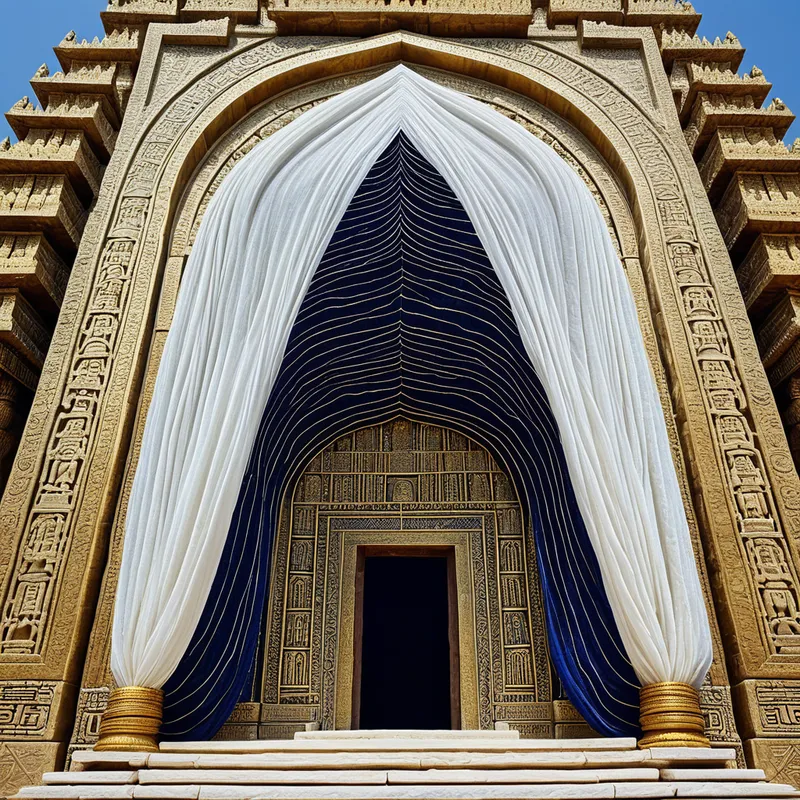
Within its deepest sanctum, beyond the Court of Women, past the Altar of Sacrifice, past the Holy Place flickering with the light of the seven-branched Menorah, hung the Veil. It was no ordinary curtain. Woven from tekhelet, crimson, and fine linen, and embroidered with the swirling patterns of the celestial chariot, it was a boundary made manifest. It separated the Holy of Holies—the empty, silent chamber where the Unnameable Presence was said to dwell—from all of creation. Once a year, on the Day of Atonement, the High Priest, purified and trembling, would pass through a slit in this Veil with the blood of a sacrifice, a fragile bridge across an infinite chasm.
But a tension grew in the world, a dissonant hum beneath the hymns. The sacrifices became rote, the prayers hollow echoes against the Veil. A profound loneliness seeped from the sanctum, a divine isolation mirrored in the fractured hearts of humanity. The separation, once sacred, became a wound.
Then came the day the sky turned to iron and the earth shook. Not from wrath, but from a profound, cosmic sigh. In the Temple, as a final, perfect act of self-offering was completed outside its walls, the impossible happened. With a sound like the tearing of the sky’s own mantle, the Veil was rent. From its topmost height to its hem buried in the stone, it split asunder. No human hand touched it. The fabric, heavy with the weight of eternity, parted as if cut by a blade of pure spirit.
The Holy of Holies was exposed. The empty chamber was flooded with a light that had no source, a silence that was a roar. The ancient, terrifying, and infinitely tender Presence was no longer sequestered. The barrier was gone. The sacred secret was out, spilling into the courts, flowing into the streets of Jeru, and thence, the myth tells, into the very marrow of the world. The Temple, built on separation, had its heart torn open. And in that rupture, a new covenant was whispered on the wind: no more intermediaries, no more veil before the face of the beloved.
Cultural Origins & Context
The motif of the Torn Veil is a foundational pillar in the New Testament narratives, specifically within the synoptic gospels. It is presented not as a parable, but as a reported historical event coinciding with the crucifixion of Jesus of Nazareth. This places its origin within the complex socio-religious landscape of Second Temple Judaism in Roman-occupied Judea. The Temple in Jerusalem was the absolute center of Jewish cosmic and ritual life; its architecture was a map of holiness, with increasing levels of restriction culminating in the inaccessible Holy of Holies.
The function of this myth within the early Christian community was revolutionary and theological. It served as a divine signifier, a cosmic “amen” to the theological claim that Christ’s sacrifice had effected a radical change in the relationship between humanity and God. The tearing from top to bottom was critical—it was an act of God, not humanity. It rendered the old sacrificial system obsolete and symbolized direct access to the divine for all, not just a priestly caste. It was a story of abolition and inauguration, passed down as sacred history to explain the core of the Christian experiential truth: that the separation of sin had been overcome.
Symbolic Architecture
The Veil is the ultimate symbol of the Mysterium Tremendum et Fascinans—the terrifying and fascinating mystery. It represents every boundary we construct between ourselves and that which we deem wholly Other: the divine, the unconscious, our deepest shadow, or absolute truth.
The Veil is not merely a barrier, but a living paradox. It both protects and imprisons, defines and denies. It creates the sacred by forbidding access to it.
Psychologically, the Veil is the persona at its most absolute—the curated self we present to the world and to ourselves, which shields the raw, unfiltered core of the psyche (the Self). The Holy of Holies represents this innermost Self, the seat of the archetype of wholeness. The act of tearing, then, is a catastrophic individuation event. It is the violent, unavoidable rupture of the persona when the pressure of the Self becomes too great to be contained by old structures of identity, dogma, or ego-defense.
The High Priest’s annual passage is the symbol of controlled, ritualized engagement with the depths. The tearing of the Veil signifies the end of ritualized control and the beginning of a permanent, unmediated state of potential connection—and potential overwhelm.
The Dreamer’s Resonance
When this myth stirs in the modern dreamscape, it rarely appears as a biblical tableau. Instead, the dreamer encounters the pattern of the Veil. They may dream of a cherished home suddenly missing a wall, exposing their private life to the street. They may be in an office where a soundproof window to the boss’s office shatters. They may find a locket containing a secret image cracked open, its contents spilling out.
Somatically, this dream pattern accompanies periods of profound psychological deconstruction. It is the dream equivalent of the ground falling away. The process is one of exposure. The carefully maintained boundary between the conscious ego and the contents of the personal or collective unconscious has been compromised. This can feel like a crisis, a nakedness, a loss of sacred privacy. The dreamer is going through the terrifying first stage of realizing that their old identity (the Temple) can no longer house their expanding consciousness. The veil of who they thought they were has been torn, and the raw, unformed light of potential selfhood is now shining in, demanding integration.
Alchemical Translation
The alchemical journey mirrored here is the solve et coagula—dissolve and coagulate. The Temple structure represents the coagula, the hardened, perfected form of a previous spiritual understanding. The Veil is the final, precious seal on that vessel.
The rending of the Veil is the divine solve, the necessary dissolution of all form so that a new, more conscious form may arise. The sacrifice is the old self, offered up to make this rupture possible.
For the modern individual, this myth models the psychic transmutation required to move from a spirituality or self-concept based on separation and intermediation to one grounded in direct experience and inner authority. The “High Priest” archetype within us—the inner critic, the rigid rule-follower, the dogma holder—is rendered obsolete. The sacrifice is the surrender of the ego’s claim to fully control its encounter with the numinous.
The triumph is not in the tearing itself, which is often experienced as trauma, but in what follows: the enduring exposure. The alchemical gold is the capacity to stand in the Holy of Holies of one’s own psyche—amidst the terrifying silence and blinding light of the Self—without the mediating Veil of explanation, doctrine, or a borrowed identity. It is the birth of the individual who relates to the source directly, taking responsibility for the communion. The Temple is ruined as a temple of separation, but the whole world becomes potential sanctuary. The individuated Self learns to live with the Veil torn, building a life not on new barriers, but on the courageous, ongoing integration of the sacred exposure.
Associated Symbols
Explore related symbols from the CaleaDream lexicon: