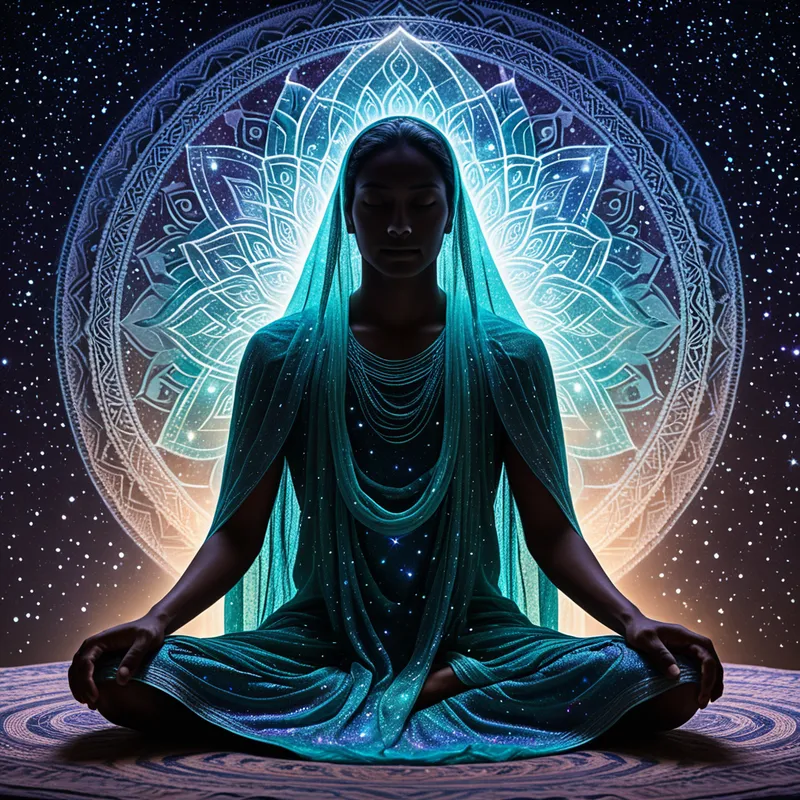
The Veil of Maya in Hindu phil Myth Meaning & Symbolism
A tale of cosmic illusion, where a seeker learns that reality is a divine play, and truth lies beyond the shimmering Veil of appearances.
The Tale of The Veil of Maya in Hindu phil
Listen. Before the first word was spoken, before the first star drew its arc of fire across the void, there was a silence so profound it was a kind of sound. From that silence, a breath. And with that breath, the dream began.
The great Brahman, the One without a second, rested in its own blissful fullness. Yet, within that boundless peace, a potential stirred—not a need, but a divine play, a lila. From its own being, Brahma arose, the architect of worlds. And to aid in this magnificent, bewildering act of creation, Brahma summoned a power, a divine artist of unimaginable skill. Her name was Maya.
Maya did not arrive with thunder. She emerged like the first hint of dawn, a shimmer at the edge of perception. She bowed to Brahma, and from her being, she began to weave. She did not weave with thread, but with the stuff of possibility itself. She took the pure, undifferentiated consciousness of Brahman and spun it into form. She spun the silver of moonlight into rivers, the heat of desire into fire, the solidity of thought into mountain ranges. She wove the five senses from the chords of the universe and taught them their songs: sight, sound, touch, taste, and smell.
Her masterpiece was a Veil. It was not a thing to be seen, but the very act of seeing things as separate. It was the space between the seer and the seen, the thinker and the thought. She cast this Veil over the face of the One, and where there was unity, multiplicity blossomed. The one Sun became a million reflections on a choppy sea. The single note of existence fractured into the symphony of creation—the cry of a newborn, the rustle of leaves, the clash of armies, the whisper of lovers.
In a lush grove by a river, a seeker sat. His name was not important, for he was every seeker. He saw the world Maya had made: the breathtaking beauty of a lotus, the sharp pain of a thorn, the sweet taste of ripe fruit, the bitter loss of a loved one. He was ensnared by it all, believing the lotus to be truly separate from the pond, the pain to be his alone, the loss to be a final verdict. He chased pleasure and fled pain, a leaf caught in the storm of his own perceptions, believing the storm to be all that existed. The Veil was perfect. It convinced him it was the only reality.
But deep within, a memory slept—a faint echo of the silence before the breath. A sorrow arose, not for the things of the world, but for a home he could not name. He turned inward, away from the dazzling display. He stilled the storm of his senses and sought the source of his own awareness. For years, he sat, while Maya’s play continued around him: seasons turned, empires rose and fell, stars were born and died in the sky above his unmoving head.
Then, in a moment outside of time, his seeking pierced the final layer of self. The eye that looked outward turned and saw itself looking. In that impossible, silent explosion of understanding, the loom of Maya paused. The Veil did not tear; it simply became transparent. He saw the lotus, the thorn, the river, his own body, not as separate things, but as patterns dancing on the surface of a single, boundless ocean of being—the very being of Brahman. The weaver and the weaving, the dreamer and the dream, were one. He was not a leaf in the storm; he was the sky that held it. A laugh arose, not of joy or sorrow, but of profound, liberating recognition. The play went on, more beautiful than ever, but he was no longer lost in the plot. He was home, awake in the dream.

Cultural Origins & Context
The concept of the Maya is not a single myth from one text, but a profound philosophical bedrock that permeates Hindu thought, crystallizing in the ancient Upanishads and expounded upon in texts like the Bhagavad Gita. It was not merely a story told by bards, but a living truth transmitted from guru to disciple in the forest academies of ancient India. Its societal function was radical: to provide a metaphysical explanation for the experience of suffering, limitation, and duality (dvaita), and to map the path (marga) to liberation (moksha) from it. It was the ultimate context-setter, teaching that the world of social duties, personal desires, and material pursuits, while real on its own level, was not the ultimate reality. This allowed for a profound engagement with life without absolute attachment to its outcomes, a principle that shaped ethics, art, and the very goal of human existence.
Symbolic Architecture
The Veil is the master symbol of conditioned perception. It is not a lie, but a selective presentation. Maya is not a demoness; she is a divine power (shakti), the necessary creative force that allows the One to experience itself as the Many.
The world is real, but its reality is relative, not absolute. It is a truth wrapped in a greater Truth.
The seeker represents the individual soul (Atman), which has forgotten its true nature as the universal soul (Brahman). His journey from entanglement to recognition is the core drama of human consciousness. The senses are the agents of the Veil, constantly reporting a world of separation. The turning inward (pratyahara) is the critical pivot, the withdrawal of projection from the phenomenal world to investigate the projector itself. The final “awakening” is not an acquisition of something new, but a remembering of what one always was.
The Dreamer’s Resonance
In modern dreams, the Veil of Maya manifests as dreams of profound disorientation within familiar spaces. You dream of your childhood home, but the rooms rearrange themselves as you walk through them. You see a loved one’s face, but their features are blurred or shifting. You try to speak, but your voice makes no sound, or the words come out as someone else’s. These are somatic experiences of the psyche’s own illusory constructs breaking down.
Dreaming of endlessly searching through a vast, bureaucratic building (an airport, a mall, a government office) where the goal is always one corridor away symbolizes entanglement in samsara—the cyclical world of cause and effect. Conversely, a dream where a mirror reflects not your face, but a vast, peaceful landscape or a source of light, points to the moment of insight, where the perceived separation between self and world dissolves. The psychological process is one of ego-decentralization; the dream-ego is confronted with the fluid, constructed nature of its own reality.

Alchemical Translation
For the modern individual, the myth models the entire process of individuation. The initial state is identification with the persona—the social mask, the curated self, the “I” defined by job, relationships, and achievements. This is the Veil in its personal aspect.
The first alchemical operation is not to fight the illusion, but to recognize the illusion as illusion. This is the nigredo, the dark night of seeing one’s own constructs.
The “turning inward” is the work of depth psychology: shadow work, engaging with the unconscious, withdrawing projections from partners, parents, and enemies to see these dynamics as internal parts of the self. This is the arduous separatio.
The realization of non-duality is the coniunctio oppositorum (the conjoining of opposites) on the highest level. It is not a bland unity, but a state where the tension between opposites (self/other, joy/sorrow, life/death) is held in a conscious, vibrant wholeness. The modern seeker learns to live in the world of Maya—paying bills, loving, creating, grieving—but not as it. The Veil becomes the very tapestry of a conscious life, its patterns appreciated not as absolute truth, but as the beautiful, fleeting, and poignant expression of the one Consciousness dreaming itself into form. The triumph is psychological sovereignty: to be fully human, fully engaged, yet inwardly free.
Associated Symbols
Explore related symbols from the CaleaDream lexicon: