The Veil at Samhain Myth Meaning & Symbolism
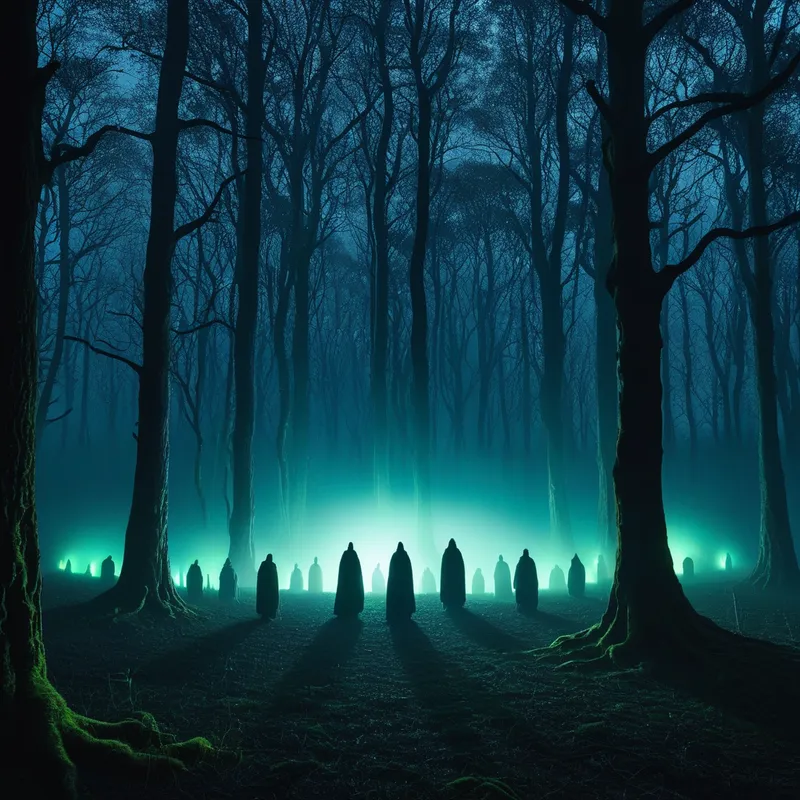
At Samhain, the veil between worlds thins, allowing the dead to walk and the living to glimpse the Otherworld, demanding courage and remembrance.
The Tale of The Veil at Samhain
Listen. The wheel of the year turns to its final, splintered spoke. The sun, the Dagda’s great wheel, flees low and weak across the sky. The world holds its breath in the space between the last apple falling and the first hard frost. This is Samhain. Not a night, but a three-day tide where time itself unravels at the seams.
In the great halls of the Sídhe, the mounds that are not hills, the Aos Sí stir. Their music, which usually whispers on the wind, grows loud and clear. The doors of earth and stone that were sealed stand open, not with a crash, but with a sigh—a thinning. It is as if the very air between the world of the living and the Tír na nÓg, the Land of Youth, becomes a worn cloth, translucent and fragile.
Through this thinning veil they come. Not with menace, but with the weight of forgotten seasons. The honored dead, ancestors whose names are spoken in the firelight. The forgotten dead, those with no one to call them home. And the Aos Sí themselves, magnificent and terrible, riding forth on steeds of mist to reclaim the lands that sleep. To be abroad on this night is to walk in two worlds. The crunch of leaves underfoot might be answered by a spectral footfall. The cry of a fox might be the keen of a banshee. The warmth of your own hearth is the only beacon against the pressing, curious dark.
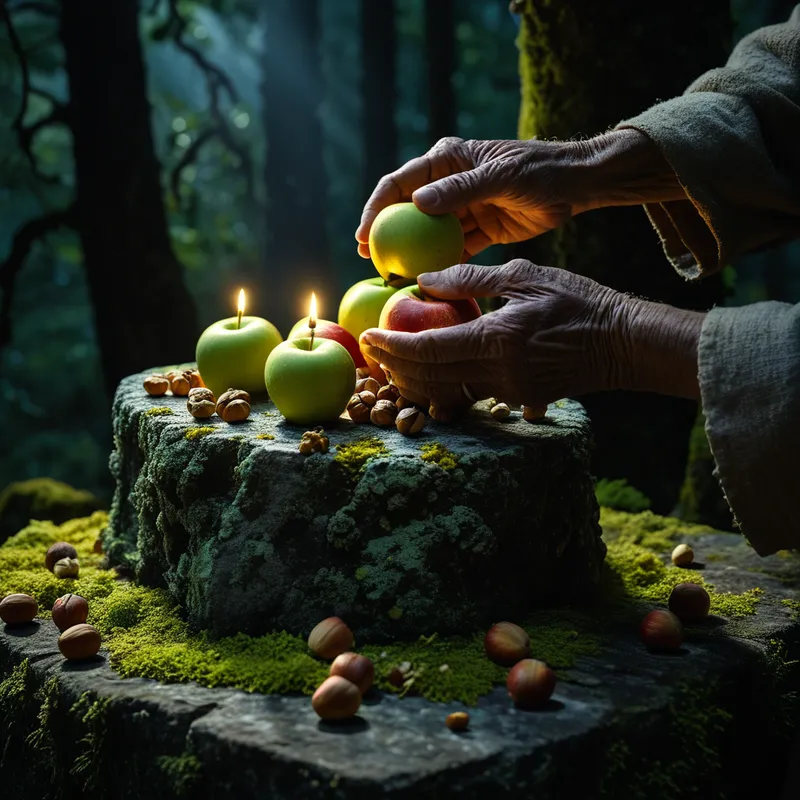
The people know the rites. They douse their hearth fires, taking light instead from the great communal bonfire, the Samhnag, whose sparks are meant to ward and guide. They set places at the table—empty chairs with portions of bread and ale. They leave offerings at the boundary stone: milk for the gentle spirits, iron for the restless. They carve faces into turnips, making lanterns to hold a flickering soul of flame, a mimic sun to confuse and illuminate.
This is the heart of the tale: a confrontation not of swords, but of presence. It is the moment a child, peering from a doorway, locks eyes with a shimmering form that wears her grandmother’s smile. It is the farmer who feels the approving touch of a long-gone hand on the last sheaf of grain. It is the terror and the awe of knowing you are not alone, that the past is not dead, and that the boundaries you rely on are, for this sacred tide, merely a suggestion written on water. The veil does not tear; it breathes. And in that breath, everything is remembered.
Cultural Origins & Context
The myth of the thinning veil is not a single story with a named hero, but a pervasive cosmological understanding woven into the fabric of pre-Christian Gaelic culture, primarily in Ireland, Scotland, and the Isle of Man. It was less a narrative told than a reality experienced and ritually navigated. This knowledge was the domain of the Druí and later, the fili, who functioned as historians, judges, and intermediaries with the unseen world.
Samhain (pronounced SOW-in) was one of the four great fire festivals, marking the end of the pastoral year and the beginning of the dark half. It was a time of communal gathering, where tribal debts were settled, and kingship rituals were performed. Societally, the myth served critical functions. It explained the palpable shift in season and the increase in supernatural encounters. It enforced social cohesion through communal fire-lighting and feasting. Most profoundly, it provided a structured, sacred time to honor the dead and acknowledge the Aos Sí, thereby maintaining cosmic order and balance. To ignore these rites was to invite chaos—blighted crops or ill fortune—as the untended spirits or offended gods crossed the veil unchecked.
Symbolic Architecture
The myth is a masterclass in symbolic thought about liminality—the potent, transformative quality of thresholds.
The Veil Itself is the ultimate symbol of the constructed boundary. It represents the ego’s necessary fiction of separation: between conscious and unconscious, past and present, self and other, life and death. Its thinning signifies the temporary collapse of these binaries, revealing their inherent permeability.
The Ancestors and the Aos Sí represent the contents of the personal and collective unconscious. The ancestors symbolize personal history, inherited trauma, and forgotten wisdom. The Aos Sí represent the archetypal, transpersonal forces—the wild, untamed patterns of psyche that are older than individual identity.
The veil is not a wall to keep the unknown out, but a membrane that allows for the sacred exchange of breath between the world of form and the world of essence.
The Offerings and the Doused Hearth symbolize the ego’s necessary humility and sacrifice. Extinguishing the private hearth fire (the individual ego’s light) to take flame from the communal bonfire represents surrendering personal isolation to the shared, transcendent spirit. The food left out is psychic nourishment offered to the inner figures we often neglect.
The Dreamer’s Resonance
When this mythic pattern erupts in modern dreams, it signals a psychological Samhain. The dreamer is at a threshold where inner divisions are dissolving.
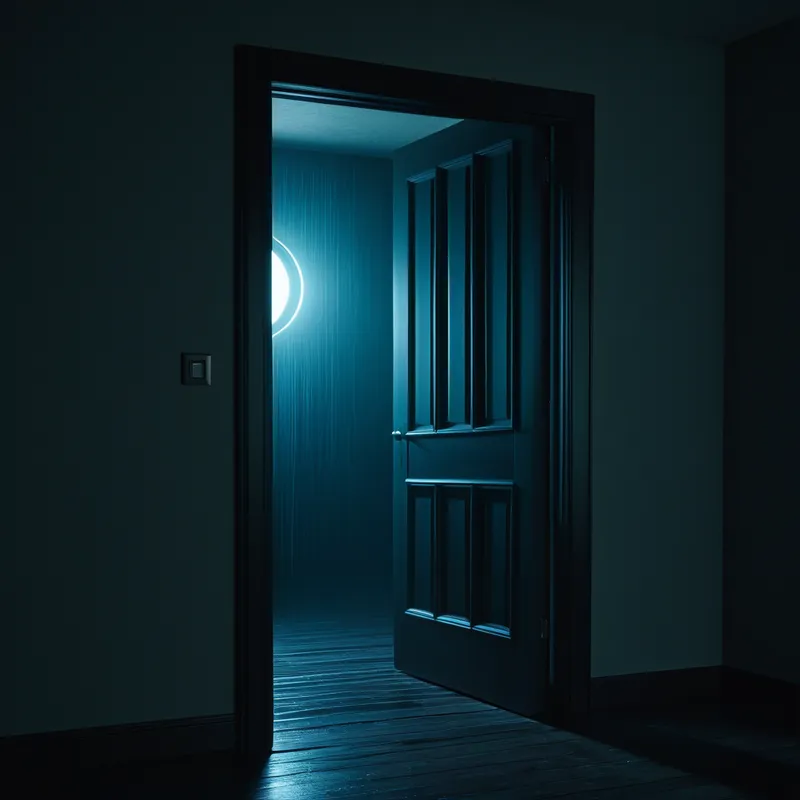
You may dream of a familiar house with unknown, open doors leading into dark forests or crowded halls. This is the psyche’s architecture changing; sealed chambers of memory or potential are becoming accessible. You might encounter vague, shadowy figures in your living space—these are often unintegrated aspects of the self or unresolved ancestral patterns seeking recognition. Dreams of trying to light a fire that won’t catch, or of a vital light source (a lamp, the sun) becoming dim and weak reflect the ego’s energy waning, making way for a different kind of illumination from the unconscious.
Somatically, this process can feel like a deep fatigue that is not entirely physical, a sense of “thinning” or vulnerability, or a heightened, almost eerie sensitivity to atmosphere and memory. It is the psyche’s equivalent of the year’s energy drawing inward to the root. The dreamer is not breaking down but being prepared for a profound re-membering.
Alchemical Translation
The alchemical process mirrored here is Solutio—dissolution. In individuation, we must periodically dissolve the rigid structures of the persona and conscious attitudes to allow for reorganization at a deeper level.
The myth provides the map. First, Acknowledge the Tide (The Conscious Ritual). The modern equivalent is creating intentional space—through meditation, journaling, or therapy—to honor what is ending and what from the past is asking for attention. This is the “setting a place at the table.”
Second, Extinguish the Private Hearth (Ego Relinquishment). This involves temporarily suspending the daily identity—the “I” as manager, achiever, or constant narrator—to simply be present to the inner atmosphere. It is a voluntary vulnerability.
Third, Greet the Visitors (Shadow Integration). As the contents of the unconscious approach, the task is not to fight or flee, but to witness. That shimmering figure in the dream, that sudden surge of forgotten grief or archaic fear, is the “ancestor” or “Aos Sí” seeking integration. Offering it “food” means giving it conscious attention and meaning.
The goal is not to live perpetually with a thin veil, in psychic chaos, but to undergo these sacred tides of dissolution so that the reconstituted self is wiser, more inclusive, and more whole.
Finally, Relight the Hearth (New Synthesis). After the tide recedes, you take the renewed understanding—the “spark” from the communal bonfire of the Self—back into your daily life. The veil restores, but it is now a wiser membrane, having allowed a sacred exchange. You have remembered parts of yourself, and in doing so, you have changed your relationship to both your past and your future. The wheel turns, not back to where it was, but forward on its eternal spiral, carrying the wisdom of what was met in the dark.
Associated Symbols
Explore related symbols from the CaleaDream lexicon: