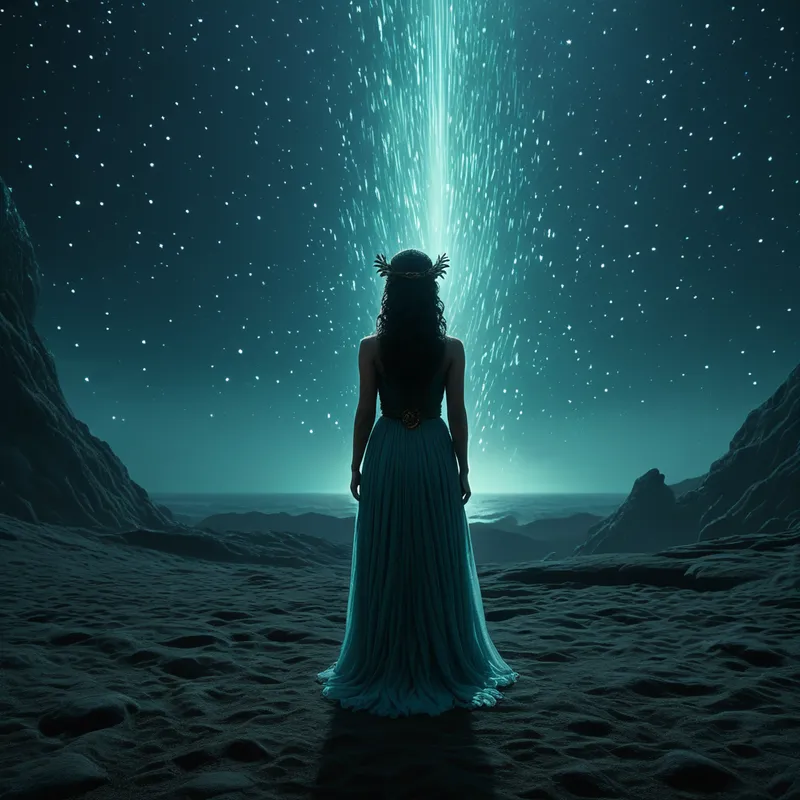
The Valley of Dry Bones Ezekiel
A prophet's vision of dry bones miraculously restored to life, symbolizing hope and divine promise for a nation's rebirth.
The Tale of The Valley of Dry Bones Ezekiel
The hand of the Lord came upon Ezekiel, priest and prophet, in the midst of exile. He was carried away, not in body but in spirit, and set down in the middle of a valley. It was a vast and silent plain, a place of profound desolation. The ground was not earth, but a mosaic of [death](/myths/death “Myth from Tarot culture.”/)—it was a valley full of bones. They were not merely scattered; they were exceedingly dry, bleached by a relentless sun, brittle with the passage of uncounted seasons. No memory of flesh clung to them, no whisper of the life they once held. The Spirit led him back and forth among them, and he saw the terrible totality: a great army, utterly fallen, reduced to its most basic, mineral state.
Then came the question, a divine inquiry that pierced the silence: “Son of man, can these bones live?”
Ezekiel, faced with the absolute finality of the scene, answered not from his own understanding but from a place of surrendered faith. “O Lord God, you alone know.”
The command followed, a charge that bridged the chasm between the impossible and the divine will. “Prophesy to these bones,” said the voice. “Say to them, ‘O dry bones, hear [the word](/myths/the-word “Myth from Biblical culture.”/) of the Lord!’” And so, the prophet spoke to the lifeless fragments. He declared the promise of breath, of sinew and skin, of life restored. As he prophesied, a sound arose—not a wind at first, but a rattling, a deep tectonic shifting. Bone found its matching bone, and they knit together with a sound like stones tumbling. Sinews appeared upon them, and flesh grew, and skin covered them. Yet there was no breath in them. They were magnificent corpses, a silent, assembled host.
Then the voice spoke again: “Prophesy to the breath; prophesy, son of man, and say to the breath, ‘Thus says the Lord God: Come from the four winds, O breath, and breathe upon these slain, that they may live.’” Ezekiel obeyed. He called to the [ruach](/myths/ruach “Myth from Hebrew culture.”/), the very spirit-wind of God. And it came. A rushing, a mighty inhalation of the universe filled the valley. The breath entered them, and they lived. They stood upon their feet, a vast and exceedingly great army, no longer a collection of parts but a unified, breathing whole.
Then the word of the Lord explained the vision: “These bones are the whole house of Israel.” They lamented, “Our bones are dried up, and our hope is lost; we are cut off completely.” But the prophecy was one of radical return. “Behold, I will open your graves, and raise you from your graves, O my people… And I will put my Spirit within you, and you shall live.”
Cultural Origins & Context
The vision is recorded in the 37th chapter of the Book of Ezekiel, a text composed during the Babylonian Exile (c. 597–538 BCE). This period was the ultimate national catastrophe for the Kingdom of Judah. [The temple](/myths/the-temple “Myth from Jewish culture.”/) in [Jerusalem](/myths/jerusalem “Myth from Biblical culture.”/) was destroyed, the Davidic monarchy ended, and a significant portion of the population was forcibly relocated to Mesopotamia. The exile was not merely a political event; it was a theological and existential crisis. The core covenants with Yahweh—promises of land, progeny, and divine presence—seemed shattered. The people felt spiritually and nationally dead, severed from their identity and their God.
Ezekiel, himself a priest in exile, ministered to this community of the spiritually deceased. His prophecies often took the form of intense, symbolic visions and enacted parables. The [Valley of Dry Bones](/myths/valley-of-dry-bones “Myth from Biblical culture.”/) sits at the heart of his message. It directly confronts the dominant feeling of hopelessness (“our hope is lost”) with a divine assertion of possibility that transcends all human logic. The vision does not sugarcoat reality—the bones are exceedingly dry—but it insists that God’s power operates precisely in the place where all human power has failed. It redefines restoration not as a gradual reform but as a miraculous resurrection, a new [creation ex nihilo](/myths/creation-ex-nihilo “Myth from Multiple culture.”/), promising a return to the land and, more profoundly, a return of God’s own Spirit to the heart of the people.
Symbolic Architecture
The [vision](/symbols/vision “Symbol: Vision reflects perception, insight, and clarity — often signifying the ability to foresee or understand deeper truths.”/) is a masterwork of symbolic layers, each deepening the psychological and spiritual [diagnosis](/symbols/diagnosis “Symbol: A medical or psychological assessment revealing a condition, often symbolizing self-awareness, vulnerability, or a need for change.”/) and cure. The [Valley](/symbols/valley “Symbol: A valley often symbolizes a period of transition or a place of respite between two extremes.”/) itself is a liminal [space](/symbols/space “Symbol: Dreaming of ‘Space’ often symbolizes the vastness of potential, personal freedom, or feelings of isolation and exploration in one’s life.”/), a low point between mountains, often a place of testing and [revelation](/symbols/revelation “Symbol: A sudden, profound disclosure of truth or insight, often through artistic or musical means, that transforms understanding.”/). Here, it becomes the grave of a nation. The Bones represent the absolute end of the [life](/symbols/life “Symbol: The symbol of ‘Life’ represents a journey of growth, interconnectedness, and existential meaning, encompassing both the joys and challenges that define human experience.”/) process; they are the final, [static](/symbols/static “Symbol: Static represents interference, disruption, and the breakdown of clear communication or signal, often evoking feelings of frustration and disconnection.”/) [residue](/symbols/residue “Symbol: What remains after a process or event; traces left behind that persist beyond the original occurrence.”/), the core [structure](/symbols/structure “Symbol: Structure in dreams often symbolizes stability, organization, and the framework of one’s life, reflecting how one perceives their environment and personal life.”/) stripped of all animation. Their dryness signifies the complete [absence](/symbols/absence “Symbol: The state of something missing, void, or not present. Often signifies loss, potential, or existential questioning.”/) of moisture, the mayim (waters) of [life](/symbols/life “Symbol: The symbol of ‘Life’ represents a journey of growth, interconnectedness, and existential meaning, encompassing both the joys and challenges that define human experience.”/), and the [passage](/symbols/passage “Symbol: A passage symbolizes transition, movement from one phase of life to another, or a journey towards personal growth.”/) of time beyond any natural hope of renewal.
The two-stage resurrection is critically important. The reassembly of bones, sinew, and flesh signifies a restoration of form and structure—the political and social reconstitution of Israel. But it creates only a beautiful [corpse](/symbols/corpse “Symbol: A corpse symbolizes death, the end of a cycle, and often implies the need for transformation and renewal.”/). The second stage, the calling of the [breath](/symbols/breath “Symbol: Breath symbolizes life, vitality, and the connection between the physical and spiritual realms.”/) (ruach), is the infusion of [spirit](/symbols/spirit “Symbol: Spirit symbolizes the essence of life, vitality, and the spiritual journey of the individual.”/), the divine animating principle. This distinguishes a merely functional nation from a spiritually alive people.
This sequence mirrors the creation of Adam in Genesis, where God forms the human from the dust (adamah) and then breathes into it the breath of life. The prophecy is thus a promise of re-creation, a second genesis for a people who have returned to the dust of despair.
The vision masterfully translates internal, subjective [despair](/symbols/despair “Symbol: A profound emotional state of hopelessness and loss, often signaling a need for transformation or surrender to deeper truths.”/) (“our bones are dried up”) into an external, objective vision, then shows the divine [action](/symbols/action “Symbol: Action in dreams represents the drive for agency, motivation, and the ability to take control of situations in waking life.”/) that can reverse it. It externalizes the inner [landscape](/symbols/landscape “Symbol: Landscapes in dreams are powerful symbols representing the dreamer’s emotional state, personal journey, and the broader context of life situations.”/) of a collective [psyche](/myths/psyche “Myth from Greek culture.”/) so that it can be witnessed and, ultimately, healed.
The Dreamer’s Resonance
For the individual dreamer or visionary, the Valley of Dry Bones maps onto those periods of profound psychic death. It is the season of depression, burnout, or soul-loss, when one’s inner world feels like a desolate, sun-bleached plain. Creativity is exhausted, relationships feel skeletal, and faith in the future has evaporated. The “bones” are the core structures of the personality—one’s values, talents, and history—that remain when the animating passion, the ruach, has departed.
Ezekiel’s initial response, “You alone know,” is the essential posture for engaging such a state. It is an admission of personal helplessness and an openness to a force beyond [the ego](/myths/the-ego “Myth from Jungian culture.”/). The act of “prophesying to the bones” translates, psychologically, to the act of speaking to one’s own deepest despair. It is the commitment to affirm life and possibility toward the dead parts of oneself, even when no evidence supports it. This speech is not naive optimism; it is a ritual invocation, a creative act that begins the reassembly.
The two-stage process is crucial here as well. One may rebuild the structures of life—get a new job, establish routines, “go through the motions”—and still feel lifeless. The final, essential step is an invitation to the spirit, a conscious invocation of meaning, passion, and connection that must come from a source beyond mere willpower. It is the breath that makes the structure live.

Alchemical Translation
In the alchemical opus, the vision corresponds to the stage of mortificatio and [putrefactio](/myths/putrefactio “Myth from Alchemical culture.”/)—the necessary death, blackening, and dissolution of the old, rigid form. The dry bones are the [caput mortuum](/myths/caput-mortuum “Myth from Alchemical culture.”/), the dead head, the worthless residue left after the fiery trials. This stage feels like utter failure, the reduction of a complex being to its barest, most inert components. It is a state beyond melancholy; it is the nihilistic conviction that no transformation is possible.
The divine question, “Can these bones live?” is the spark of the anima mundi, the world soul, intruding upon the absolute certainty of death. It is the alchemist’s faith that within the most despised and rejected substance lies the potential for the lapis philosophorum, the philosopher’s stone.
The prophecy is the application of the verbum, the sacred word or formula, to the dead matter. The rattling and coming together signify the [coagulatio](/myths/coagulatio “Myth from Alchemical culture.”/), the re-solidification into a new, purified body. But the alchemical process is not complete with the creation of a [homunculus](/myths/homunculus “Myth from Alchemical culture.”/), a artificial man. The final infusion of [spiritus](/myths/spiritus “Myth from Alchemical culture.”/), the volatile, life-giving principle—here called from the four winds—is the sublimatio and animatio. This completes the work, transmuting the base, dead matter into a living, spiritualized being. The vision is thus a complete map of the psychic process of disintegration and reintegration at a collective level, promising that the spirit seeks not to abandon the form it has created, but to resurrect it to a higher order of life.
Associated Symbols
Explore related symbols from the CaleaDream lexicon:
- Valley — A low, enclosed landscape representing a state of trial, introspection, or collective despair, often the necessary ground for revelation and renewal.
- Bone — The essential, enduring structure of a being or a truth, stripped of all superficial life; the core framework that remains after death or decay.
- Breath — The invisible animating force, the spirit or [pneuma](/myths/pneuma “Myth from Greek culture.”/) that distinguishes living form from inert matter, representing divine inspiration and life itself.
- Grave — A place of confinement and finality for the old self or old order, which paradoxically becomes the site of potential for radical emergence.
- Army — A symbol of collective identity, unified purpose, and restored power, emerging from [chaos](/myths/chaos “Myth from Greek culture.”/) and individuated fragments into an ordered whole.
- Prophet — The mediating consciousness who can hear the divine question, speak to the dead places, and serve as a vessel for the restorative word.
- Wind — The unseen, powerful movement of spirit (ruach), coming from all directions to enact change and fill what is empty.
- Rebirth — The core promise of the myth: not mere repair, but a total resurrection into new life, transcending the natural cycle.
- Hope — The divine seed planted in the soil of absolute hopelessness, a force that is declared into existence before any evidence appears.
- Spirit — The ultimate agent of restoration, the divine essence that returns to inhabit and vivify the rebuilt forms of individual and community.