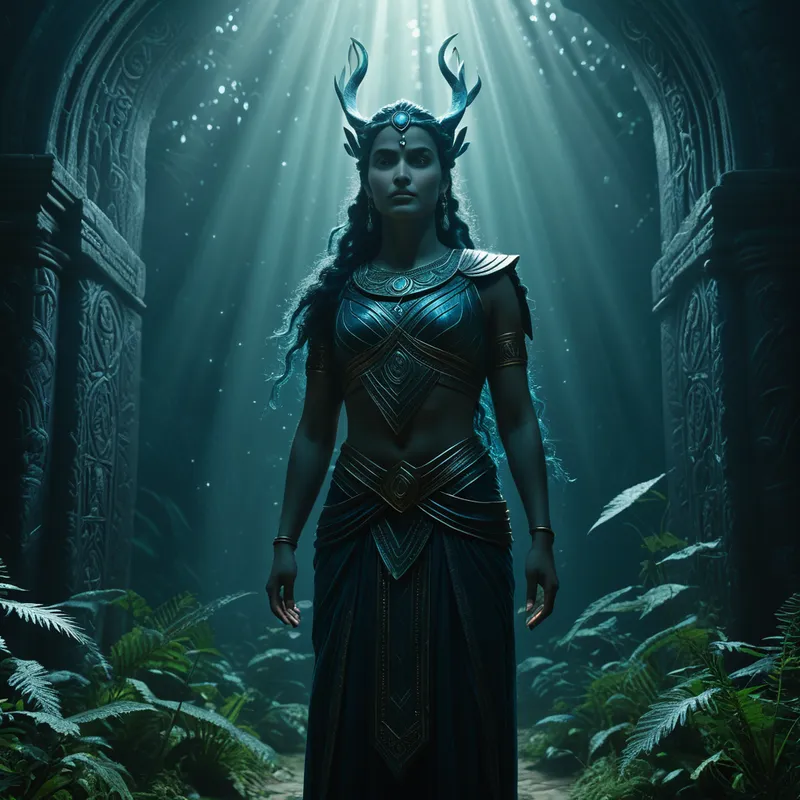
The Valley of Diamonds
A legendary Arabian valley brimming with diamonds, protected by mystical forces that challenge those who dare to seek its riches.
The Tale of The Valley of Diamonds
The story is not of a single journey, but a pattern of attempts, a legend whispered among merchants and adventurers. It speaks of a place hidden within the trackless, scorching wastes of [the world](/myths/the-world “Myth from Tarot culture.”/), a valley so deep and sheer-walled that no ordinary path leads down into its heart. Its floor is not sand or stone, but a glittering crust of diamonds, rubies, and emeralds, scattered as carelessly as gravel. The sun, when it pierces the chasm, sets the entire abyss ablaze with a cold, hard fire.
But the valley is not empty. It is guarded. Some tell of immense serpents, older than kingdoms, coiled upon the jewels. Others speak of mythical creatures with eyes like lamps and talons of brass. Most persistent, however, is the tale of the eagles—or perhaps they are rocs, the colossal birds of legend—who make their eyries on the inaccessible cliffs. They are the valley’s true wardens.
The cunning of those who seek the treasure lies not in brute force, but in a macabre stratagem. Knowing the eagles carry great slabs of meat to their young, adventurers would journey to the rim. There, they would slaughter a sheep or goat, skin it, and sew the fresh, bloody hide into a bag. Into this gruesome sack they would place pieces of meat, and themselves crawl inside, clutching a sharp knife. Silent, patient, they would wait in the reeking darkness.
Sooner or later, an eagle would descend. Mistaking the lump for carrion, it would seize the hide in its mighty talons and soar, carrying the hidden man down into the depths of the valley. Upon landing, the man would cut his way out from his leather womb, startling the bird away. Suddenly, he stood alone in the fabled place, surrounded by fortune beyond imagination. He would stuff his pockets, his robes, his very turban with gems until he could carry no more.
Yet the descent was the easy part. The walls were unscalable. Escape required the same dreadful symbiosis. The seeker would lie upon the glittering ground, the precious hoard upon his chest, and wait. He had to hope an eagle, seeking food for its chicks, would mistake him for dead meat and lift him again, carrying him and his burden back to the world above. It was a gamble with a divine porter. If the eagle chose a different path, or if it saw through the ruse, the man was doomed to die amidst the very wealth he coveted, a skeleton adorned with diamonds.
Cultural Origins & Context
The Valley of Diamonds is a migratory legend, most famously embedded within the overarching narrative of [The Thousand and One Nights](/myths/the-thousand-and-one-nights “Myth from Arabian culture.”/), particularly in the voyages of Sindbad the Sailor. Its roots, however, tap into older strata of Arabian and Persian geography and mercantile anxiety. Pre-Islamic and early Islamic cartographers often spoke of terra incognita filled with wonders and terrors, reflecting the vast, unmapped deserts and the perils of long-distance trade along the Incense Route and beyond.
The myth functions as a profound metaphor for the mercantile reality of the medieval Islamic world. Diamonds and precious stones flowed into Baghdad and Basra from mines in India and beyond, their origins shrouded in merchant secrecy and fantastical rumor. The valley represents the ultimate, almost abstract source of this wealth—inaccessible, inherently dangerous, and requiring not just courage but a morally ambiguous, symbiotic trickery to tap. The eagles are not merely monsters; they are natural forces, the unknowable mechanisms of fortune and trade that must be harnessed, at great personal risk, to bring treasure from the remote to the civilized.
It is a story born at [the crossroads](/myths/the-crossroads “Myth from Celtic culture.”/) of desire and dread, where the human hunger for the rare and beautiful collides with a deep-seated respect for the boundaries of the natural world. The valley is a temple of pure material value, and its guardians ensure that the price of admission is never merely gold, but one’s very flesh and fate.
Symbolic Architecture
The [valley](/symbols/valley “Symbol: A valley often symbolizes a period of transition or a place of respite between two extremes.”/) is not a setting but a psychic apparatus. Its sheer walls represent the absolute [boundary](/symbols/boundary “Symbol: A conceptual or physical limit defining separation, protection, or identity between entities, spaces, or states of being.”/) between the mundane [consciousness](/symbols/consciousness “Symbol: Consciousness represents the state of awareness and perception, encompassing thoughts, feelings, and experiences.”/) of daily [life](/symbols/life “Symbol: The symbol of ‘Life’ represents a journey of growth, interconnectedness, and existential meaning, encompassing both the joys and challenges that define human experience.”/) and the unconscious [realm](/symbols/realm “Symbol: The symbol of ‘Realm’ often signifies the boundaries of one’s consciousness, experiences, or emotional states, suggesting aspects of reality that are either explored or ignored.”/) of latent potential and immense value. One cannot simply walk into the [depths](/symbols/depths “Symbol: Represents the subconscious, hidden emotions, or foundational aspects of the self, often linked to primal fears or profound truths.”/) of [the self](/myths/the-self “Myth from Jungian culture.”/); one must be taken, by a force greater and other.
The diamonds themselves are the ultimate [symbol](/symbols/symbol “Symbol: A symbol can represent an idea, concept, or belief, serving as a powerful tool for communication and understanding.”/) of crystallized value—hard, luminous, and cold. They are the condensed essence of earthly desire, the [prima materia](/myths/prima-materia “Myth from Alchemical culture.”/) of greed and aspiration. Yet, scattered on the valley [floor](/symbols/floor “Symbol: The floor in dreams often symbolizes the foundation of one’s life or psyche, representing stability, grounding, and the underlying structures of our experiences.”/), they are also utterly devalued, mere stones. Their worth is assigned only by the world above, the world of markets and meaning. In their [native](/symbols/native “Symbol: The term ‘native’ represents an intrinsic connection to one’s heritage or origin, often symbolizing identity and belonging.”/) state, they are just another facet of the inhospitable [landscape](/symbols/landscape “Symbol: Landscapes in dreams are powerful symbols representing the dreamer’s emotional state, personal journey, and the broader context of life situations.”/).
The true guardian of the treasure is not the eagle, but the valley itself. Its architecture—the descent, the glittering floor, the impossible ascent—is a perfect psychic trap. It offers the fulfillment of a wish only to reveal that the fulfillment is the prison.
The method of entry and exit is the myth’s most brilliant psychological stroke. The [seeker](/symbols/seeker “Symbol: A person actively searching for meaning, truth, or a higher purpose, often representing the dreamer’s own quest for identity or fulfillment.”/) must use a carcass, a simulacrum of [death](/symbols/death “Symbol: Symbolizes transformation, endings, and new beginnings; often associated with fear of the unknown.”/), and be carried as [meat](/symbols/meat “Symbol: Meat in dreams often symbolizes sustenance, vitality, and the primal aspects of one’s nature, as well as potential conflicts or desires.”/). This is a [ritual](/symbols/ritual “Symbol: Rituals signify structured, meaningful actions carried out regularly, reflecting cultural beliefs and emotional needs.”/) of profound humiliation and [regression](/symbols/regression “Symbol: A psychological or spiritual return to earlier states of being, often involving revisiting past patterns, memories, or developmental stages for insight or healing.”/). To gain the [treasure](/symbols/treasure “Symbol: A hidden or valuable object representing spiritual wealth, inner potential, or divine reward.”/) of the Self (or the world), one must first pretend to be dead, to be passive carrion, and be delivered into the depths by an unconscious, instinctual force (the [eagle](/symbols/eagle “Symbol: The eagle is a symbol of power, freedom, and transcendence, often representing a person’s aspirations and higher self.”/)). The return [journey](/symbols/journey “Symbol: A journey in dreams typically signifies adventure, growth, or a significant life transition.”/) requires the same [posture](/symbols/posture “Symbol: Posture in dreams represents one’s stance in life, social presentation, and inner confidence or submission. It reflects how one carries themselves through challenges and relationships.”/): playing dead beneath the [weight](/symbols/weight “Symbol: Weight symbolizes burdens, responsibilities, and emotional loads one carries in life.”/) of one’s newfound [wealth](/symbols/wealth “Symbol: Wealth in dreams often represents abundance, security, or inner resources, but can also symbolize burdens, anxieties, or moral/spiritual values.”/), hoping for [redemption](/symbols/redemption “Symbol: A theme in arts and music representing transformation from failure or sin to salvation, often through creative expression or cathartic performance.”/) by the same blind force.
The Dreamer’s Resonance
When this valley appears in the soul’s landscape, it signals a confrontation with a core complex around value, ambition, and the price of fulfillment. The dreamer stands at the rim, looking down at a glittering potential—a career goal, a creative project, a relationship that promises transformative riches. The allure is visceral, the diamonds a metaphor for the perfected, hardened state we believe will solve our inner poverty.
But the dream always includes the guardians. The serpents or eagles manifest as the palpable fears, the ethical compromises, the sheer logistical nightmares that protect any profound undertaking. They are the “yes, but…” that arises with every grand ambition. The myth warns that what we value most is often protected by what we fear most.
The resonant tension lies in the method. Are we willing to be sewn into the stinking hide of our own cunning? To regress, to become manipulative, to use trickster energy to bypass the guardians? And once we have the treasure, can we bear the weight of it? The final, awful wait on the valley floor is the moment of integration. Having seized the prize, we are now utterly dependent on a grace we cannot control for our deliverance. It is the archetypal crisis of the successful explorer: having found [the grail](/myths/the-grail “Myth from Arthurian culture.”/), he may become its prisoner.

Alchemical Translation
In the alchemical opus, the Valley of Diamonds corresponds to the stage of [Nigredo](/myths/nigredo “Myth from Alchemical culture.”/)—the blackening, the descent into the materia prima, often depicted as a [death](/myths/death “Myth from Tarot culture.”/) or putrefaction. The seeker, sewn in the bloody hide, undergoes a symbolic death and is carried into the dark valley. The glittering stones are the raw, unreflected aspects of the [psyche](/myths/psyche “Myth from Greek culture.”/), the fragmented scintillae or sparks of spirit trapped in matter.
The eagle, a creature of the sky, carrying the “dead” matter into the earth and back, performs the function of the avis hermeticus—the Hermetic Bird. It is the volatile spirit (Mercurius) that mediates between the above and the below, capable of uniting the opposites. The seeker’s trick is to temporarily identify with the massa confusa, the dead matter, to be acted upon by this spirit.
The process is one of extraction and elevation. The base desire (greed) is the initial impulse, but the ordeal transforms it. The diamonds must be carried out, elevated from the realm of instinct (the valley) to the realm of consciousness (the world above). This is not a rejection of the treasure, but its integration. The successful return—a rare outcome in the tales—symbolizes the [coniunctio oppositorum](/myths/coniunctio-oppositorum “Myth from Alchemical culture.”/), where the hard, luminous value of the spirit is brought into living relation with the human world, no longer as an object of greed, but as a hard-won facet of the realized self. The failed seeker is one who remains identified with the treasure, becoming a fixed, glittering part of the landscape of the unconscious.
Associated Symbols
Explore related symbols from the CaleaDream lexicon:
- Valley — A deep, enclosed space in [the earth](/myths/the-earth “Myth from Hindu culture.”/), representing the unconscious, a place of fertility and danger, of hidden potential and profound introspection.
- Diamond — The ultimate symbol of crystallized value, clarity, and invulnerability, born from immense pressure; it is hardened light, representing the perfected but potentially cold aspect of the spirit.
- Eagle — A sovereign bird of the heights, representing spirit, vision, and the power to ascend; as a carrier between realms, it embodies the mediating force between heaven and earth, consciousness and the unconscious.
- Journey — The fundamental archetypal movement from a known state to an unknown destination, encompassing quest, ordeal, transformation, and the hope of return.
- Danger — The inherent presence of threat, harm, or the unknown within a situation; it is the necessary friction that tests resolve and defines the value of any undertaking.
- Trickster — The archetypal boundary-crosser who uses cunning, deception, and rule-breaking to achieve goals, often embodying the ambiguous intelligence needed to navigate impossible situations.
- Death — Not merely an ending, but a profound transition, a necessary dissolution of a former state to allow for transformation, rebirth, or passage to a new level of being.
- Fate — The impersonal, often inscrutable force that governs outcomes, representing the limits of human control and the role of destiny in the intersection of choice and circumstance.
- Sacrifice — The voluntary surrender of something of value, often a part of the self or a comfort, as a necessary price for a greater gain, initiation, or communion.
- Mountain — A towering, aspirational form representing a supreme challenge, achievement, and the vantage point of consciousness; its opposite, the valley, lies in its shadow.
- Shadow — The hidden, rejected, or unconscious aspects of the personality, often containing both creative power and destructive potential, which must be encountered in any deep journey.
- Meat — Symbol of raw, corporeal life, instinct, and mortality; to be carried as meat is to identify wholly with the vulnerable, perishable body, a state of ultimate humility and regression.