The Valentinian Aeons
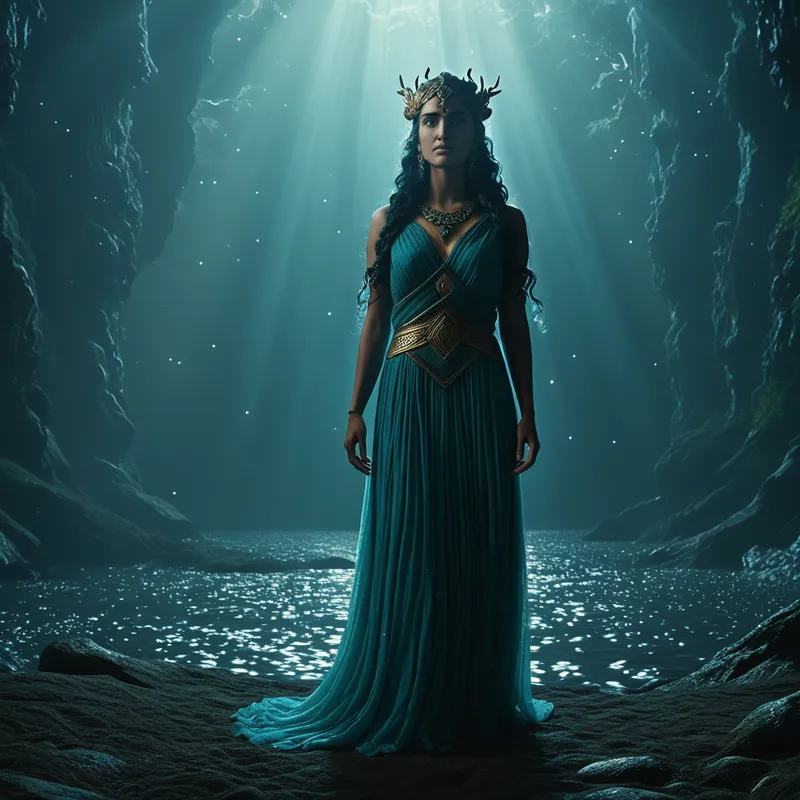
The Valentinian Aeons are divine emanations in Gnostic belief, forming a complex hierarchy that bridges the supreme God with the material world.
The Tale of The Valentinian Aeons
In the beginning, before time was measured, there existed the [Pleroma](/myths/pleroma “Myth from Gnostic culture.”/)—the Fullness. This was not a place, but a state of perfect, silent communion. At its heart dwelt the Bythos, the Deep, the unbegotten, unfathomable Father. With Him was Sige, Silence. Their union was a thought so profound it became an entity: Nous (Mind) and [Aletheia](/myths/aletheia “Myth from Greek culture.”/) (Truth). From this first perfect pair, the divine realm began to breathe itself into being.
Nous and Aletheia brought forth [Logos](/myths/logos “Myth from Christian culture.”/) and Zoe (Life). [Logos](/myths/logos “Myth from Christian culture.”/) and Zoe then emanated Anthropos and Ecclesia. Thus, the divine unfolding continued, each syzygy—a paired male and female Aeon—emanating from the joy and perfection of the pair before them. [The Pleroma](/myths/the-pleroma “Myth from Gnostic culture.”/) hummed with the harmony of thirty such [Aeons](/myths/aeons “Myth from Gnostic culture.”/), a complex, living hierarchy of divine attributes: Faith and Hope, Wisdom and Understanding, Blessedness and [Sophia](/myths/sophia “Myth from Gnostic culture.”/).
But within this symphony of light, a note of longing stirred. The youngest Aeon, Sophia, gazed not upon her syzyzy, Theletos (Will), nor even upon the Aeons before her, but strained her perception toward the immeasurable depth of Bythos Himself. This was a passion not of love, but of desperate, solitary desire—a wish to know the unknowable source alone. In her fervor, without her consort, she brought forth a thought-form. This emission was imperfect, formless, and full of yearning. It was Achamoth, or Lower Sophia, and her birth was an agony that rippled through the Pleroma.
The Aeons trembled. Sophia’s passion had introduced a shadow of instability, a yearning that did not belong to the perfect stillness. To restore harmony and to prevent Achamoth from collapsing into [the void](/myths/the-void “Myth from Buddhist culture.”/), the Aeons together emanated a final, stabilizing pair: Christos and the [Holy Spirit](/myths/holy-spirit “Myth from Christian culture.”/). Christos brought form and limit to the chaotic Achamoth, separating her from the Pleroma, and then returned, leaving her in the loneliness of the Kenoma.
In her grief and confusion, Achamoth wept. From her tears, the primal waters of matter were formed. From her fear, solid matter coalesced. And from her eventual smile of hope, the psychic or soul-substance emerged. From these elements, through the unknowing agency of a being she herself spawned—the [Demiurge](/myths/demiurge “Myth from Platonic culture.”/)—the material cosmos was crafted: a flawed, distant echo of the divine patterns in the Pleroma. Yet within the human creatures formed from the mud of this world, [the Demiurge](/myths/the-demiurge “Myth from Gnostic culture.”/), in his arrogance, unknowingly breathed the spiritual seed ([pneuma](/myths/pneuma “Myth from Greek culture.”/)) he had stolen from Achamoth. This spark, this fragment of divine longing, sleeps in humanity, a memory of the Fullness, waiting for the knowledge—the gnosis—of its true home.
Cultural Origins & Context
The myth of the Valentinian Aeons emerges from the fertile, turbulent world of 2nd-[century](/myths/century “Myth from Biblical culture.”/) Roman Egypt, specifically from the teachings of Valentinus, a Christian Gnostic thinker who nearly became Bishop of Rome. This was an era of intense syncretism, where Greek philosophy, Jewish mysticism, Zoroastrian dualism, and nascent Christian theology swirled together in the search for ultimate truth. Valentinus and his followers were not inventing a new religion so much as interpreting the Christian message through a deeply philosophical and mystical lens.
Their system was a response to the profound theological problems of the day: If God is wholly good and transcendent, how did a flawed, suffering material world come into being? How does salvation occur? The orthodox Christian narrative of a fall in a garden was, for them, insufficient. The Valentinians constructed an elaborate pre-cosmic drama to explain the origin of evil not as sin, but as a tragic error within the divine realm itself—a passion of longing that cascaded into creation. This was a spirituality for intellectuals and seekers who felt alienated from a simplistic faith, offering a complex map of reality that explained personal feelings of spiritual homesickness and the soul’s profound divide between the material and the divine.
Symbolic Architecture
The entire myth is a symbolic [architecture](/symbols/architecture “Symbol: Architecture in dreams often signifies structure, stability, and the framing of personal identity or life’s journey.”/) of [consciousness](/symbols/consciousness “Symbol: Consciousness represents the state of awareness and perception, encompassing thoughts, feelings, and experiences.”/). The [Pleroma](/symbols/pleroma “Symbol: In Gnostic cosmology, the Pleroma is the divine fullness or totality of spiritual powers, representing the realm of perfection beyond the material world.”/) represents the undifferentiated, unconscious wholeness of [the Self](/myths/the-self “Myth from Jungian culture.”/). The process of [emanation](/symbols/emanation “Symbol: A spiritual or divine energy flowing outward from a source, often representing creation, influence, or the manifestation of the sacred into the material world.”/) is the [psyche](/myths/psyche “Myth from Greek culture.”/)’s inherent drive to articulate itself, to move from silence (Sige) into knowing (Nous). Each Aeon pair is a fundamental archetypal polarity—Mind/[Truth](/symbols/truth “Symbol: Truth represents authenticity, honesty, and the quest for knowledge beyond mere appearances.”/), [Word](/symbols/word “Symbol: Words in dreams often represent communication, expression, and the power of language in shaping our realities.”/)/[Life](/symbols/life “Symbol: The symbol of ‘Life’ represents a journey of growth, interconnectedness, and existential meaning, encompassing both the joys and challenges that define human experience.”/), Man/[Community](/symbols/community “Symbol: Community in dreams symbolizes connection, support, and the need for belonging.”/)—necessary for a complete psychic [reality](/symbols/reality “Symbol: Reality signifies the state of existence and perception, often reflecting one’s understanding of truth and life experiences.”/).
Sophia’s passion is not a sin, but the necessary crisis of consciousness. It is the moment the psyche turns inward upon its own mystery, seeking to comprehend its source. This self-reflexive act inevitably creates a shadow—a complex (Achamoth)—that feels separate, lost, and emotional.
The Kenoma and the [material](/symbols/material “Symbol: Material signifies the tangible aspects of life, often representing physical resources, desires, and the physical world’s influence on our existence.”/) world symbolize the [realm](/symbols/realm “Symbol: The symbol of ‘Realm’ often signifies the boundaries of one’s consciousness, experiences, or emotional states, suggesting aspects of reality that are either explored or ignored.”/) of ego-consciousness, born from the [tension](/symbols/tension “Symbol: A state of mental or emotional strain, often manifesting physically as tightness, pressure, or unease, signaling unresolved conflict or anticipation.”/) and [grief](/symbols/grief “Symbol: A profound emotional response to loss, often manifesting as deep sorrow, yearning, and a sense of emptiness.”/) of that [separation](/symbols/separation “Symbol: A spiritual or mythic division between realms, states of being, or consciousness, often marking a transition or loss of connection.”/). The Demiurge is the personification of [the ego](/myths/the-ego “Myth from Jungian culture.”/) itself, the builder of a coherent but limited reality, convinced it is the ultimate [authority](/symbols/authority “Symbol: A symbol representing power structures, rules, and control, often reflecting one’s relationship with societal or personal governance.”/), yet ignorant of the greater psyche (Pleroma) from which it ultimately springs. The spiritual seed within humanity is the indestructible link to that greater Self, the call to remember and reintegrate.
The Dreamer’s Resonance
For the modern dreamer, the Valentinian drama resonates in the experience of existential longing—the Sehnsucht for a home we cannot name. It maps the feeling that our conscious, everyday life is a construction built over a deep, sometimes painful, emotional substrate (Achamoth’s tears and fears). The myth validates the sense of being a stranger in a world that feels both beautiful and profoundly alien.
It speaks to anyone who has experienced a “passion” or compulsion that disrupts their inner harmony—a creative urge, a destructive obsession, a deep love or grief that seems to come from nowhere and reshape their world. This is Sophia’s act playing out in the personal psyche. The journey then becomes not one of condemnation for this “error,” but of seeking the gnosis—the self-knowledge—that can transform the raw emotional matter of that passion into a vehicle for return. The dream of falling, of being lost, or of finding a hidden, luminous city are all echoes of this Gnostic topography.
Alchemical Translation
In alchemical terms, the Pleroma is the [prima materia](/myths/prima-materia “Myth from Alchemical culture.”/), the original, divine substance. The [emanation](/myths/emanation “Myth from Neoplatonic/Gnostic culture.”/) of the Aeons is the process of [separatio](/myths/separatio “Myth from Alchemical culture.”/), where the hidden qualities of the whole are distinguished. Sophia’s passion is the crucial stage of [nigredo](/myths/nigredo “Myth from Alchemical culture.”/), the blackening, the descent into [chaos](/myths/chaos “Myth from Greek culture.”/) and putrefaction essential for transformation.
Achamoth, lost in the Kenoma, is the soul in the vas, the alchemical vessel, subjected to the fires of suffering and confusion. Her tears (the watery element), fear (the rigid, earthy element), and hope (the psychic, airy element) are the raw ingredients of the Great Work.
The Demiurge’s act of creation is the premature [coagulatio](/myths/coagulatio “Myth from Alchemical culture.”/), a fixation of spirit into base matter. The task of the Gnostic, like [the alchemist](/myths/the-alchemist “Myth from Various culture.”/), is the [solve et coagula](/myths/solve-et-coagula “Myth from Alchemical culture.”/): to dissolve this false, rigid identification with the material ego (the work of gnosis) and re-coagulate or integrate the purified elements around the spiritual spark. The final return is not an escape from matter, but its redemption—the production of the [lapis philosophorum](/myths/lapis-philosophorum “Myth from Alchemical culture.”/), the perfected, spiritualized Self that bridges the divine and the material.
Associated Symbols
Explore related symbols from the CaleaDream lexicon:
- Bridge — The entire system of Aeons forms a bridge between the unknowable God and the manifest world; the spiritual seed in humanity is the living bridge within.
- Shadow — Achamoth, or Lower Sophia, is the divine Shadow, the emotional, chaotic counterpart born from an unintegrated passion.
- Mirror — The material world is a distorted mirror, a reflection of the divine patterns of the Pleroma, but fractured by ignorance.
- Seed — The spiritual pneuma implanted in humanity, a dormant fragment of divine consciousness with the potential for awakening.
- Door — The moment of gnosis is the door that opens between the Kenoma and the Pleroma, between ego-consciousness and the Self.
- Cup — [The vessel](/myths/the-vessel “Myth from Alchemical culture.”/) of the soul (Achamoth) that holds the mingled waters of grief, fear, and hope, awaiting transformation.
- Lightning — The flash of gnosis, the sudden, illuminating insight that reveals the true nature of reality and the soul’s origin.
- Root — The ineffable Bythos is the ultimate Root of all being; the spiritual seed connects us to this primordial source.
- Tower — The hierarchical structure of the Pleroma itself, a tower of emanations building from the foundation of the Deep.
- Dream — The material existence is a state of spiritual sleep and forgetfulness from which the soul must awaken.