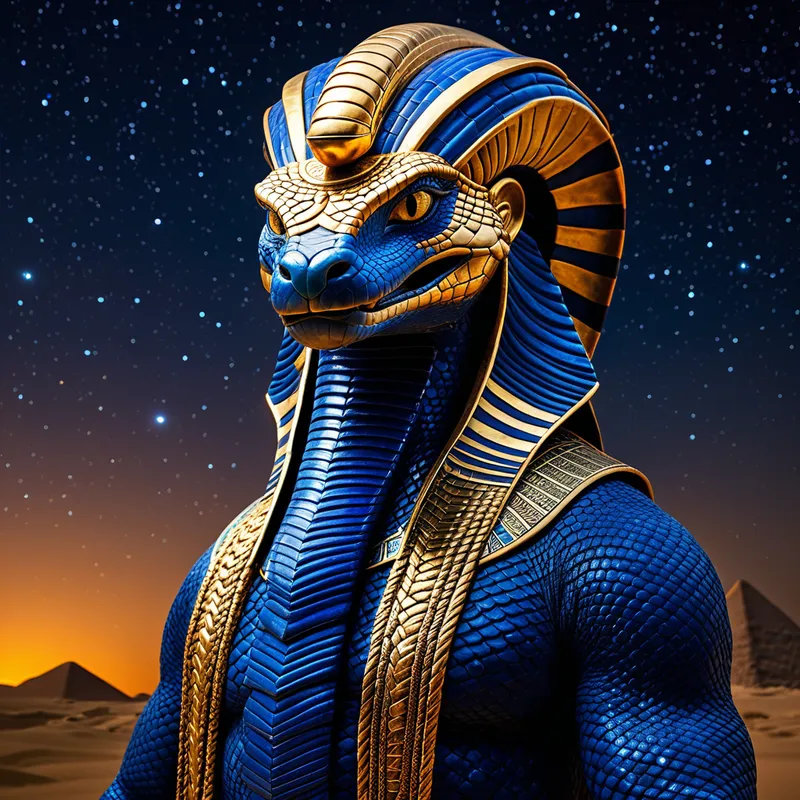
The Uraeus Myth Meaning & Symbolism
The sacred cobra that sprang from the brow of the sun god to defend cosmic order, becoming the emblem of divine authority and awakened perception.
The Tale of The Uraeus
Before the first dawn etched its light upon the black waters of Nun, there was only the Word. And the Word was Ra. From the silence of his own being, he spoke the world into existence. But order is a fragile flame in the vast dark. As Ra sailed his solar barque across the sky, bringing light and law to the Two Lands, the chaos of the uncreated depths watched and hungered.
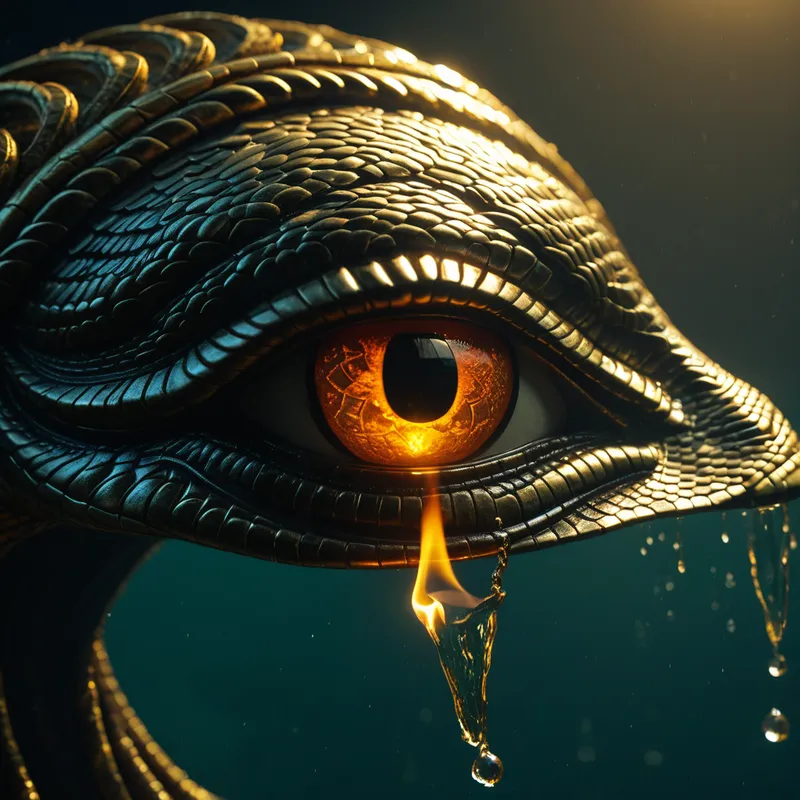
One day, as the sun god rested upon his throne, a weariness born of eternity settled upon him. It was not a fatigue of limb, but of spirit—the immense burden of maintaining Maat against the endless, whispering tide of Isfet. From his divine brow, a bead of sacred sweat, hotter than the desert noon, gathered and fell.
It did not splash into the waters below. Instead, it hung in the air, a droplet of concentrated will and royal power. It shimmered, twisted, and began to become. Scales of burnished gold and carnelian formed from the light. A spine of pure intent straightened. A head rose, and a hood, wider than a warrior’s shield, flared open with a sound like tearing silk. Two eyes opened—not eyes of flesh, but twin furnaces containing the focused fury of the sun itself.
This was no ordinary serpent. This was the Uraeus, the “She Who Rears Up.” She was the embodiment of Ra’s sovereign might, his protective rage given form. She was the living flame of his authority, detached yet eternally connected, a vigilant daughter sprung from his mind.
Her first act was not to slither, but to coil. She placed herself upon the very brow from which she was born, a living diadem. When the forces of chaos, in the form of the great serpent Apep, rose from the abyss to swallow the solar barque and plunge creation back into night, it was not Ra who first struck. It was the Uraeus. With a hiss that stilled the winds, she would launch herself, a dart of divine fire. Her venom was not mere poison; it was the searing, purifying flame of order itself, a flame that could cauterize chaos. She was the spark that ignited the defense, the guardian who made the first stand, ensuring the sun would rise again.
From that moment, she never left. She became the fixed star upon the crown of divinity. When Ra passed the mantle of kingship to his earthly son, the Pharaoh, he did not give him a sword or a scepter alone. He gave him the Uraeus. To wear her upon the brow was to bear the eye of Ra itself—to see with the penetrating, judging, and protecting gaze of the sun god. She was the promise that the ruler was not alone in his burden; the very fire of cosmic sovereignty rested between his eyes, ever-watchful, ever-ready to rear up and defend the sacred order of the world.
Cultural Origins & Context
The Uraeus was not merely a story told in temples; it was a physical, political, and spiritual reality woven into the fabric of Kemet. Its image, the reared cobra, is one of the most persistent and potent symbols in Egyptian iconography, dating back to the predynastic period. It was carved into stone, woven into linen, and forged in gold.
This myth was the sacred charter for pharaonic power. The king’s crown—the Nemes headdress, the Hedjet, the Pschent—was incomplete, indeed invalid, without the Uraeus affixed to its front. She was the divine stamp of approval, the visible proof that the pharaoh was the “son of Ra,” the legitimate heir to the sun god’s authority. Her presence transformed a man into a god-king, a living conduit for the power that held chaos at bay.
The myth was passed down not through a single epic poem, but through ritual, art, and titulary. Priests enacted it in temple dramas. Craftsmen embedded it in every royal portrait. To see the king was to see the Uraeus. Its societal function was absolute: to legitimize, protect, and mystify the institution of kingship. It declared that true authority was not brute force, but a sacred duty, a burden of consciousness charged with a protective, purifying fire. The king ruled not by his own will alone, but by carrying the awakened, vigilant eye of the cosmos on his forehead.
Symbolic Architecture
At its core, the Uraeus is a symbol of awakened sovereignty. It represents authority that is not inherited passively, but earned through a fiery process of consciousness. It is power that has passed through the crucible of awareness.
The Uraeus is the moment potential becomes kinetic, when latent power rears up into active, focused will. It is the spark of consciousness that separates order from chaos.
Psychologically, the Uraeus symbolizes the integrative function of the Self. It is not the ego, but a higher, guiding principle that emerges from the crown of one’s being (the brow, the ajna chakra). It is the inner guardian, the aspect of our psyche that can discern true danger from illusion and that holds the line for our personal integrity. Its venom is not for destruction, but for discernment—the burning away of that which would corrupt or dissolve the structure of the individual soul (one’s personal Maat). The serpent, often a symbol of the unconscious and primal energy, here is fully conscious, elevated, and placed in service to the light. It is the taming and enlisting of one’s own primal, instinctual power for a purpose beyond the self.
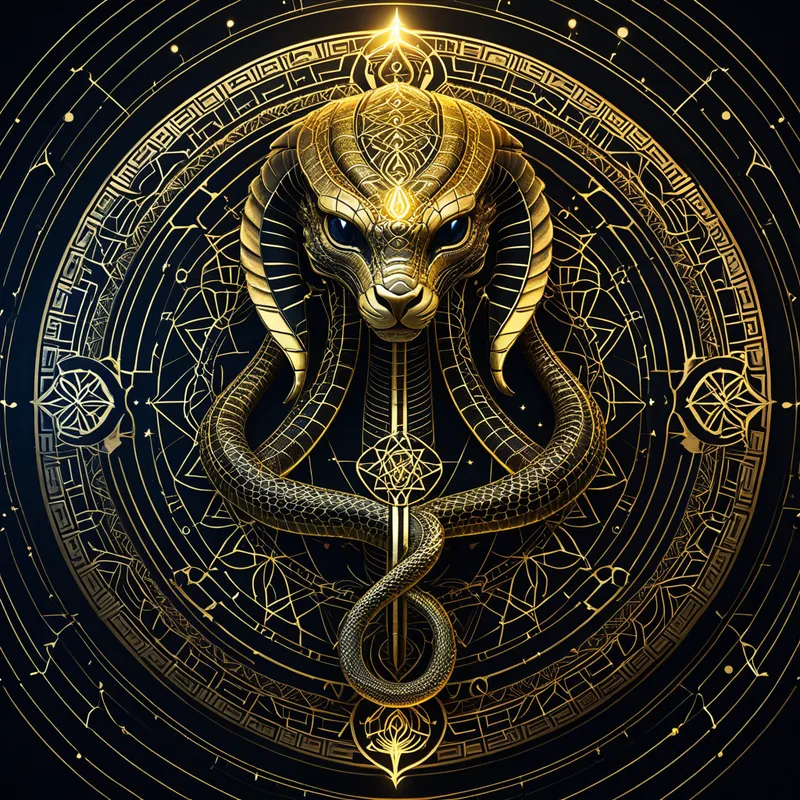
The Dreamer’s Resonance
When the Uraeus appears in a modern dream, it signals a profound psychological process of claiming authority. This is not about dominating others, but about integrating one’s own fragmented power. The dreamer may be in a life situation where they feel their boundaries are being violated, their voice silenced, or their vision clouded.
To dream of a cobra rising from one’s own forehead is a powerful somatic experience. It often accompanies feelings of pressure, heat, or tingling in the brow—a psychic “awakening.” This serpent is the dreamer’s own latent will and discernment, finally mobilizing. It may appear to confront a shadowy figure (an internalized Apep—perhaps a habit of self-sabotage, a toxic relationship pattern, or a deep-seated fear). The hiss is the sound of a boundary being firmly drawn. The strike is not an act of malice, but a necessary, precise act of psychic self-defense—the burning away of an invasive influence. The dreamer is undergoing the process of becoming their own sovereign, learning to wear their own authority with conscious, protective grace.
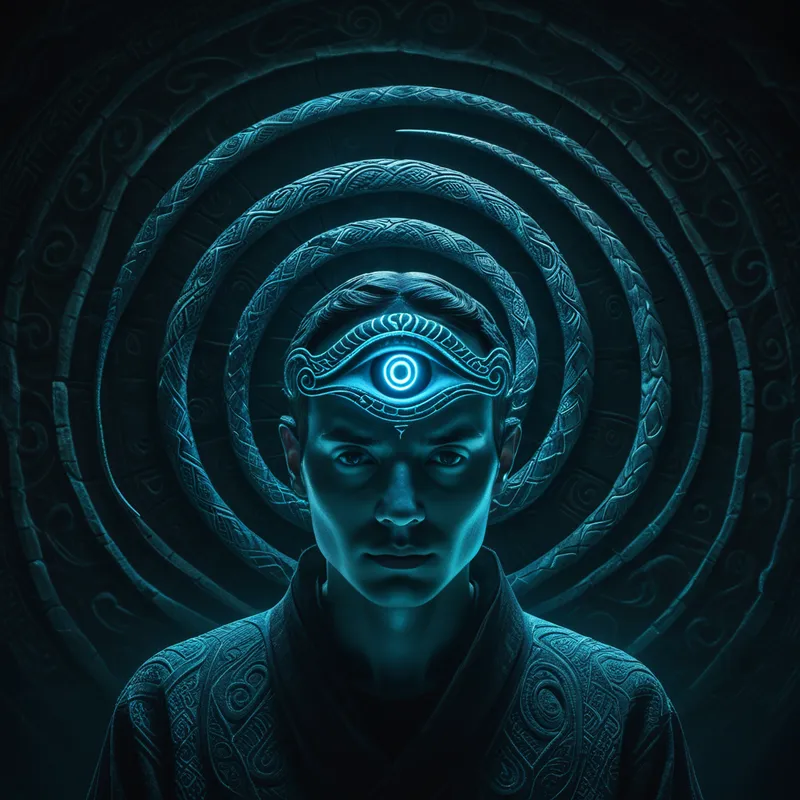
Alchemical Translation
The myth of the Uraeus models the alchemical stage of Albedo—the whitening, the illumination. It is the process where the prima materia of the psyche (the sweat, the effort, the burden of consciousness) is subjected to the inner fire and transformed into a tool of luminous perception.
The journey begins with the burden (Ra’s weariness). Every individual carries the weight of their own consciousness, the struggle to maintain inner order. This pressure, instead of crushing the spirit, becomes the catalyst. The “sweat of the brow” is the focused effort, the labor of self-examination and holding tension.
Individuation requires that we sweat our own Uraeus into being. The burden of self-awareness must condense into a focused, willing form—a guardian born not of naivety, but of endured pressure.
From this effort, the awakened faculty (the Uraeus) is born. It is the development of conscious intuition, ethical discernment, and the courage to protect one’s own psychological integrity. One learns to “rear up”—not in blind anger, but in conscious, righteous defense of one’s values and boundaries. Finally, this faculty is integrated (coiled on the brow). It is no longer a separate, feared impulse, but the crown jewel of the personality. The individual no longer looks for authority externally; they see from a place of internal authority. Their perception is clarified, their gaze becomes penetrating, and they understand that true power is the vigilant, protective flame of a consciousness that has agreed to bear the weight of its own sovereignty. The chaos of the unconscious is not eliminated; it is forever watched by this fiery, compassionate sentinel born from the struggle itself.
Associated Symbols
Explore related symbols from the CaleaDream lexicon: