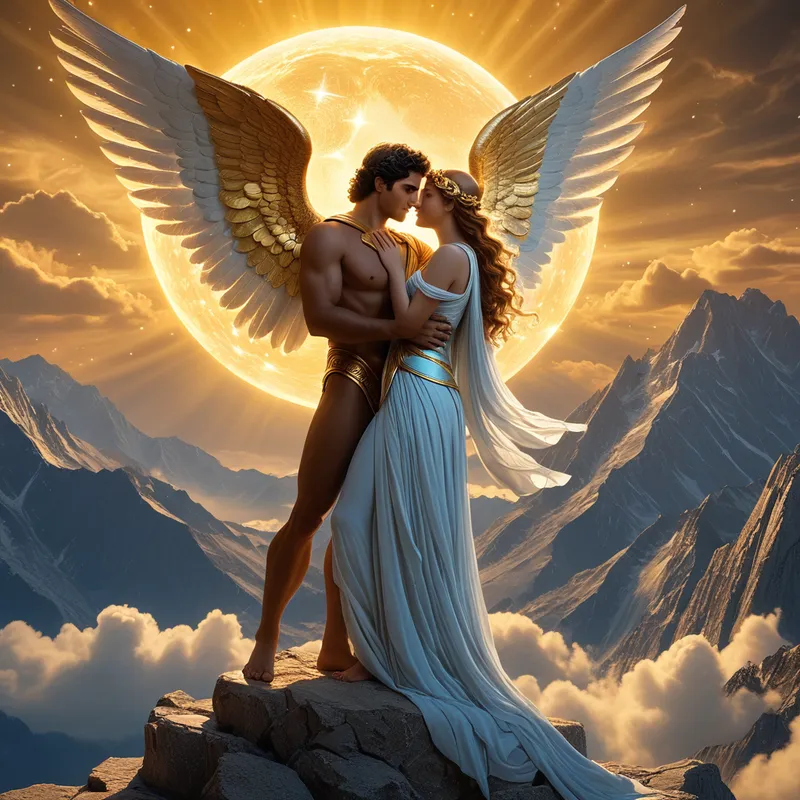
The union of Eros and Psyche f Myth Meaning & Symbolism
A mortal soul, Psyche, must endure impossible trials to reunite with divine Love, Eros, forging a sacred union that transcends mortality.
The Tale of The union of Eros and Psyche f
Listen, and let the old truth settle in your bones. In a time when gods walked the edges of human perception, there lived a mortal princess whose beauty was not of this earth. Her name was Psyche. So radiant was she that men forgot the altars of Aphrodite, offering their prayers instead to this living, breathing maiden. A fury, cold and jealous, ignited in the divine heart. Aphrodite summoned her son, the god Eros, whose arrows could command the heart of any being. “Make her fall in love,” she commanded, “with the most vile, wretched creature that crawls upon the earth.”
But destiny is a slippery thing, even for a god. As Eros descended, arrow nocked, to enact his mother’s vengeance, he beheld Psyche in the soft light of her chamber. One glimpse of her soul-deep beauty, and the archer was pierced by his own invisible dart. The command shattered; a deeper law took hold.
Psyche’s earthly fate, however, was sealed by an oracle. She was to be taken to a lonely mountain crag, a bride for a monstrous, unseen husband. Winds, gentle as whispers, carried her not to death, but to a hidden valley of wonders. A palace of impossible beauty materialized, built of air and longing. Here, in the velvet darkness, her husband came to her. He was a presence of night, a voice of honey and shadow, forbidding her ever to look upon his face. “Trust in the love I offer,” he pleaded. “To see me is to lose me.” For a time, in that palace of invisible servants and nocturnal bliss, Psyche was content. Her soul was loved, but it was a love without a face.
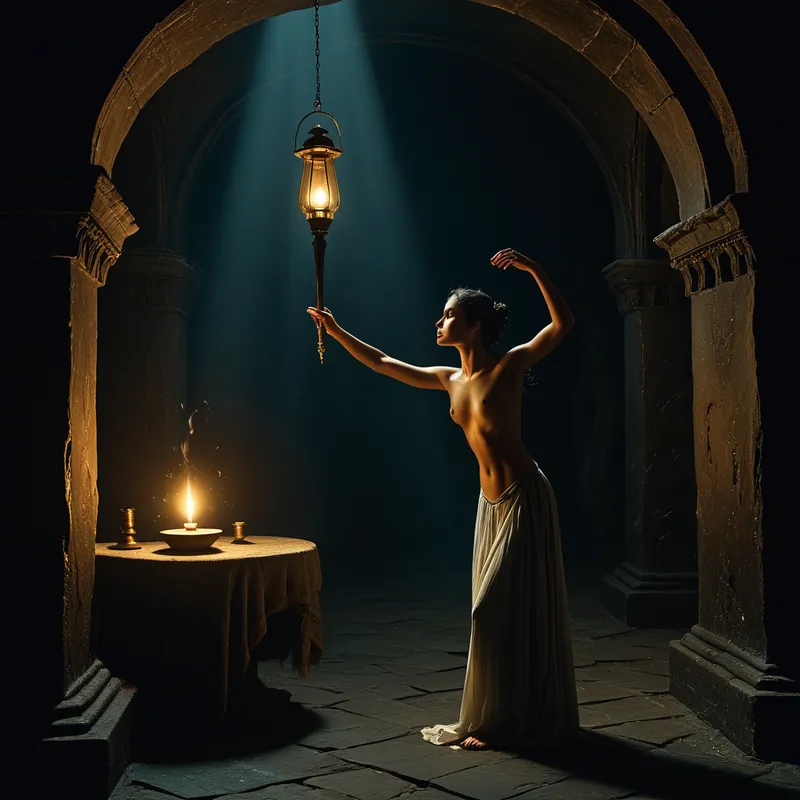
Whispers, like poison ivy, crept into her paradise. Visiting sisters, green with envy, seeded a terrible doubt. “Your husband is the serpent of the oracle,” they hissed. “He waits only to devour you in the night.” Fear, colder than the mountain stone, coiled around her heart. One fateful night, armed with a dagger and a flickering lamp, she betrayed the one law of her paradise. The golden light fell not on a monster, but on the most beautiful being her eyes had ever witnessed: the god Eros himself, asleep, his wings shimmering like captured moonlight. In a shock of awe and terror, her hand trembled. A single drop of scalding oil fell upon his perfect shoulder.
He awoke. The look in his eyes was not of anger, but of a profound, heartbreaking betrayal. “Love cannot live where there is no trust,” he said, his voice the sound of a world ending. And with that, he was gone. The palace dissolved into mist. Psyche stood alone on the barren earth, her paradise vanished, her heart a hollow echo of what it had held.
Her journey then began—not to find him, but to earn him. She presented herself to the vengeful Aphrodite, who set before her four impossible labors: to sort a mountain of mixed seeds, to gather golden wool from deadly rams, to fetch black water from the river Styx, and finally, to descend into the underworld itself and retrieve a casket of beauty from Persephone. In each task, Psyche, the mortal soul, was aided by the small, forgotten voices of the world: ants, a reed, an eagle, a whispering tower. They helped not because she commanded, but because her genuine despair and newfound humility had earned their pity.
She succeeded. But on the final return, a human flaw—curiosity, the desire for a beauty of her own to win back her love—made her open the casket. Instead of divine beauty, she was engulfed in a deathlike sleep of the soul. It was here, at the absolute end of her strength, that Eros found her. His wound had healed, and his love, tempered by her suffering and courage, had grown stronger. He swept her up to Olympus and pleaded their case before Zeus himself.
The father of gods was moved. He granted Psyche immortality, offering her the drink of ambrosia. From the mortal who had stirred divine jealousy was born the immortal goddess of the soul. And there, in the golden halls of heaven, Eros and Psyche were wed in a union that would last for all eternity. From their marriage was said to be born a daughter named Voluptas—the very embodiment of bliss.
Cultural Origins & Context
This is not merely a Greek fairy tale. The story of Eros and Psyche is the singular narrative within The Metamorphoses or The Golden Ass by Apuleius, a Platonic philosopher and storyteller. Written in the 2nd century CE, it exists at a crossroads of culture: a Latin text infused with Greek mythology, Egyptian mystery cult influences, and burgeoning philosophical ideas about the soul’s journey. It was not a state-sanctioned religious hymn but a sophisticated, novelistic exploration embedded within a larger, picaresque tale. Its function was multifaceted: as entertainment, as a moral allegory about curiosity and devotion, and as a profound philosophical metaphor for the Neoplatonic ascent of the soul toward the divine. It was a story told to illuminate, not to dictate doctrine, making it uniquely portable and universally resonant across epochs.
Symbolic Architecture
At its core, this is the myth of the individuation of the soul through its relationship with love. Psyche is not just a character; she is the human Self in its raw, potential state—beautiful but unconscious, admired but not yet integrated.
The soul must be wounded by its own curiosity to begin its true work. The paradise of unconscious bliss is a prison for the developing spirit.
Eros represents the animating, connecting, and often unconscious force of Love—not merely romantic, but the fundamental desire for life, relationship, and creation. He is the animus to her psyche, the divine spark that activates her journey but who must remain partially hidden until she is ready to bear the sight. The four impossible labors are the archetypal trials of the ego: sorting chaos (the seeds), confronting aggressive, untamed power (the rams), integrating the waters of death and the unconscious (the Styx), and finally, making the nekyia, the heroic descent into the underworld of the personal and collective shadow to retrieve essential wisdom.
The Dreamer’s Resonance
When this myth stirs in modern dreams, it signals a critical phase in the dreamer’s relationship between their conscious identity (Psyche) and their deep, often hidden, emotional and relational drives (Eros). Dreaming of a beautiful but invisible lover speaks to a longing for a connection that feels fated but undefined, perhaps hindered by one’s own “sisters”—internalized voices of doubt, cynicism, or societal expectation.
Dreams of impossible tasks—sorting endless piles, approaching terrifying beasts, or finding oneself in labyrinthine, underworld spaces—mirror the psyche’s somatic recognition of an initiatory crisis. The body in the dream feels the weight, the anxiety, the sheer impossibility. This is the soul laboring. The profound moment of the dream is often the appearance of unexpected aid—the ant, the reed—symbolizing the emergence of instinctual wisdom and supportive inner resources when the ego surrenders its arrogance and admits its desperation.
Alchemical Translation
The myth of Eros and Psyche is a perfect map of the alchemical nigredo, the darkening, and the subsequent stages of purification and union. The initial, unconscious marriage in the dark palace is the conjunctio, but an immature one, lacking the light of consciousness. The spilling of the oil is the necessary separatio—the painful but essential crisis that forces differentiation. Psyche’s solitary labors are the albedo, the whitening, where she is purified through effort, humility, and the integration of opposites (sorting, gathering, descending).
The soul does not ascend to the divine by avoiding the mortal; it becomes divine by fully undertaking the mortal journey.
Her final failure—opening the casket—is not a regression, but the last egoic desire that must be surrendered. The deathlike sleep is the final dissolution before the rubedo, the reddening, the achievement of the Philosopher’s Stone. Eros’s return to rescue her symbolizes the Self, now whole and conscious, reclaiming its own animating principle. Their celestial wedding is the sacred marriage, the hieros gamos, within the individual. The immortal child, Voluptas, born from this union, is the ultimate goal: not a sterile perfection, but the capacity for profound, embodied joy—the bliss that can only emerge when Love and the Soul, after enduring all trials, are finally and consciously made one.
Associated Symbols
Explore related symbols from the CaleaDream lexicon: