The Underworld / Katabasis Myth Meaning & Symbolism
A hero's perilous descent into the land of the dead, a journey to confront the ultimate mysteries of loss, memory, and the self.
The Tale of The Underworld / Katabasis
Listen. The world you know is but the upper chamber. Beneath the sunlit earth, beneath the roots of the oldest olive tree, lies the true, silent kingdom. It is not a place for the living. The air there is still and cold, carrying only the whispers of forgotten names. This is the realm of Hades, the Unseen One, and his queen, Persephone, who knows both the kiss of sunlight and the embrace of eternal dusk.
To walk there is to undertake the Katabasis. Few dare it, and fewer return. One who did was Orpheus, whose music could charm stones and bend trees. His love, Eurydice, was taken, her life severed by a viper’s bite. Her shade was drawn down the long, dark path to the Asphodel Meadows.
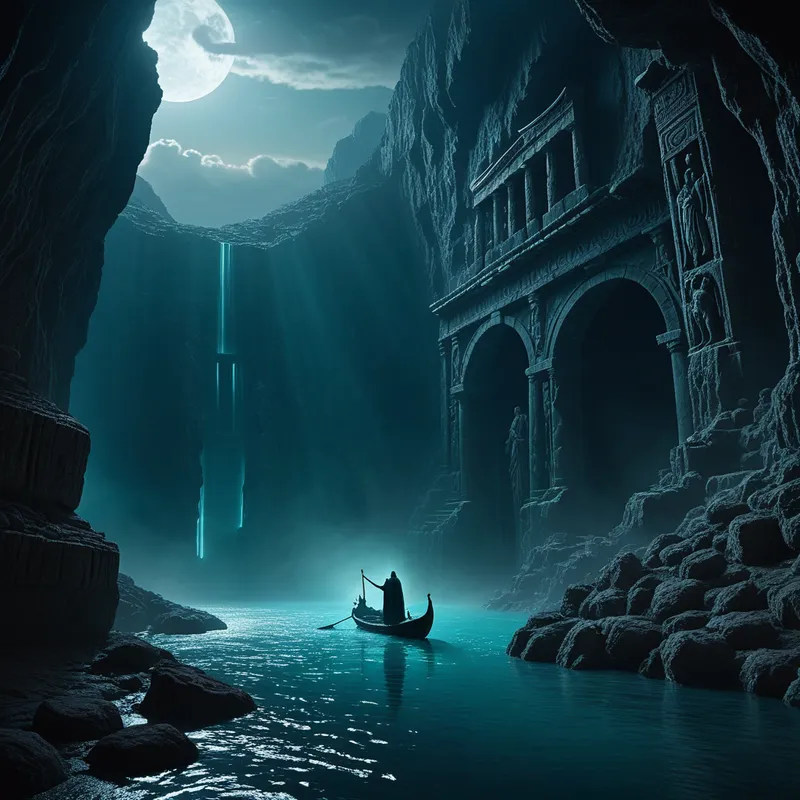
Orpheus’s grief was a soundless scream that no lyre could express. With only his song for a shield and his love for a guide, he found the hidden entrance at Taenarum. He descended, the warmth of the world leaching from his bones. He came to the bank of the Styx, where the souls crowd like mist, and faced the ferryman, Charon, whose eyes were coins. Orpheus played, and the melody was so full of mortal longing that even Charon’s stony heart was moved. He ferried the living man across the waters of oblivion.
At the gate, the three-headed hound Cerberus growled, a sound that shook the very darkness. Orpheus played a lullaby of such profound stillness that the beast’s heads drooped, and the monster slept. He passed through the throngs of whispering shades in the grey fields, through the groves of black poplar, until he stood in the very heart of silence: the throne room of Hades and Persephone.
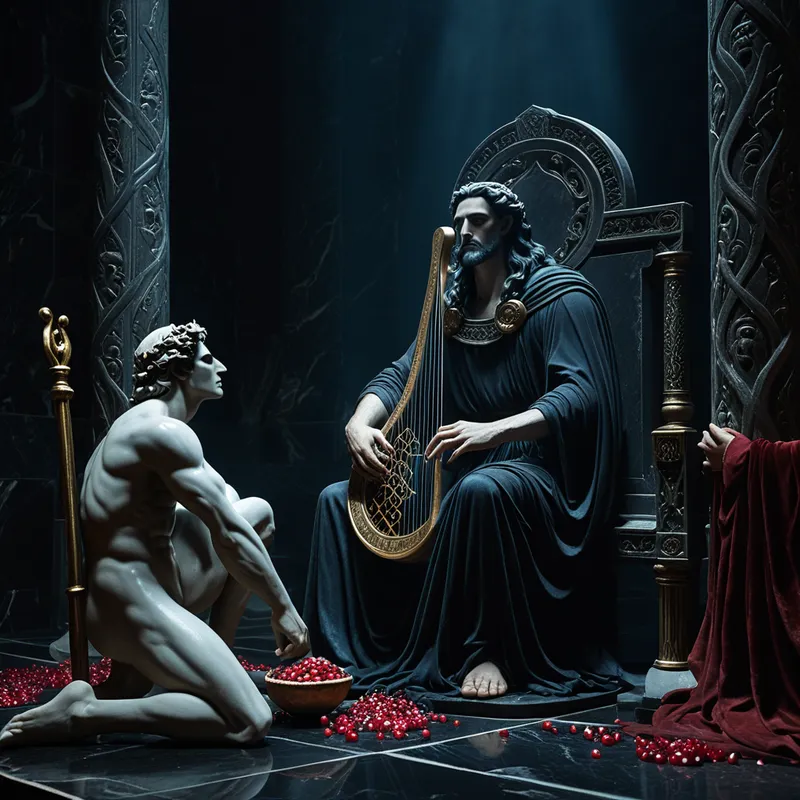
The rulers of the dead were pale as marble, implacable as fate. Orpheus did not demand. He did not threaten. He took up his lyre and sang. He sang of Eurydice’s laughter in the sunlight, of the emptiness of the world without her, of love that defied the order of things. He sang not to the gods, but to the memory of love they themselves might have known. His music filled the silent hall, and it is said that for the first time, the Erinyes themselves wept tears of black iron.
Hades, the Unmoved, was moved. Persephone, who knew the price of a journey between worlds, touched her lord’s arm. A condition was set: Eurydice would follow him up the steep path to the light, but Orpheus must not turn to look upon her until both had reached the upper world. A thread of hope, thinner than a spider’s silk, was granted.
The ascent was agony. He heard only the faintest rustle of a step behind him. Was it her, or the echo of his own hope? The darkness began to thin; a scent of soil and life teased the air. He saw a crack of true, golden light—the mouth of the cave. In a flood of relief and desperate love, he turned. For a single, shattered moment, he saw her, his Eurydice, her face a mixture of love and gentle sorrow. Then the condition broke. She was pulled back, not with a cry, but with a soft sigh, her form dissolving into the shadows from which she came. His hand closed on empty air. The light of the world above had never seemed so cruel, or so empty.
Cultural Origins & Context
The myth of the Underworld descent is not a single story but a deep pattern woven into the fabric of Greek thought, from the epic poetry of Homer’s Odyssey to the hymns of Orphic mystery cults. It was a collective narrative for confronting the ultimate human unknowns: death, memory, and what lies beyond the final boundary. Bards and poets were the primary vessels, performing these tales in aristocratic halls and public festivals, making the unimaginable landscape of Hades a shared psychological territory.
Societally, these myths functioned as more than entertainment. They reinforced cultural values about proper rites for the dead (hence the coin for Charon), the sacredness of oaths, and the tragic consequences of human error (hamartia), as seen in Orpheus’s fatal glance. For initiates in the Eleusinian Mysteries, which centered on Demeter and Persephone’s own cycle of descent and return, the katabasis pattern was a template for spiritual transformation, a promise that confrontation with the dark could lead to renewal.
Symbolic Architecture
The Underworld is not a literal hell of punishment, but the psychic realm of the Shadow, the forgotten, and the repressed. It is the land of memory, where all that we have been and all we have lost resides. Hades himself represents the principle of containment—the unconscious mind that holds everything without judgment.
The journey down is not an escape from life, but a deeper engagement with its foundation. To descend is to acknowledge that wholeness requires confronting what has been buried.
The rivers—Styx, Cocytus, Phlegethon—are the elemental, often painful, currents of the unconscious psyche. The conditional gift of Hades—“walk forward and do not look back”—is the supreme test of faith in the unconscious process. It demands a trust that the healing or the beloved (the integrated self) is following, even when it cannot be seen or verified by the conscious ego. Orpheus’s turn is the inevitable, heartbreaking moment when the conscious mind, desperate for proof, reasserts control and ruptures the delicate process of integration.
The Dreamer’s Resonance
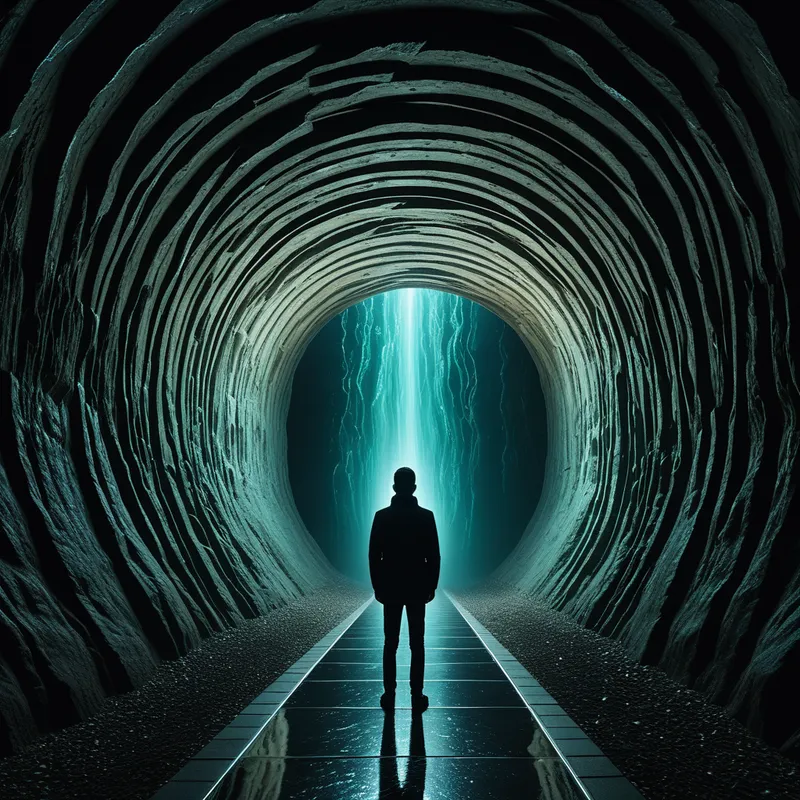
When this myth stirs in modern dreams, the dreamer is often at a precipice in a psychological process. Dreams of descending into basements, caves, subway tunnels, or underwater landscapes signal a katabasis in progress. The somatic feeling is one of weight, pressure, and coolness—a literal engagement with the “lower” realms of the body and instinct.
The figures encountered are shadow aspects. A lost loved one may appear, not merely as a memory, but as a personification of a quality or love the dreamer has “buried” with that person. A threatening guide or guardian (a modern Charon) might represent a resistant part of the psyche that demands payment—an acknowledgment of a repressed emotion like grief or rage—to allow passage deeper. The core process is one of recollection in the deepest sense: gathering the scattered, lost, or disowned pieces of the self. The dreamer isn’t visiting a foreign land; they are walking the map of their own inner history.
Alchemical Translation
Psychic transmutation, or Individuation, is modeled perfectly by the katabasis. The conscious ego (the hero) must willingly make itself vulnerable and enter the Magnum Opus of the unconscious (the Underworld). This is the nigredo phase—the blackening, the descent into chaos and primal matter.
The treasure sought in the underworld is never the same as the one lost. It is the alchemical gold of self-knowledge, forged in the darkness.
The condition set by Hades is the alchemical rule: the process cannot be forced or observed with the direct, analytical light of consciousness. It requires indirect attention, patience, and a trust in the transformative work happening autonomously. Orpheus’s failure is a necessary stage for many; the first attempt at integration often fails because the ego cannot yet fully relinquish control. Yet, even in failure, something is gained. Orpheus returns changed, his music now imbued with the knowledge of loss, making him a different, more profound artist. For the modern individual, the “return” may not be with the literal recovered love or lost object, but with a new, more resilient relationship to loss itself, a deeper capacity for life informed by the truths of the dark. The goal is not to escape the underworld, but to learn its language and become a citizen of both realms.
Associated Symbols
Explore related symbols from the CaleaDream lexicon: