The Underworld Journey Myth Meaning & Symbolism
A universal hero descends into the land of the dead, confronts loss and the self, and returns transformed, modeling the soul's deepest journey.
The Tale of The Underworld Journey
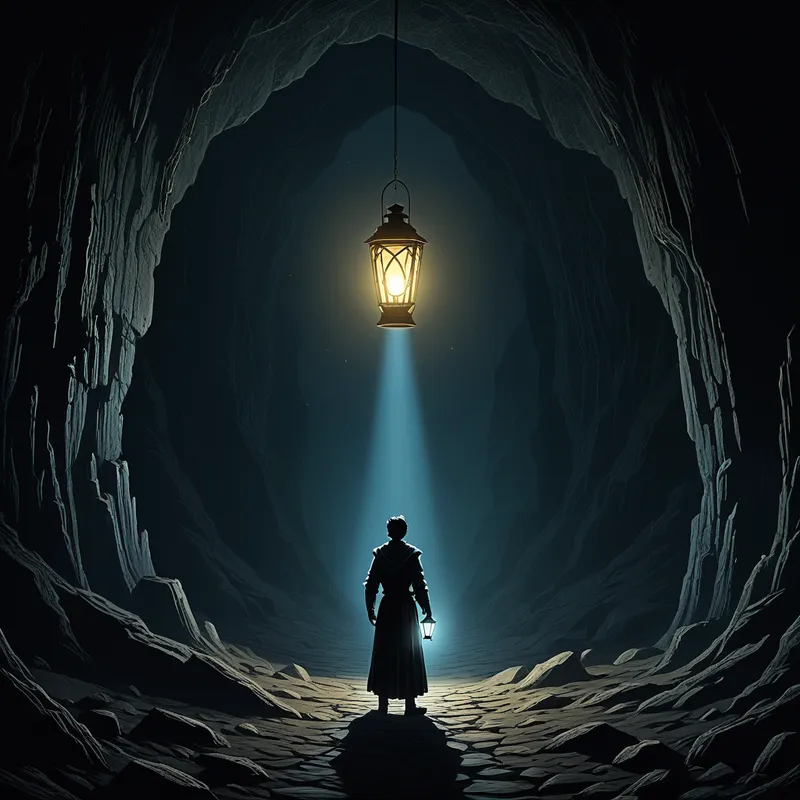
Listen. The world you know is only half the story. There comes a time in the life of a soul when the sunlit path ends, and the only way forward is down. Into the throat of the earth, into the realm where the sun’s chariot never runs, into the silent kingdom of Thanatos.
Our hero stands at the threshold. Perhaps they are Inanna, Queen of Heaven, shedding her crown and royal robes at each of the seven gates, her power stripped away until she stands naked and shivering before her dark sister, Ereshkigal. Or perhaps they are Orpheus, whose lyre can charm stones to weep, walking a path no living foot should tread, his only passport a melody of unbearable grief for his lost Eurydice. The air grows cold and thick, smelling of damp clay and old roots. The light dies, replaced by a phosphorescent gloom that clings to jagged rock.
The river must be crossed. Here is Charon, gaunt and silent, his hand outstretched for the coin placed on the tongue of the deceased. Our hero pays the toll with a piece of their own soul. The water is black and slow, whispering with the regrets of a million souls. On the far shore, the three-headed hound Cerberus growls, a rumble that vibrates in the bones. The hero passes, by trick, by gift, or by the sheer force of their need.
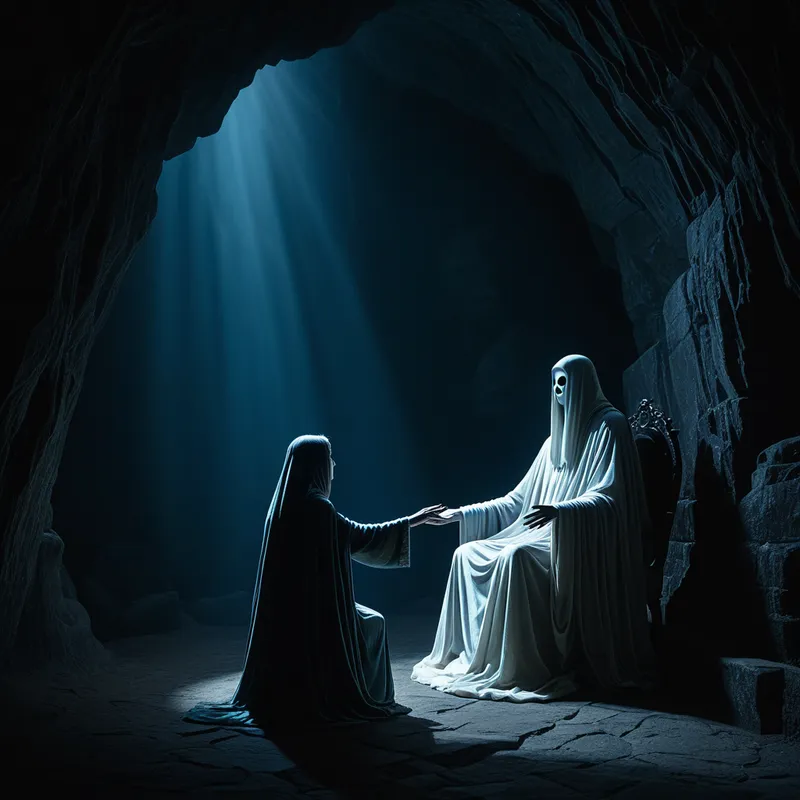
This is Hades, Helheim, Irkalla. A gray plain where shades flit like mist, their voices a dry rustle. The ruler sits upon a shadowy throne—Hades himself, implacable and cold, or Hel, half flesh, half corpse. The hero makes their plea, their bargain, their desperate stand. The price is always the same: a piece of their life, a memory, a hope. For Orpheus, it is the cruel condition: do not look back. For Inanna, it is her very body, hung upon a hook as a piece of rotting meat.
The journey out is harder than the journey in. The weight of the underworld clings to the ankles. The light ahead seems a cruel trick. And in that moment of terrible tension—the foot on the threshold of life, the loved one a step behind—the heart cracks. Orpheus turns. A sigh, a fading whisper, and she is gone, not with a scream, but with a softness more devastating than any fury. For Inanna, escape requires a substitute sent to take her place. Even in triumph, there is a stain, a scar, a ghost that now walks beside them in the upper world. They emerge, blinking in the sun, forever divided. They have seen the architecture of death, and life can never look the same.
Cultural Origins & Context
This is not one story, but a human story. The pattern of the katabasis (descent) appears in the clay tablets of Sumer, the papyri of Egypt, the epics of Greece and Rome, the eddas of the Norse, and the oral traditions of countless indigenous peoples. It was recited by bards at feasts, enacted in seasonal rituals, and inscribed on tomb walls as a guide for the deceased. In ancient Mesopotamia, Inanna’s descent explained the barren season and the cycle of fertility. For the Greeks, tales like those of Orpheus, Heracles, and Odysseus in Hades served as profound explorations of mortality, the power of love (and its limits), and the necessity of confronting the finality of death.
These myths functioned as more than entertainment; they were cosmological maps and psychological manuals. They gave a narrative shape to the terrifying unknown of death, making it a place with rules, rulers, and even a geography one could, in extreme circumstances, navigate. They reinforced cultural values about piety, courage, and the bittersweet laws of existence. The storyteller, whether a priestess, a skald, or an elder, was a keeper of this deep wisdom, mediating between the community and the ultimate mysteries of loss and what may lie beyond.
Symbolic Architecture
The underworld is not a physical place, but a psychic one. It is the shadow realm, the land of the forgotten, the repressed, and the unlived life. The hero who descends is the conscious ego, venturing into the unconscious.
The descent is always a movement away from the persona—the mask we wear in the sunlit world—and into the core of what we have denied, lost, or feared.
The stripping of possessions (Inanna’s robes) represents the shedding of identity and status. The silent ferryman is the threshold guardian, demanding payment—the ego must relinquish its certainty to proceed. The three-headed hound symbolizes the primal, untamed instincts that guard the depths of the psyche. The ruler of the dead, often a dark sister or a cold god, personifies the ultimate, impersonal reality of death and the unconscious itself, which cannot be bargained with, only acknowledged.
The failure to bring the loved one back whole (Orpheus’s glance, the need for a substitute) is not a narrative flaw, but the myth’s deepest truth. One cannot raid the unconscious and return to naive consciousness. Something is always exchanged, left behind, or integrated. The “rescue” fails in a literal sense but succeeds in a symbolic one: the hero has faced the reality of separation and mortality, and that confrontation is the transformative act.
The Dreamer’s Resonance
When this myth stirs in modern dreams, you are not dreaming of ancient gods. You are dreaming of your own depths. Dreams of descending into basements, caves, or subway tunnels that go too deep; of finding hidden, ruined rooms in your house; of being in a vast, abandoned hotel or a labyrinthine library—these are the katabasis of the soul.
Somatically, it may feel like a weight, a dragging pressure, or a chilling cold. Psychologically, it is a process of shadow-work. The dream-ego is being compelled to confront what it has avoided: a buried grief, a old shame, a rejected aspect of personality, a creative potential left to rot. The shades you meet are your own unlived lives, your regrets given form. The moment of terror or sorrow in the dream is the point of maximum tension, where the psyche is at the brink of a fundamental re-ordering. You wake not with a solution, but with the indelible imprint of the encounter.
Alchemical Translation
In the alchemy of the soul, the Underworld Journey is the nigredo. It is the necessary dissolution, the dark night where the old, outworn structures of the self are broken down into their raw, chaotic components.
The hero’s journey to the land of the dead is the ego’s journey to the source of its own being, where it must die in its current form to be remade.
The modern individual undergoes this not in a literal cave, but in the caverns of depression, in the grief that follows profound loss, in the crisis of meaning that shatters a lifelong identity. This is not pathology, but a sacred, if terrifying, process. The “bargain” struck is the acceptance of limitation, of mortality, of the pain that is part of love. The “substitute” left behind is a naive hope, a childish fantasy of omnipotence, or a rigid self-image.
The return, the albedo and rubedo, is integration. You do not come back “cured” of darkness. You come back carrying a piece of it, now conscious. The scar is the seal of transformation. The mourner who has truly descended into their grief carries a quiet authority. The person who has faced their shadow carries a grounded wholeness, having met the ruler of the underworld and survived. They have seen the other side of life, and in doing so, have made their living more complete, more authentic, and infinitely more precious. The journey ends where it began, but the traveler is forever changed.
Associated Symbols
Explore related symbols from the CaleaDream lexicon: